.svg)
flowConf 2026 Ultimate Recap: The Future of Web, Unpacked

flowConf 2026 Ultimate Recap: The Future of Web, Unpacked
On May 21, 2026, more than 400 web professionals filled two stages in Belgrade for the second edition of flowConf, the conference we at Flow Ninja built for the people designing, building, marketing, and growing the modern web.
The day in one paragraph
Two stages, 20+ speakers, one shared question. Uros Mikic opened the Main Stage with the oldest network he knows, the kolo, and asked what part of the web has to remain human as AI rewrites the rest.
Twelve hours and one afterparty later, Sïmon Saneback closed the same stage by arguing the next era of the web is not pages but systems that act on your behalf.
Everything in between (AEO playbooks, MCP demos, microsite stories, design philosophy, agency economics, facilitation theory) lived inside the gap those two talks opened.
What you will get from this recap is a written companion to the day. Every talk, both stages, captured the way I would explain it to a colleague who could not make it.
Four threads that ran through the entire day
If you stitch together every talk from both stages, four arguments showed up over and over.
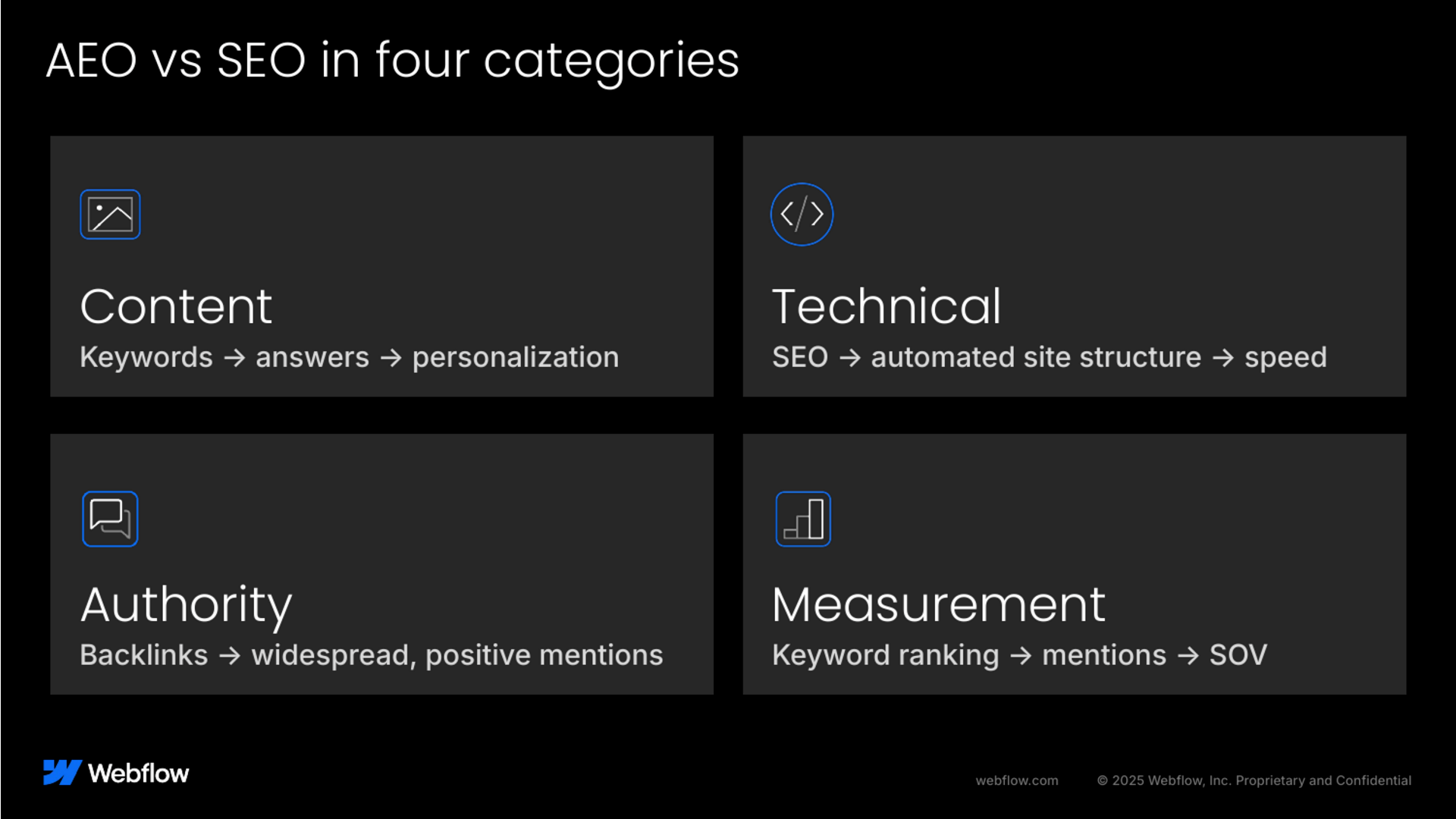
1. AEO is the new SEO, but it is not SEO. Guy Yalif, Bhanu Chawla, Oliver Kuttruff, Ksenia Fix and Al Newman, and our own panel all kept landing in the same place. The fundamentals from search still hold. The categories you optimize against (content, technical, authority, measurement) now sit on a different stack.
2. Agents and MCP are eating the dashboard. Bhanu's Claude Code stack, Webflow's official MCP server, Oliver's "agent bounce rate" framing, Greg Svoboda's Active Intelligence, and Sïmon's closing keynote all pointed the same direction. The interface is dying. The platform stays. The protocol matters now.
3. Taste, brand, and judgment are the new moat. Ilja van Eck's Taste Layer, Laura Zheng Doyon's positioning talk, Uros's opening keynote, and Rebecca Courtney's case for facilitation all made the same argument from four different angles. When execution becomes cheap, what stays human becomes the differentiator.
4. Webflow is the platform built for this shift. Miguel Montoya's enterprise framework, the AEO toolkit, the MCP server, Code to Canvas, and almost every practical demo on stage ran on the same platform. Nobody made Webflow the subject of a sermon. It just kept being the thing under everything else.
These four threads are the spine of the rest of this recap. We start on the Main Stage with the big ideas, then move into the Webflow Room for the deep technical sessions.
Main Stage: the big ideas
The Main Stage was hosted by Ran Segall, founder of Flux Academy. Ran kept the rhythm tight, the transitions warm, and the room awake. If you have ever tried to host a full day of talks, you know how hard that actually is.
Uros Mikic: opening keynote and the kolo
Uros Mikic, founder of Flow Ninja and flowConf, opened the day by walking on stage to a live performance of the kolo, the Serbian round dance, finishing in the room.
His framing: kolo is the oldest network he knows. You join by reaching out your hand. The chain keeps growing for as long as people choose to be part of it.
That is exactly how the web was designed. An open network with no hierarchy, no gatekeeper, accessible to anyone willing to show up and connect.
Then the uncomfortable turn. Traditional kolo requires an active decision. You have to reach out. You have to step in. The web, until recently, worked the same way. AI is changing that dynamic. It anticipates. It suggests. It adapts before you have even put your hand out.
The question Uros put on the room set up the rest of the day:
"If the web starts changing with AI, what will need to remain human?"
Uros also put forward the thesis Flow Ninja has been building everything around for the past two years: the website is the core digital system of a modern business. Not a brochure. Not just a landing page. The place where your brand lives, your customers decide, your team experiments, AI bots crawl, and your growth happens.
He closed by announcing something bigger than the conference itself. We will get to that later in this piece, because it deserves its own section.
Guy Yalif: making your Webflow site the answer
Guy Yalif, Chief Evangelist at Webflow, gave the most data-dense talk of the day and somehow made it feel like a conversation.
His opening reframe was simple and sharp. Your website now has two audiences: humans and machines, and they want different things.
Humans need visually stunning, emotionally engaging experiences. Machines need efficient, concise, well-structured delivery of content on a silver platter. LLMs are constantly balancing the cost of crawling your content against the quality of what they find. The lower the cost, the higher the chance you get cited.
Then the numbers that woke the room up:
- 8% of Webflow's self-serve signups now come from AI search.
- They convert 6x better than non-branded organic.
- 18% of total traffic on Webflow's own site now comes from AI and LLMs.
- AI bot traffic is up 3x year over year.
Guy spent the rest of the talk on a four-category framework I genuinely wish every marketer in the room had photographed. It is the cleanest mental model I have seen for AEO so far.
His punchiest line of the talk, and one I have already quoted twice this week:
"Being on page 2 of Google and being absent from AI answers are almost the same thing. You don't exist."
A few of the specific experiments Guy shared from Webflow's own site:
- Reframing blog post headers as questions drove a 13% lift in AI-driven traffic.
- Adding FAQ blocks and schema to six product pages drove a 24% lift in organic impressions in two weeks. 57% of new citations in the following two weeks came from those six pages.
- Content refreshes drove a 5x increase in speed of updates and a 42% lift in SEO visits post-update.
He also flagged the schema gap that is currently sitting on the table for anyone who wants it. 73% of first-page results in Google use schema. Only 12% of sites have implemented it. For B2B that drops to 2%.
If you want to see where your site sits on the AEO maturity model Guy walked through, Webflow has published it as the AEO Maturity Model. We have already run a few client sites through it and the diagnostic is sharp.
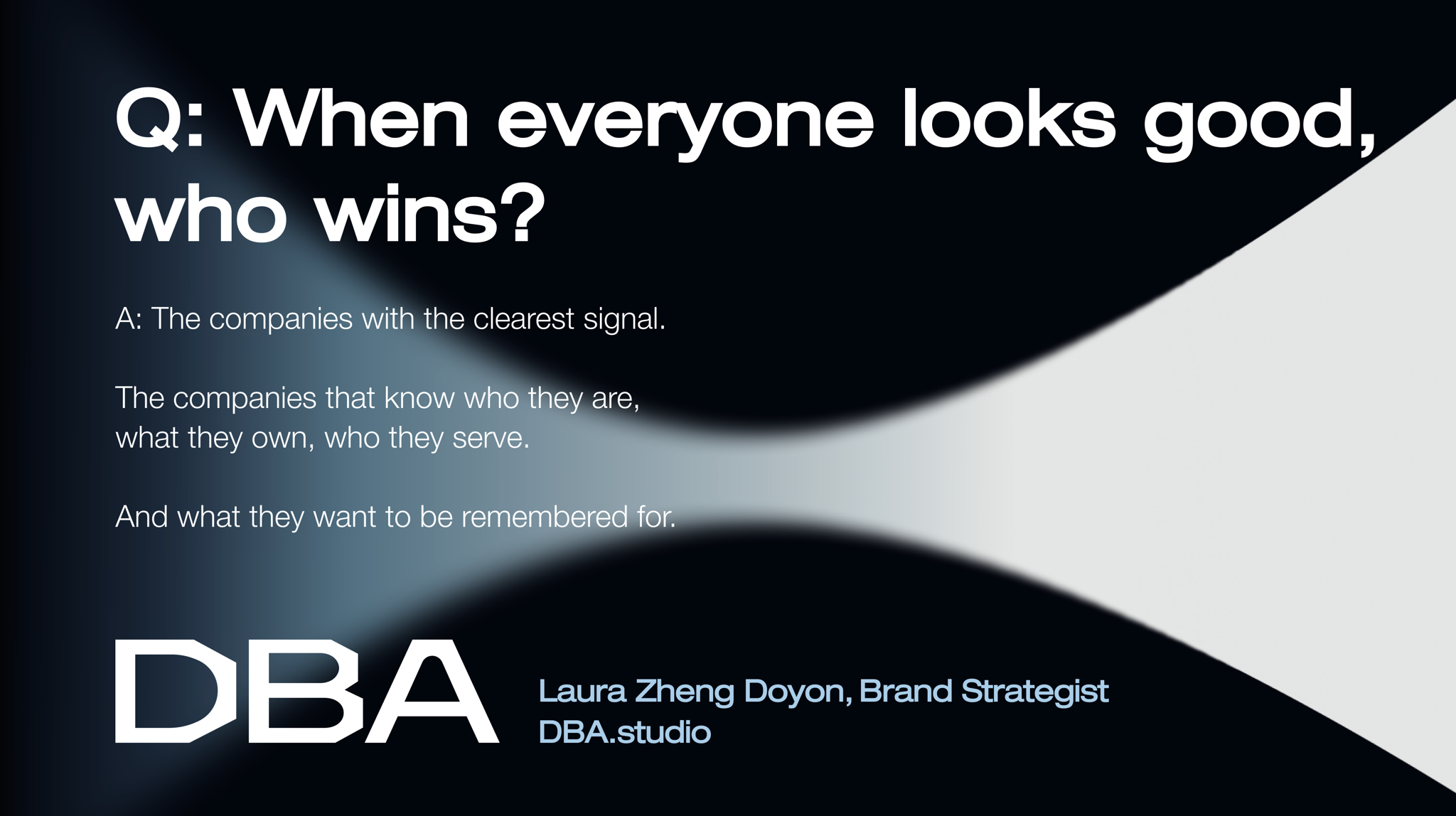
Laura Zheng Doyon: when everyone looks good, who wins?

Laura Zheng Doyon, founder of DBA.studio, has spent 14 years working on brands like Yeezy, NYFW, UFC, and Ariana Grande. She came to flowConf to argue that almost every problem we had spent the day talking about (SEO, AEO, performance, even brand) has the same upstream problem nobody talks about.
That problem is positioning.
Her one-line definition:
"Positioning is how you show you're the best, or only, choice for a specific customer for their specific needs."
Her core reframe: AI did not change the importance of positioning. It amplified it. Strong positioning gets stronger. Weak positioning gets more obvious, faster, in front of more people.
Laura's diagnostic for weak positioning was uncomfortably accurate. You feel it when prospects keep asking you to explain yourself, when close rates are low even with a solid sales function, when pricing comes up early and often, and when every campaign feels like starting from scratch.
She walked through a simple Venn diagram for finding your position: what you are genuinely amazing at right now, what people desperately want and actively pay for, and what nobody else is doing or saying. The overlap is your differentiated value.
The line that landed hardest in the room:
"Positioning isn't invented. It's excavated."
You cannot brainstorm your way to a strong position. You have to surface what is already true about the business through real customer interviews, not surveys.
The case studies sharpened the point. Blue Ribbon Sports became Nike when it stopped pitching shoes for everyone and committed to runners. The Ariana Grande emoji app became the top paid app in entertainment when Laura's team got specific about who it was for. Yeezy customers were buying an identity, a uniform, an everyday armor, not clothes.
Her closing line:
"AI made execution cheaper. Which means positioning just became more valuable. When the moat is no longer output and execution, the moat is your judgment."
If you stack Laura's talk against Guy's, the picture sharpens. When every brand sounds the same, LLMs cannot help but blur them together. Positioning is now also an AEO problem. The brand that gets cited is the brand with a sharp, defensible point of view.
Miguel Montoya: speed, efficiency, revenue with Webflow Enterprise

Miguel Montoya, Director of Customer Success at Webflow, opened with the number Webflow has been driving toward for years.
1,500+ organizations now use Webflow Enterprise.
The why, per Miguel, broke down into three pillars: speed, efficiency, revenue. He walked through what each one actually means in the workflow of a marketing team that has switched to Webflow.
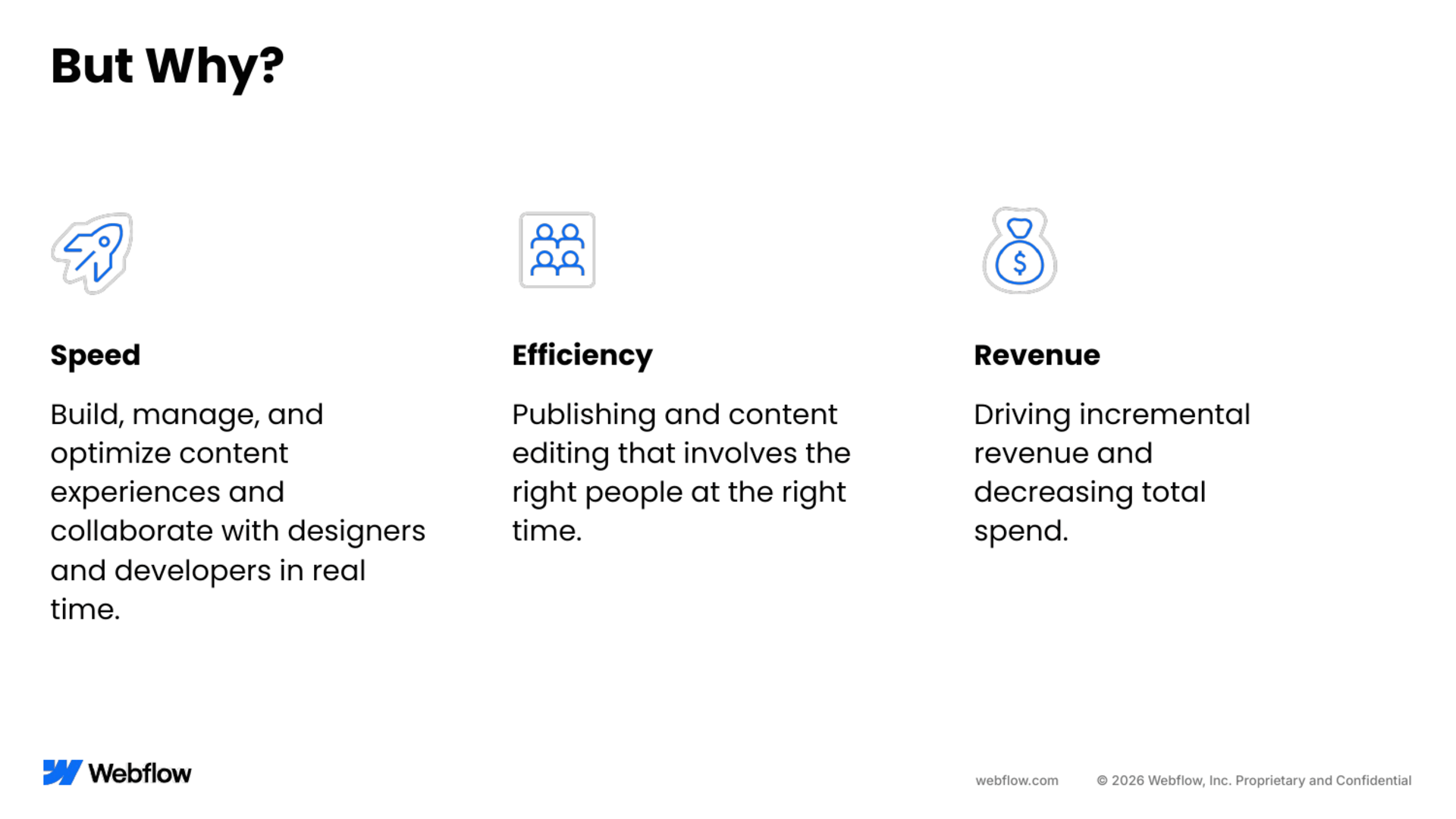
The numbers he put on screen, paraphrased:
- 10x faster website changes
- 10-minute initial page builds (a 20x reduction in time)
- 15x faster speed to launch net new sites (up to 100 a month)
- 40x increase in publish speed for content changes
The Verifone quote on his slide is one I am still quoting:
"Webflow is a 2000% leap forward, enabling us to move past incremental changes to transformational shifts in our digital strategy. AEM vs Webflow? We don't need a battleship. We need a speedboat."
He also walked through the Copy.ai story. $4M+ in pipeline attributed to organic content. Landing pages built in 100 minutes versus days. The kind of number a CMO can take to the board.
Miguel closed with a peek at where the platform is heading. AI Assistant, the official MCP server, and Code to Canvas (a multi-page Webflow generator that builds from prompts and design settings). The platform is being shaped for the prompt-first workflow that Bhanu would dive into later in the day.
Mihajlo Djokic and Ruxandra Spita: how Checkout uses microsites for ABM at scale
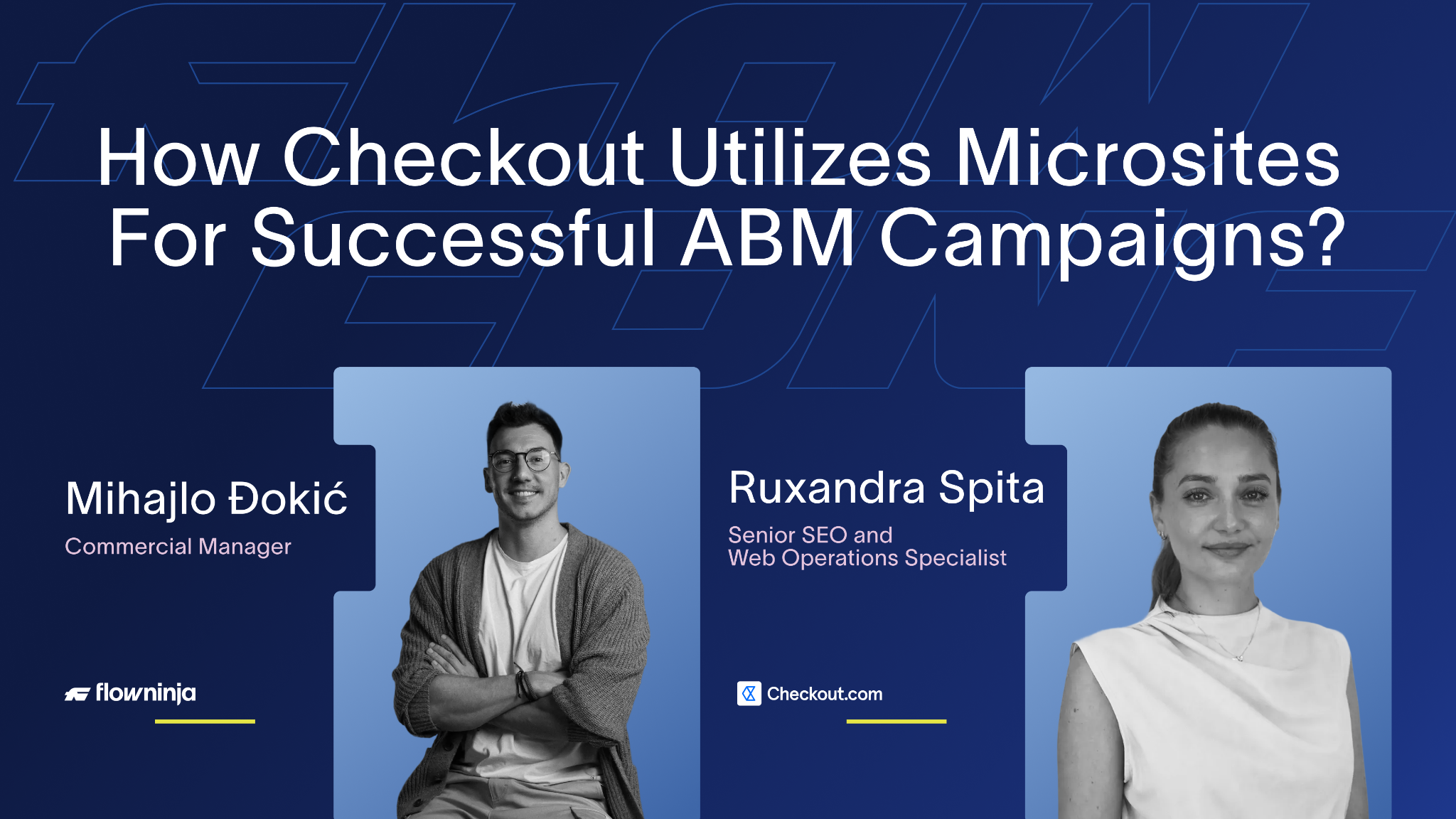
Mihajlo Djokic, Sales Manager at Flow Ninja, sat down with Ruxandra Spita, Senior Web Operations Specialist at Checkout.com, for a conversation about how Checkout built a microsite engine on Webflow.
The backstory: three years ago, every Checkout microsite was a custom project. Idea, design, review, dev, feedback, live. Three to four hours of dev time per microsite. Hard ceiling of one per day. Lost RFPs because the team could not move fast enough.
What they ended up building, together with our team:
- A 9-component microsite system on Webflow (heading, hero, navigation, case studies, attachments, contact person, events, and a couple more).
- A drag-and-drop workflow that regional marketing builds themselves. No queue. No dev request.
- One microsite in one hour ideal, two to three hours maximum.
- Parallel builds across regions, multiple marketers shipping at the same time.
The line from the session I keep quoting:
"Drag, drop, ship."
The deeper point Ruxi made, and the one I think gets missed by teams who copy this pattern surface-level: what she actually built was permission for her marketing team to move without asking. A component library is a tool. The permission is the leadership choice underneath it.
The current scale: over 100 microsites shipped. Accounts include eBay and Spotify. Strong engagement. Massively reduced time to production.
Ruxi also flagged where this is heading. Checkout is rolling out an early-stage AI tool to reduce time to production further. 97% of the Checkout org is actively using AI. The ambition is to be a leading payments provider in an AI-first world, and microsites are one of the surfaces moving fastest.
David Souliotti-Barker and Helene Simon: delivering unique a thousand times
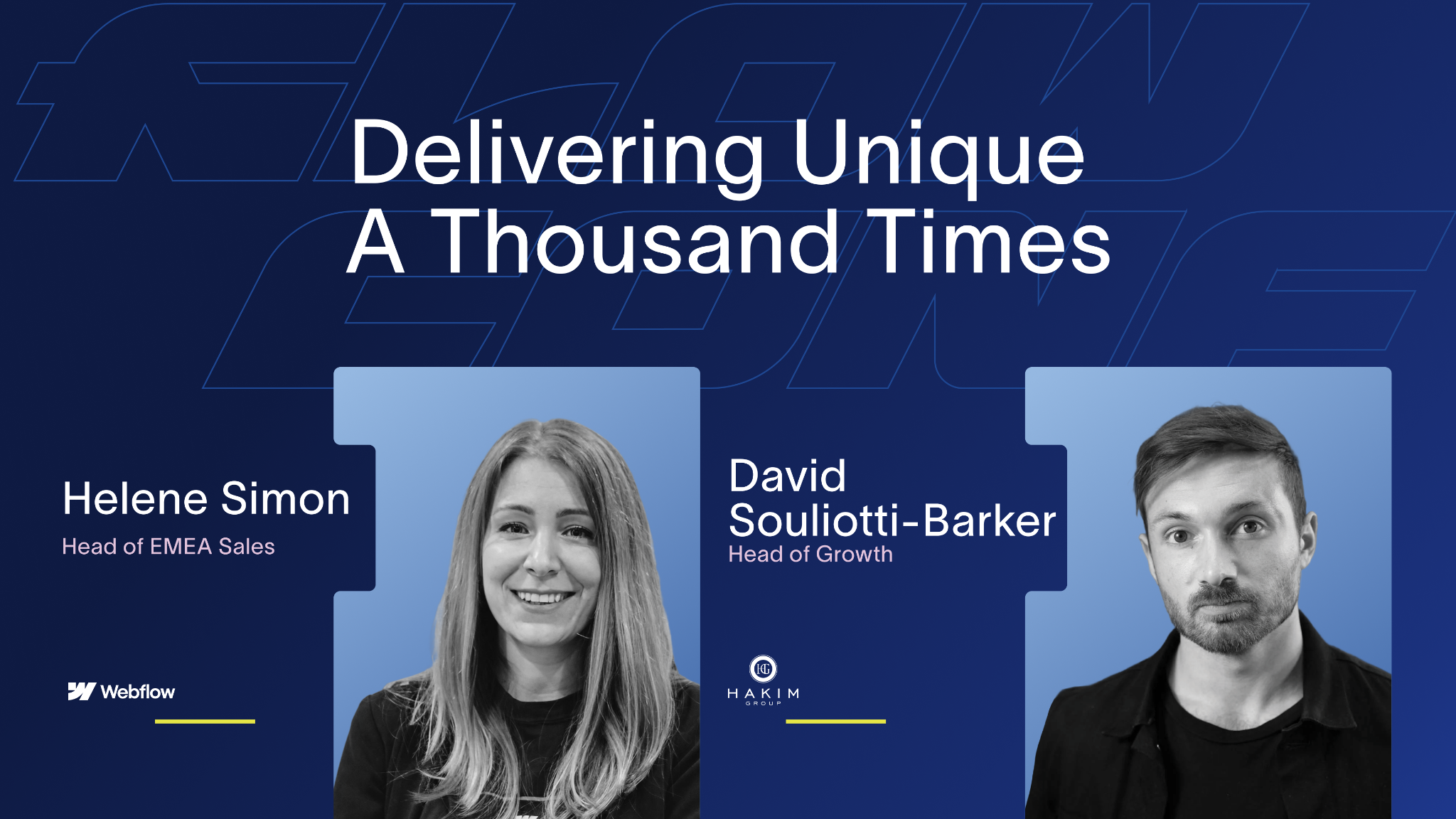
David Souliotti-Barker, Head of Growth at Hakim Group, and Helene Simon, Head of EMEA GTM at Webflow, told one of the most underrated stories of the day.
Hakim Group runs more than 100 independent optical brands across the UK, and the problem they came to flowConf to talk about is one every multi-brand operator eventually hits: how do you run hundreds of websites without losing the autonomy of each brand, and without burning your team out every time something needs to change across all of them?
The original setup was a legacy system. Different stacks. Different teams. The kind of architecture where changing one element across a portfolio means doing the same job a hundred or a thousand times.
What they did, together with Webflow, was consolidate all of it into a single Webflow Enterprise environment that hosts more than 100 sites in one place. Each brand kept its individuality, its visual identity, and its local feel. The underlying system, the components, the publishing workflow, the governance, became one.
The story is interesting for two reasons.
First, scaling changes across the portfolio became dramatically easier. Roll out a new component, fix a brand-wide pattern, ship a global update, all from one place. The kind of work that used to require a project plan now happens in a working session.
Second, and this is the part that landed hardest for the agency owners in the room, the build pushed Webflow far past how it usually gets framed as a "web design tool and builder." David and Helene were clear: the architecture they built for this use case is the kind of system that custom code or a Cloud-only solution could not produce on their own.
"Local brand freedom plus centralised infrastructure. That is the model."
It is also a good example of what enterprise Webflow actually is now. Not a faster way to ship one site. A platform for running a portfolio. Build the system once, give every brand its own surface, and stop paying the multi-site tax forever.
Mihajlo Ivanovic
Mihajlo is the one who replaces Lorem Ipsum texts with the actual copy - an SEO and content expert at Flow Ninja. He has 10+ years of experience as a content writer for various industries. He also plays bass occasionally.
Auditoría web de Foresight
Introduce la URL de tu sitio web y obtén un informe de auditoría web gratuito en 2 minutos.
Continuar leyendo




.webp)
¿Listo para escapar de tu pesadilla de CMS?
Más de 100 migraciones exitosas. Cero desastres de posicionamiento en el lanzamiento. Un equipo integrado que ya lo ha hecho antes.