.svg)
flowConf 2026 Ultimate Recap: The Future of Web, Unpacked
On May 21, 2026, more than 400 web professionals filled two stages in Belgrade for the second edition of flowConf, the conference we at Flow Ninja built for the people designing, building, marketing, and growing the modern web.
The day in one paragraph
Two stages, 20+ speakers, one shared question. Uros Mikic opened the Main Stage with the oldest network he knows, the kolo, and asked what part of the web has to remain human as AI rewrites the rest.
Twelve hours and one afterparty later, Sïmon Saneback closed the same stage by arguing the next era of the web is not pages but systems that act on your behalf.
Everything in between (AEO playbooks, MCP demos, microsite stories, design philosophy, agency economics, facilitation theory) lived inside the gap those two talks opened.
What you will get from this recap is a written companion to the day. Every talk, both stages, captured the way I would explain it to a colleague who could not make it.
Four threads that ran through the entire day
If you stitch together every talk from both stages, four arguments showed up over and over.
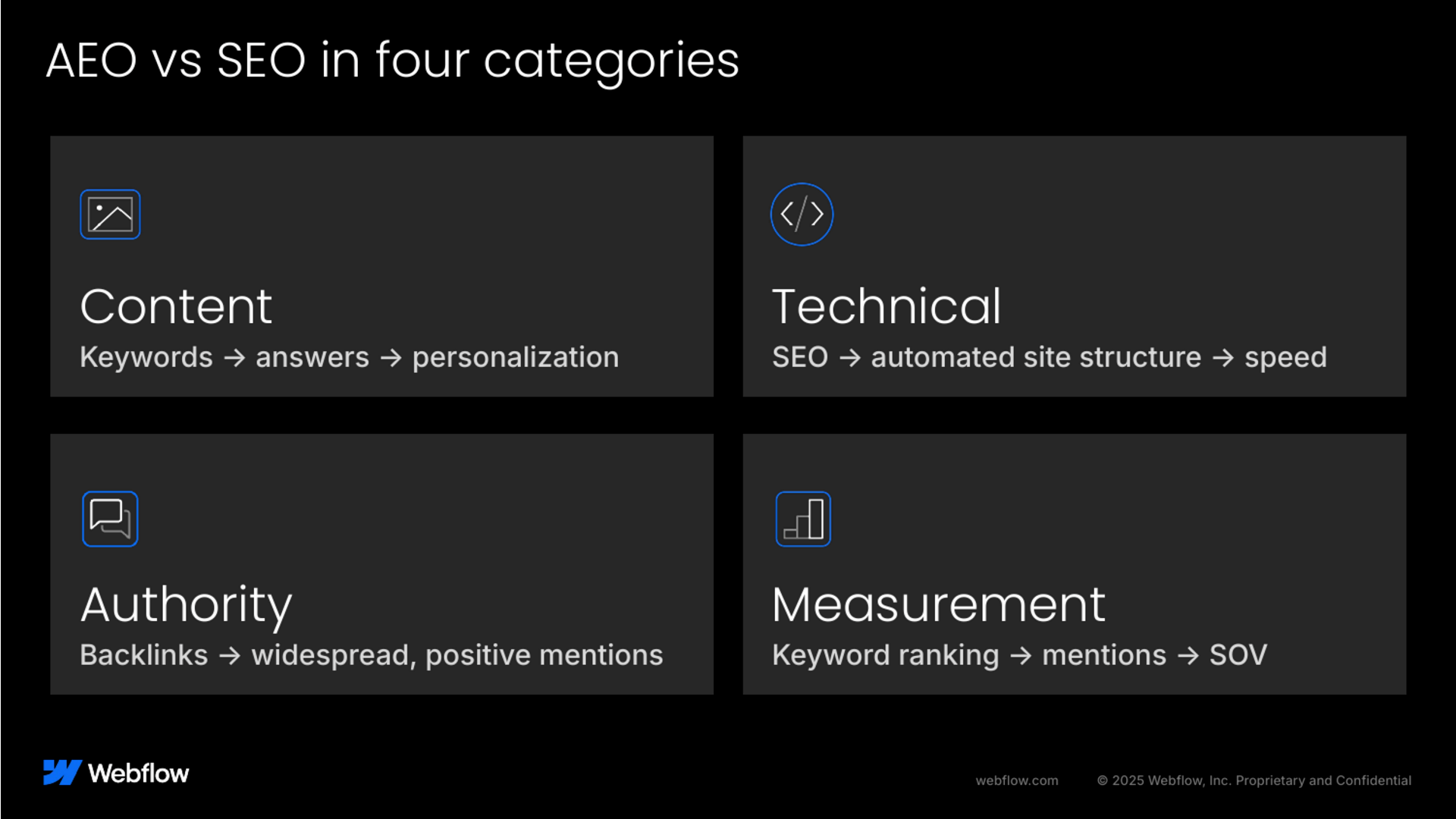
1. AEO is the new SEO, but it is not SEO. Guy Yalif, Bhanu Chawla, Oliver Kuttruff, Ksenia Fix and Al Newman, and our own panel all kept landing in the same place. The fundamentals from search still hold. The categories you optimize against (content, technical, authority, measurement) now sit on a different stack.
2. Agents and MCP are eating the dashboard. Bhanu's Claude Code stack, Webflow's official MCP server, Oliver's "agent bounce rate" framing, Greg Svoboda's Active Intelligence, and Sïmon's closing keynote all pointed the same direction. The interface is dying. The platform stays. The protocol matters now.
3. Taste, brand, and judgment are the new moat. Ilja van Eck's Taste Layer, Laura Zheng Doyon's positioning talk, Uros's opening keynote, and Rebecca Courtney's case for facilitation all made the same argument from four different angles. When execution becomes cheap, what stays human becomes the differentiator.
4. Webflow is the platform built for this shift. Miguel Montoya's enterprise framework, the AEO toolkit, the MCP server, Code to Canvas, and almost every practical demo on stage ran on the same platform. Nobody made Webflow the subject of a sermon. It just kept being the thing under everything else.
These four threads are the spine of the rest of this recap. We start on the Main Stage with the big ideas, then move into the Webflow Room for the deep technical sessions.
Main Stage: the big ideas
The Main Stage was hosted by Ran Segall, founder of Flux Academy. Ran kept the rhythm tight, the transitions warm, and the room awake. If you have ever tried to host a full day of talks, you know how hard that actually is.
Uros Mikic: opening keynote and the kolo
Uros Mikic, founder of Flow Ninja and flowConf, opened the day by walking on stage to a live performance of the kolo, the Serbian round dance, finishing in the room.
His framing: kolo is the oldest network he knows. You join by reaching out your hand. The chain keeps growing for as long as people choose to be part of it.
That is exactly how the web was designed. An open network with no hierarchy, no gatekeeper, accessible to anyone willing to show up and connect.
Then the uncomfortable turn. Traditional kolo requires an active decision. You have to reach out. You have to step in. The web, until recently, worked the same way. AI is changing that dynamic. It anticipates. It suggests. It adapts before you have even put your hand out.
The question Uros put on the room set up the rest of the day:
"If the web starts changing with AI, what will need to remain human?"
Uros also put forward the thesis Flow Ninja has been building everything around for the past two years: the website is the core digital system of a modern business. Not a brochure. Not just a landing page. The place where your brand lives, your customers decide, your team experiments, AI bots crawl, and your growth happens.
He closed by announcing something bigger than the conference itself. We will get to that later in this piece, because it deserves its own section.
Guy Yalif: making your Webflow site the answer
Guy Yalif, Chief Evangelist at Webflow, gave the most data-dense talk of the day and somehow made it feel like a conversation.
His opening reframe was simple and sharp. Your website now has two audiences: humans and machines, and they want different things.
Humans need visually stunning, emotionally engaging experiences. Machines need efficient, concise, well-structured delivery of content on a silver platter. LLMs are constantly balancing the cost of crawling your content against the quality of what they find. The lower the cost, the higher the chance you get cited.
Then the numbers that woke the room up:
- 8% of Webflow's self-serve signups now come from AI search.
- They convert 6x better than non-branded organic.
- 18% of total traffic on Webflow's own site now comes from AI and LLMs.
- AI bot traffic is up 3x year over year.
Guy spent the rest of the talk on a four-category framework I genuinely wish every marketer in the room had photographed. It is the cleanest mental model I have seen for AEO so far.
His punchiest line of the talk, and one I have already quoted twice this week:
"Being on page 2 of Google and being absent from AI answers are almost the same thing. You don't exist."
A few of the specific experiments Guy shared from Webflow's own site:
- Reframing blog post headers as questions drove a 13% lift in AI-driven traffic.
- Adding FAQ blocks and schema to six product pages drove a 24% lift in organic impressions in two weeks. 57% of new citations in the following two weeks came from those six pages.
- Content refreshes drove a 5x increase in speed of updates and a 42% lift in SEO visits post-update.
He also flagged the schema gap that is currently sitting on the table for anyone who wants it. 73% of first-page results in Google use schema. Only 12% of sites have implemented it. For B2B that drops to 2%.
If you want to see where your site sits on the AEO maturity model Guy walked through, Webflow has published it as the AEO Maturity Model. We have already run a few client sites through it and the diagnostic is sharp.
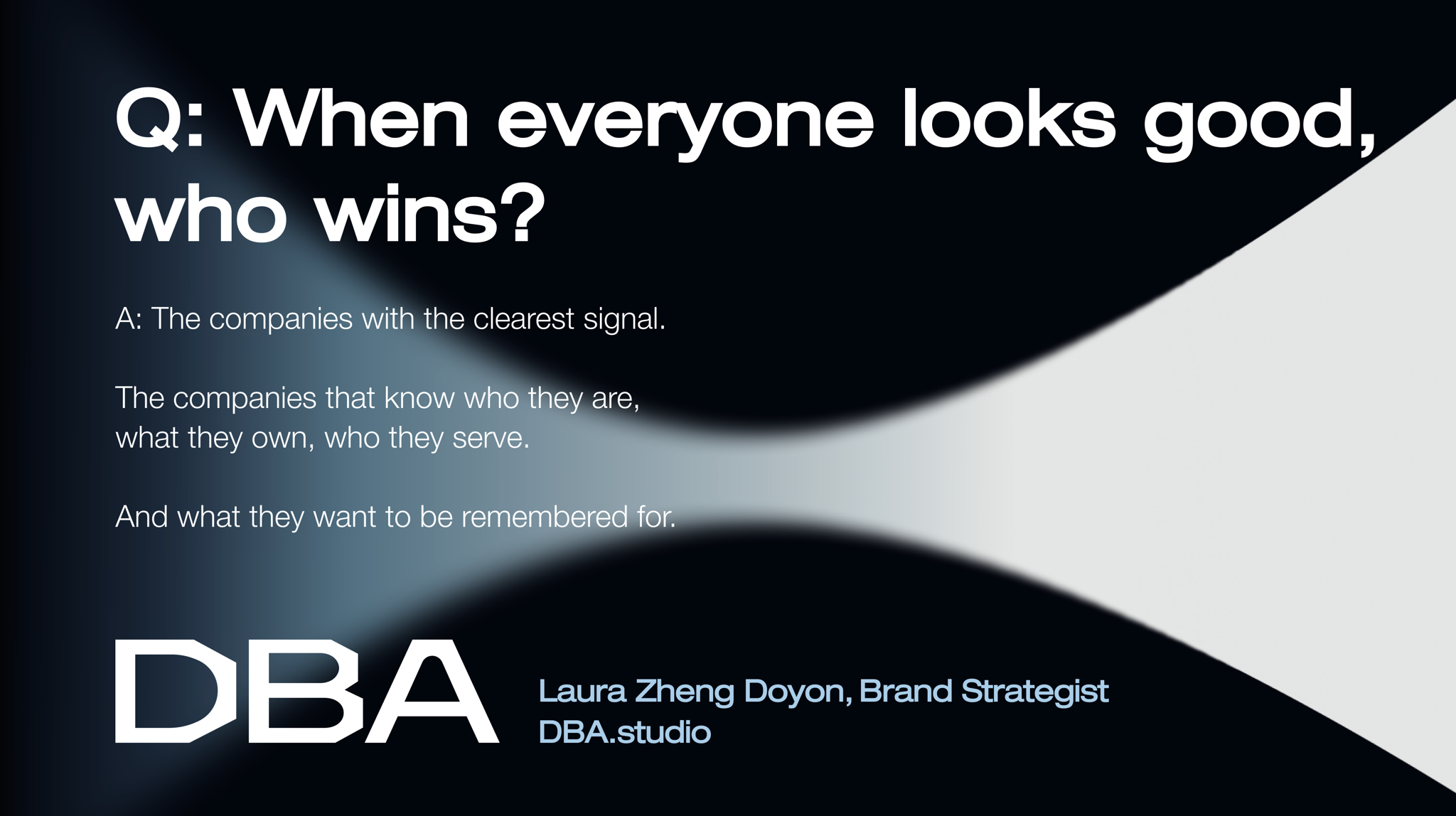
Laura Zheng Doyon: when everyone looks good, who wins?

Laura Zheng Doyon, founder of DBA.studio, has spent 14 years working on brands like Yeezy, NYFW, UFC, and Ariana Grande. She came to flowConf to argue that almost every problem we had spent the day talking about (SEO, AEO, performance, even brand) has the same upstream problem nobody talks about.
That problem is positioning.
Her one-line definition:
"Positioning is how you show you're the best, or only, choice for a specific customer for their specific needs."
Her core reframe: AI did not change the importance of positioning. It amplified it. Strong positioning gets stronger. Weak positioning gets more obvious, faster, in front of more people.
Laura's diagnostic for weak positioning was uncomfortably accurate. You feel it when prospects keep asking you to explain yourself, when close rates are low even with a solid sales function, when pricing comes up early and often, and when every campaign feels like starting from scratch.
She walked through a simple Venn diagram for finding your position: what you are genuinely amazing at right now, what people desperately want and actively pay for, and what nobody else is doing or saying. The overlap is your differentiated value.
The line that landed hardest in the room:
"Positioning isn't invented. It's excavated."
You cannot brainstorm your way to a strong position. You have to surface what is already true about the business through real customer interviews, not surveys.
The case studies sharpened the point. Blue Ribbon Sports became Nike when it stopped pitching shoes for everyone and committed to runners. The Ariana Grande emoji app became the top paid app in entertainment when Laura's team got specific about who it was for. Yeezy customers were buying an identity, a uniform, an everyday armor, not clothes.
Her closing line:
"AI made execution cheaper. Which means positioning just became more valuable. When the moat is no longer output and execution, the moat is your judgment."
If you stack Laura's talk against Guy's, the picture sharpens. When every brand sounds the same, LLMs cannot help but blur them together. Positioning is now also an AEO problem. The brand that gets cited is the brand with a sharp, defensible point of view.
Miguel Montoya: speed, efficiency, revenue with Webflow Enterprise

Miguel Montoya, Director of Customer Success at Webflow, opened with the number Webflow has been driving toward for years.
1,500+ organizations now use Webflow Enterprise.
The why, per Miguel, broke down into three pillars: speed, efficiency, revenue. He walked through what each one actually means in the workflow of a marketing team that has switched to Webflow.
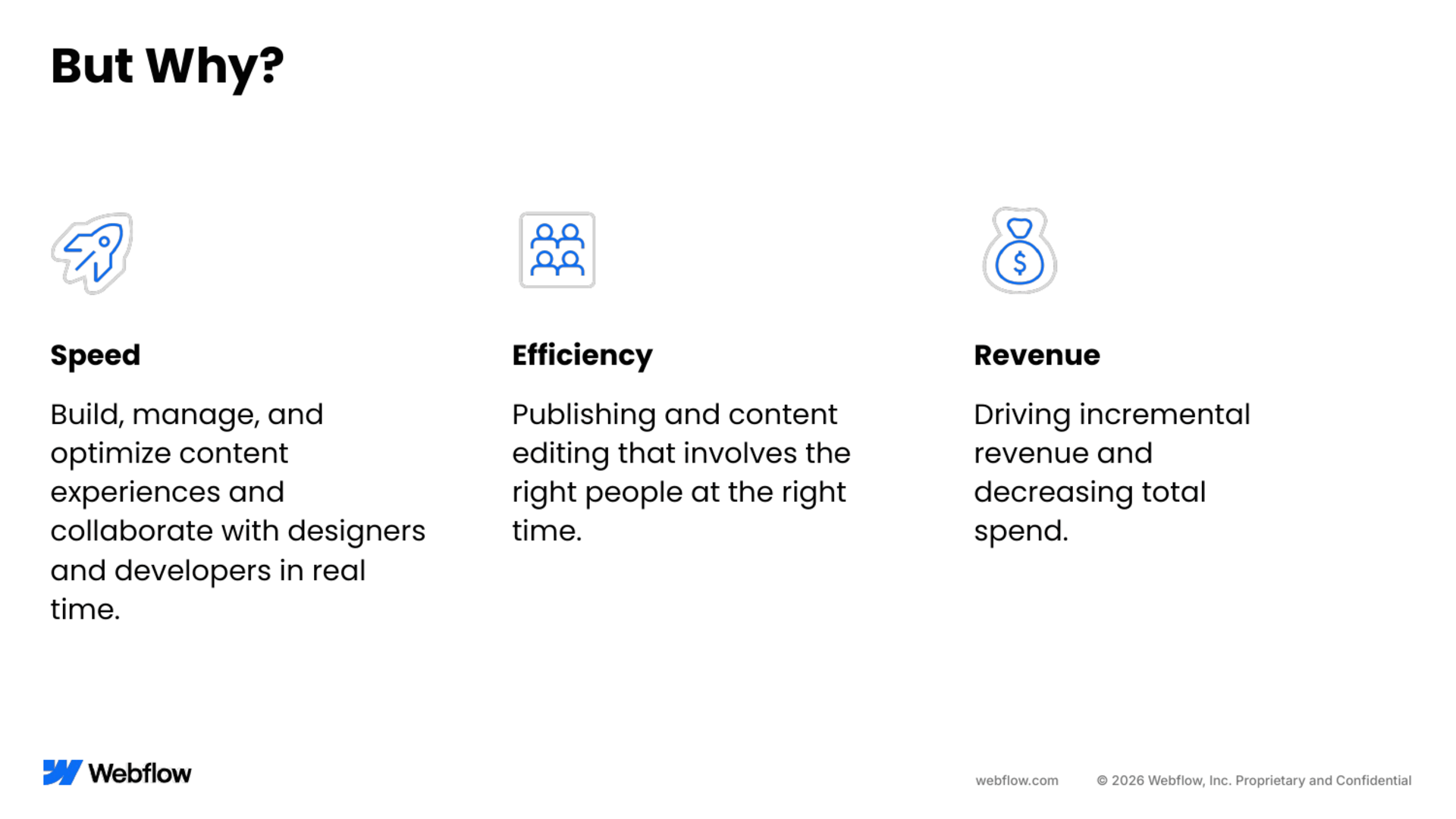
The numbers he put on screen, paraphrased:
- 10x faster website changes
- 10-minute initial page builds (a 20x reduction in time)
- 15x faster speed to launch net new sites (up to 100 a month)
- 40x increase in publish speed for content changes
The Verifone quote on his slide is one I am still quoting:
"Webflow is a 2000% leap forward, enabling us to move past incremental changes to transformational shifts in our digital strategy. AEM vs Webflow? We don't need a battleship. We need a speedboat."
He also walked through the Copy.ai story. $4M+ in pipeline attributed to organic content. Landing pages built in 100 minutes versus days. The kind of number a CMO can take to the board.
Miguel closed with a peek at where the platform is heading. AI Assistant, the official MCP server, and Code to Canvas (a multi-page Webflow generator that builds from prompts and design settings). The platform is being shaped for the prompt-first workflow that Bhanu would dive into later in the day.
Mihajlo Djokic and Ruxandra Spita: how Checkout uses microsites for ABM at scale
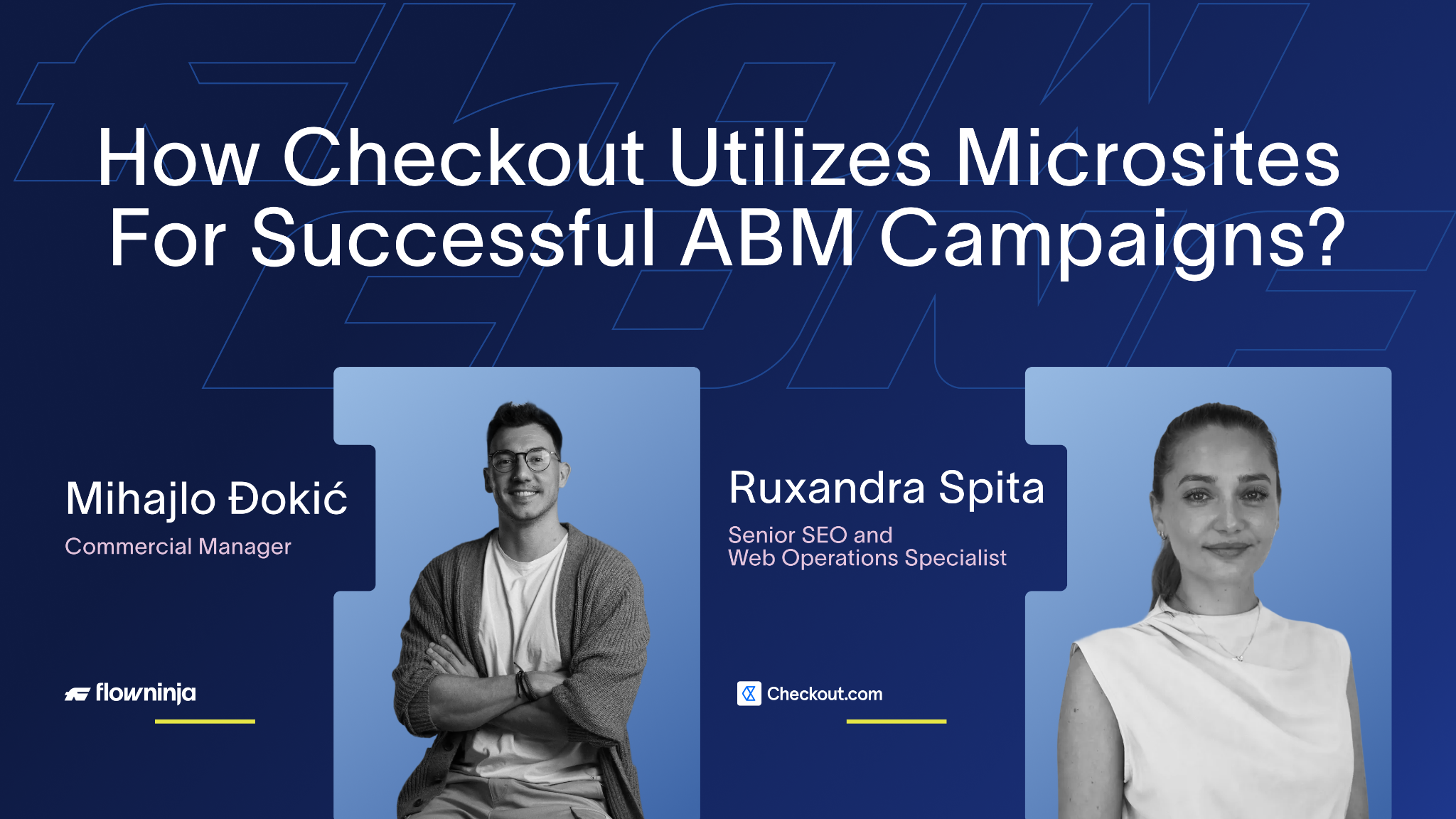
Mihajlo Djokic, Sales Manager at Flow Ninja, sat down with Ruxandra Spita, Senior Web Operations Specialist at Checkout.com, for a conversation about how Checkout built a microsite engine on Webflow.
The backstory: three years ago, every Checkout microsite was a custom project. Idea, design, review, dev, feedback, live. Three to four hours of dev time per microsite. Hard ceiling of one per day. Lost RFPs because the team could not move fast enough.
What they ended up building, together with our team:
- A 9-component microsite system on Webflow (heading, hero, navigation, case studies, attachments, contact person, events, and a couple more).
- A drag-and-drop workflow that regional marketing builds themselves. No queue. No dev request.
- One microsite in one hour ideal, two to three hours maximum.
- Parallel builds across regions, multiple marketers shipping at the same time.
The line from the session I keep quoting:
"Drag, drop, ship."
The deeper point Ruxi made, and the one I think gets missed by teams who copy this pattern surface-level: what she actually built was permission for her marketing team to move without asking. A component library is a tool. The permission is the leadership choice underneath it.
The current scale: over 100 microsites shipped. Accounts include eBay and Spotify. Strong engagement. Massively reduced time to production.
Ruxi also flagged where this is heading. Checkout is rolling out an early-stage AI tool to reduce time to production further. 97% of the Checkout org is actively using AI. The ambition is to be a leading payments provider in an AI-first world, and microsites are one of the surfaces moving fastest.
David Souliotti-Barker and Helene Simon: delivering unique a thousand times
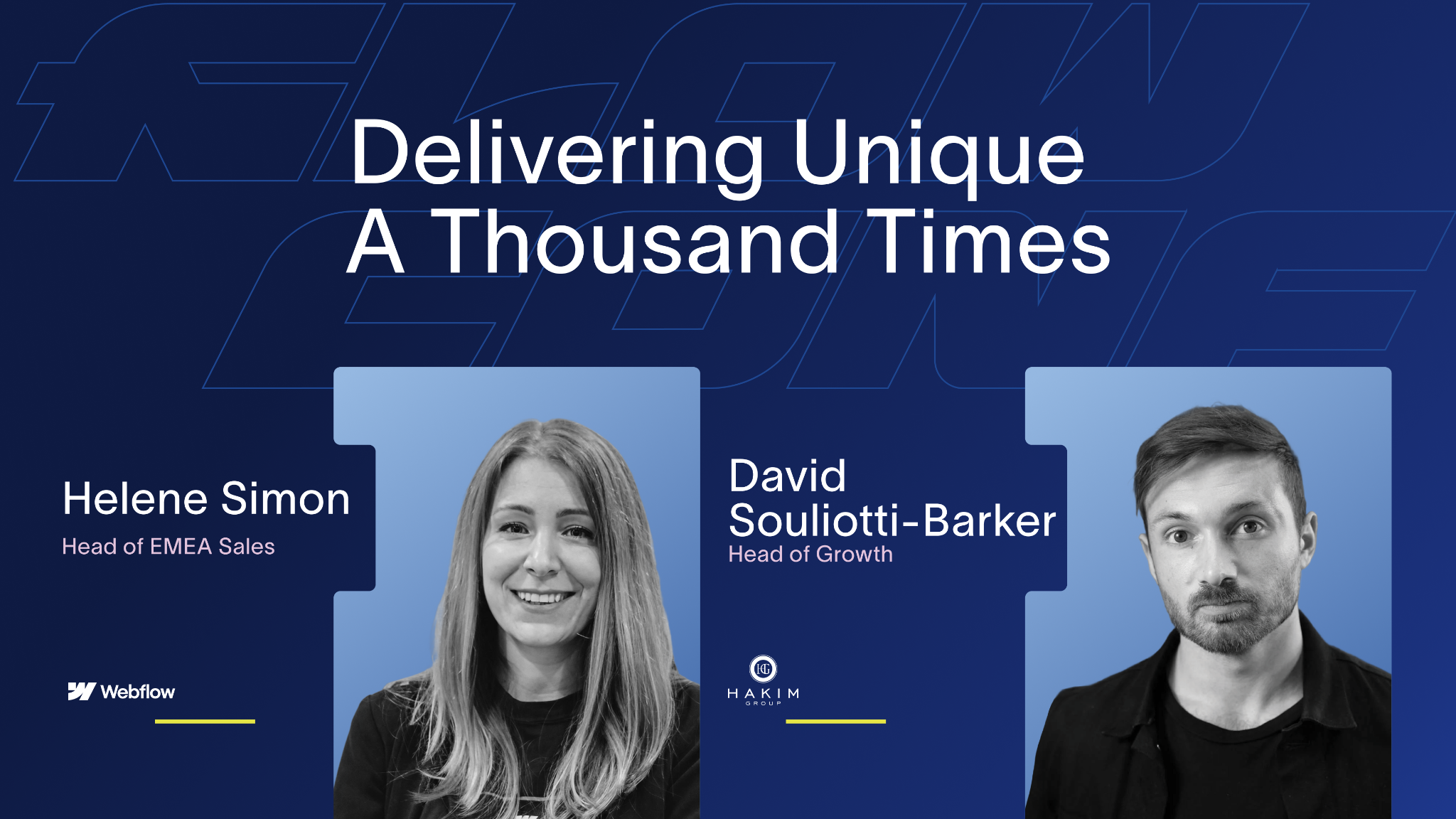
David Souliotti-Barker, Head of Growth at Hakim Group, and Helene Simon, Head of EMEA GTM at Webflow, told one of the most underrated stories of the day.
Hakim Group runs more than 100 independent optical brands across the UK, and the problem they came to flowConf to talk about is one every multi-brand operator eventually hits: how do you run hundreds of websites without losing the autonomy of each brand, and without burning your team out every time something needs to change across all of them?
The original setup was a legacy system. Different stacks. Different teams. The kind of architecture where changing one element across a portfolio means doing the same job a hundred or a thousand times.
What they did, together with Webflow, was consolidate all of it into a single Webflow Enterprise environment that hosts more than 100 sites in one place. Each brand kept its individuality, its visual identity, and its local feel. The underlying system, the components, the publishing workflow, the governance, became one.
The story is interesting for two reasons.
First, scaling changes across the portfolio became dramatically easier. Roll out a new component, fix a brand-wide pattern, ship a global update, all from one place. The kind of work that used to require a project plan now happens in a working session.
Second, and this is the part that landed hardest for the agency owners in the room, the build pushed Webflow far past how it usually gets framed as a "web design tool and builder." David and Helene were clear: the architecture they built for this use case is the kind of system that custom code or a Cloud-only solution could not produce on their own.
"Local brand freedom plus centralised infrastructure. That is the model."
It is also a good example of what enterprise Webflow actually is now. Not a faster way to ship one site. A platform for running a portfolio. Build the system once, give every brand its own surface, and stop paying the multi-site tax forever.
Greg Svoboda: inside ActiveCampaign's agentic platform
Greg Svoboda, Senior Developer Relations Engineer at ActiveCampaign, opened with a joke about the protein bar he got on his flight, then quietly delivered the most useful AI marketing framework I heard all day.
His opening reframe: most AI marketing tools are "prompt-and-response." The first result is always generic. You spend the next twenty minutes iterating on what it gave you, because the AI did not know who you were when it started.
The two problems Greg named:
- You iterate on what they create. You are patching a bad foundation instead of directing it.
- They have broken loops. Each campaign is essentially your first campaign. You are getting smarter. Your system never does.
The mindset shift he gave the room is one I have already passed to two clients:
"Instead of asking 'what do you want to make?', ask 'what are you trying to accomplish?' Give the AI three things before you ask for anything: the constraints, the hero example, and the so what."
ActiveCampaign's answer is what they call Active Intelligence, built on a five-layer framework: Overlay, Goals, Imagine, Activate, Validate. Each agent in the system maps to one of those layers. None of it exists to generate more content. All of it exists to compound learning across campaigns.
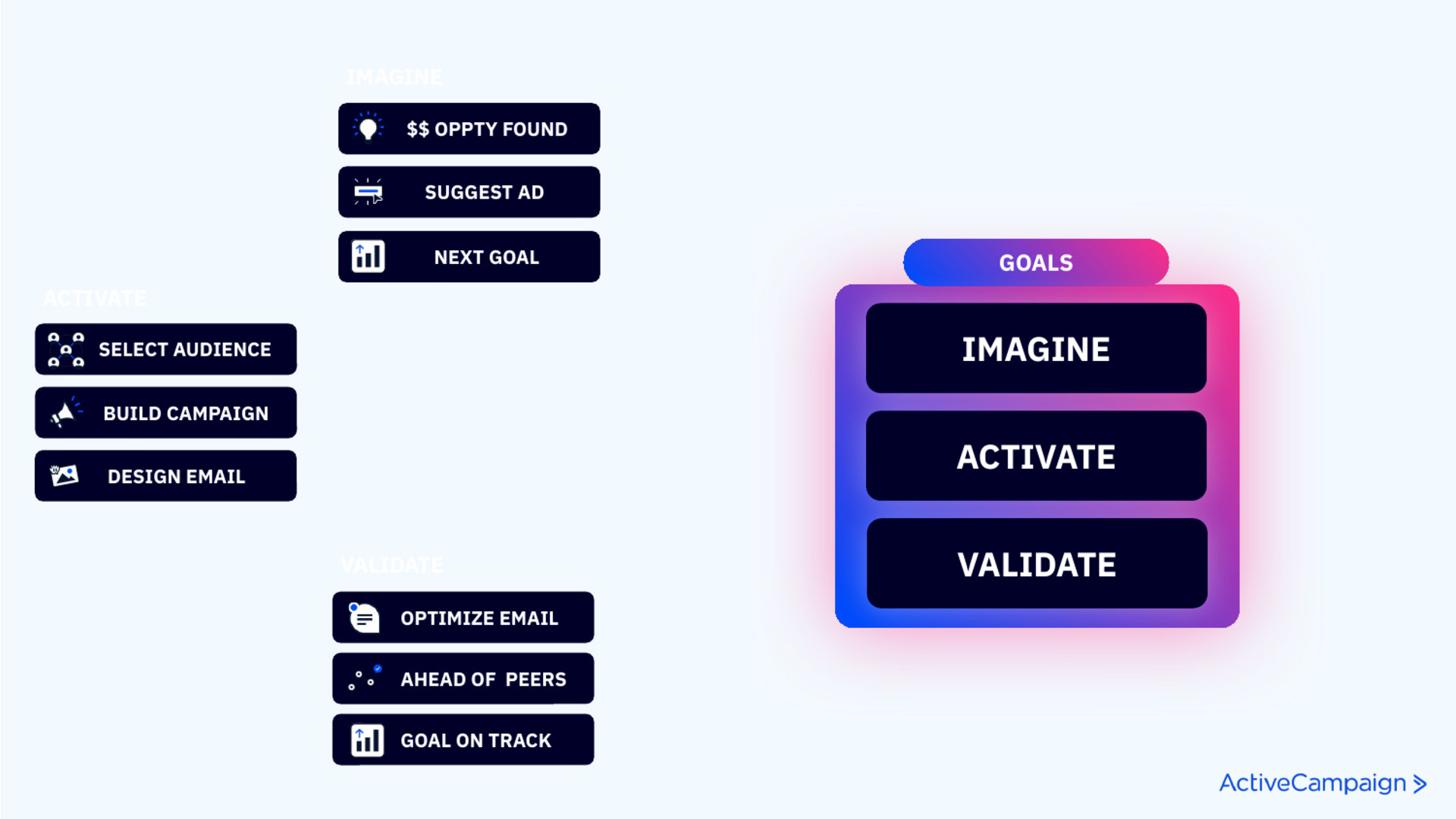
The thing they have that almost nobody else has: 22+ years of training data across 150,000+ small businesses. Billions of campaign data points feeding the model that picks the right send time, the right segment, the right next move.
Greg's closing line is the one I keep coming back to:
"People don't need more content. They need more excellence."
Ksenia Fix and Al Newman: speak every language, answer every query
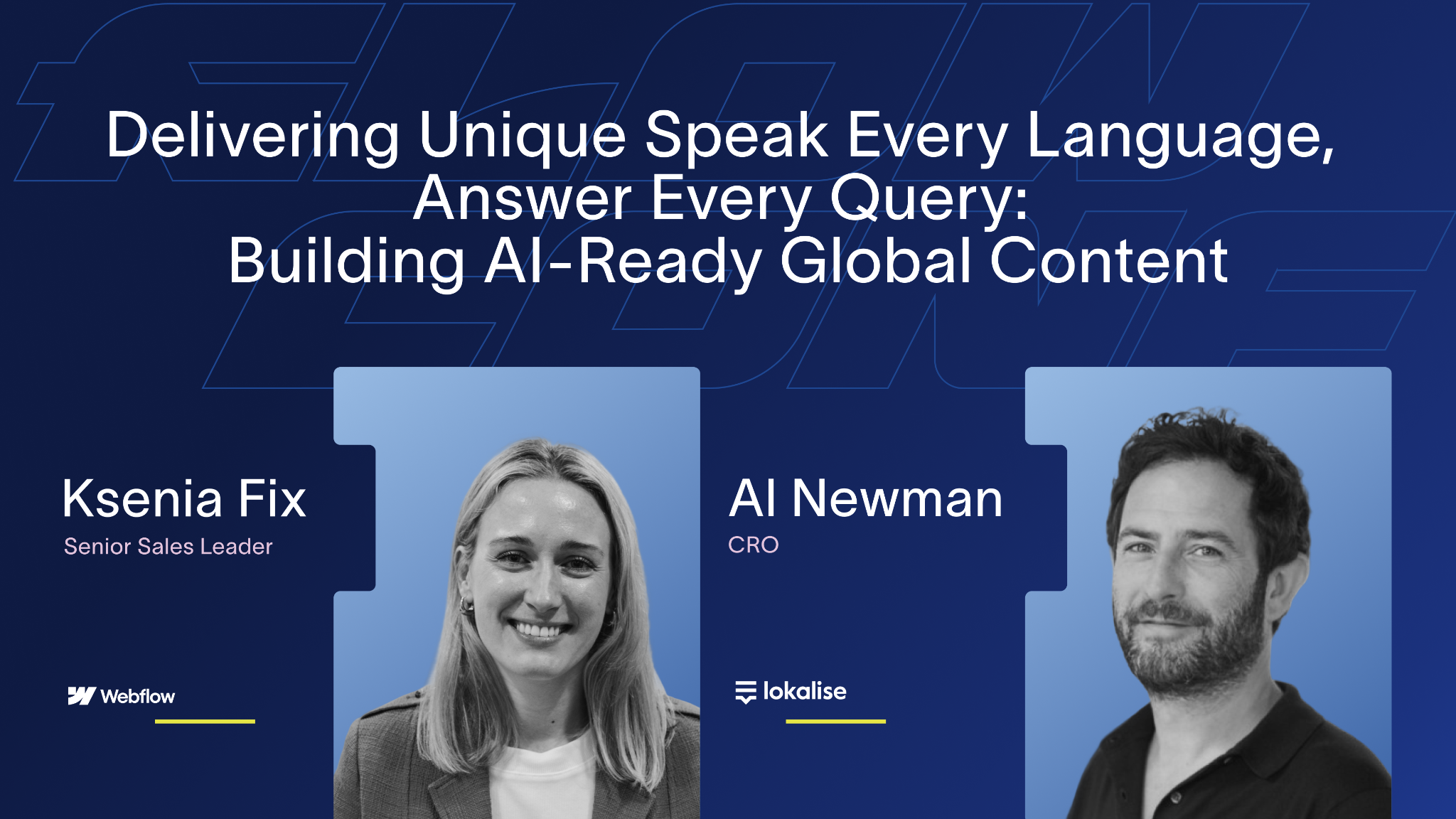
Ksenia Fix, Senior Sales Leader and Regional Sales Manager for Central Europe and the Middle East at Webflow, sat down with Al Newman, CRO at Lokalise, for a fireside conversation on multilingual AEO.
No slides, just a conversation. The core argument: AI search is reshaping global discovery, and global brands now face a double challenge. Being found, and being understood across markets.
The three practical takeaways from the conversation, paraphrased:
- Structure multilingual content for AI discoverability, not just for translation parity. AI engines weight structure heavily.
- Align localization workflows with the speed demands of modern web publishing. A page that ships in one language and then takes two months to land in five others is a citation gap waiting to happen.
- Treat non-English AEO as a land grab. Fewer pages are competing for citations in German, French, Spanish, Italian, and Mandarin. Same content, multiplied reach.
Bhanu echoed the land-grab point on stage an hour later. Non-English AEO is one of the cheapest visibility wins available right now, and almost nobody is doing it.
Peter Kang: scaling business development beyond the founder
Peter Kang, co-founder of Barrel Holdings, gave the talk every agency founder in the room needed to hear.
His central observation, from twenty years running an agency and another few running a holding company of agencies:
"Most agency founders are the entire business development operation. They are doing what they call BD. They are actually doing five separate jobs at once."
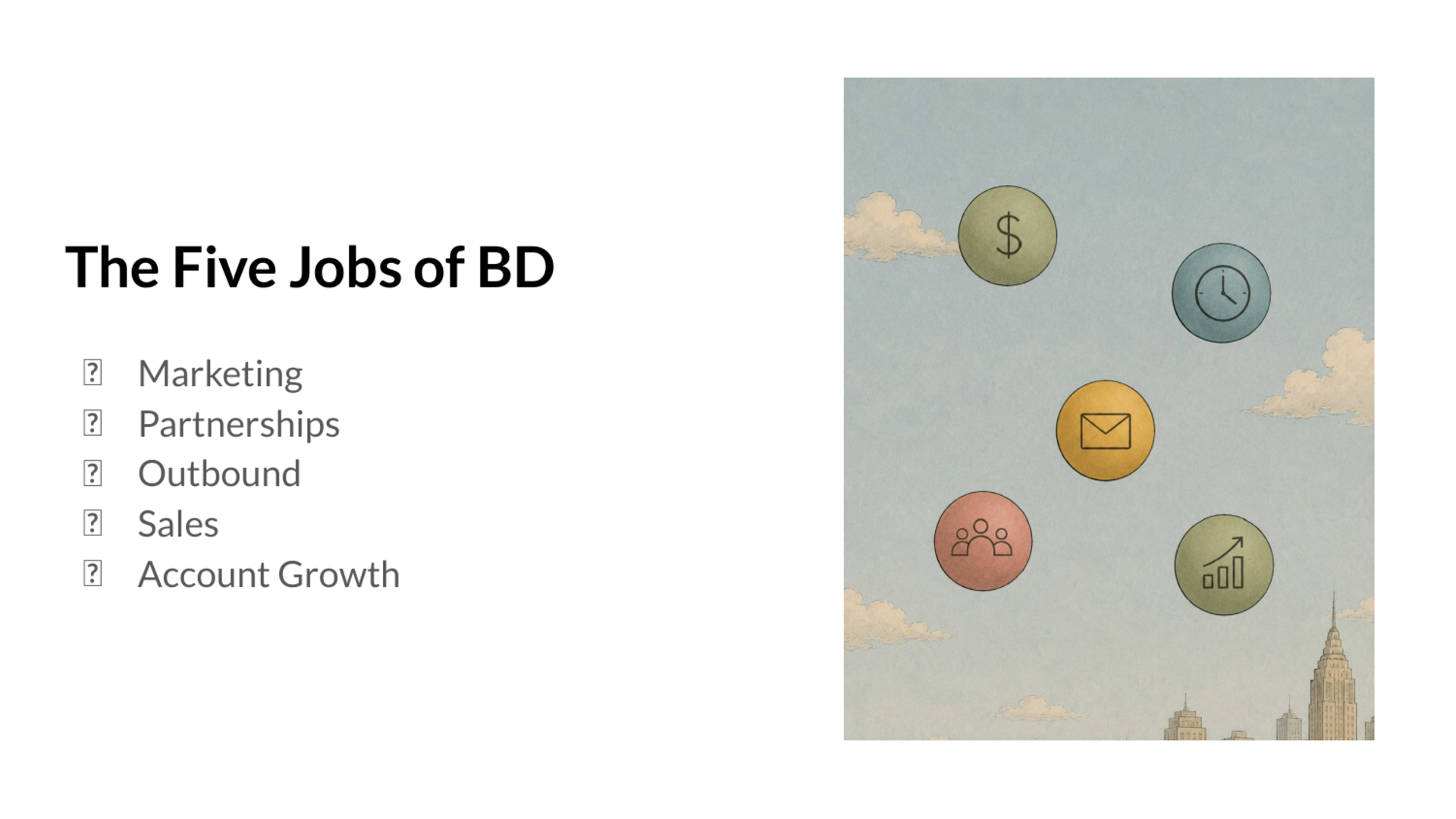
The five jobs of BD:
- Marketing (one-to-many, top of mind, content, events)
- Partnerships (ecosystem relationships, lead sharing)
- Outbound (cold prospecting to your ICP)
- Sales (qualifying, scoping, proposals, closing, contracts)
- Account growth (expansion inside existing clients)
When one ball gets big (a fire deal, a key client, a major proposal), the other four get dropped. Peter has watched this play out across his portfolio and the agencies he advises. He calls it a law.
His advice to founders who try to fix this by hiring a Head of BD:
"Stop trying to replicate yourself. Take the five jobs apart instead."
The order he recommends building capacity:
- Account growth first. Cheapest, fastest, highest-trust revenue. Lean on your account managers.
- Partnerships next. One person, even part-time, focused on deepening two or three ecosystem relationships.
- Marketing third. Founder owns the point of view. A part-time content editor owns the execution.
- Outbound fourth. Only after positioning is sharp. Work with specialists (GTM engineers, RevOps, deliverability experts).
- Sales last. Founder keeps the closing conversations and the contract negotiations. Everything else can be handed off.
His punchline:
"Build the machine. Don't look for another you."
For any agency founder reading this who has not picked up Peter's book, The Holdco Guide, I would put it on your list.
Rebecca Courtney: do we still need humans in the room?
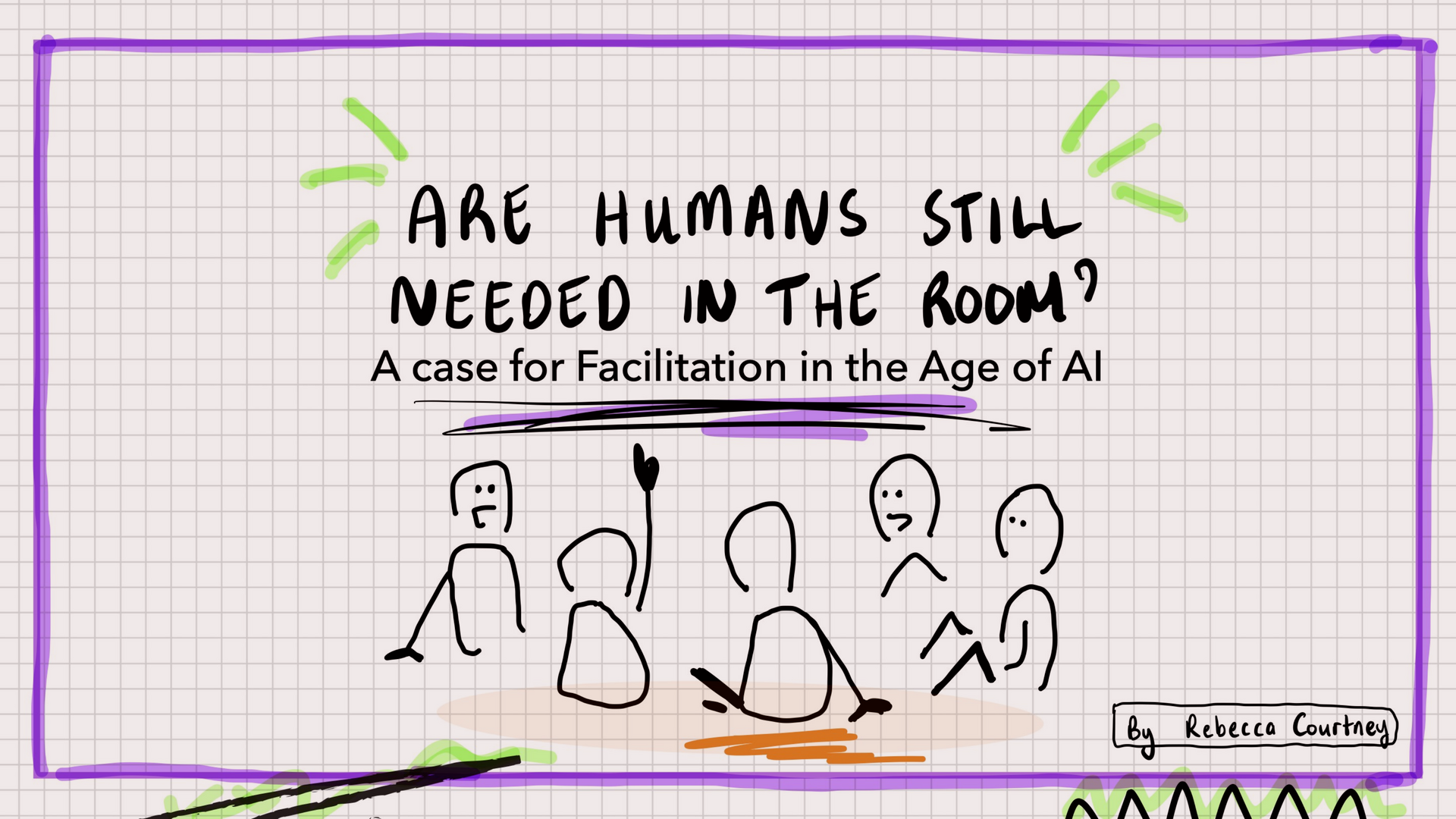
Rebecca Courtney spent five years as Lead Facilitation Coach and Trainer at AJ&Smart, working with teams at LEGO, Grammarly, and Spotify. She now runs her own practice.
Her talk was the most interactive session of the day, and on purpose. The whole argument was that AI can generate, but it cannot facilitate, so she made the room do the thing AI cannot do.
She opened with a 30-second prompt: "What's the worst meeting experience you've ever had?" The room turned into a buzz of muttered horror stories. From there she walked the room through why this matters now.
Meetings are more complex than ever. Scattered teams. More people, more complexity. Ambiguous goals. Endless distractions. AI in the room.
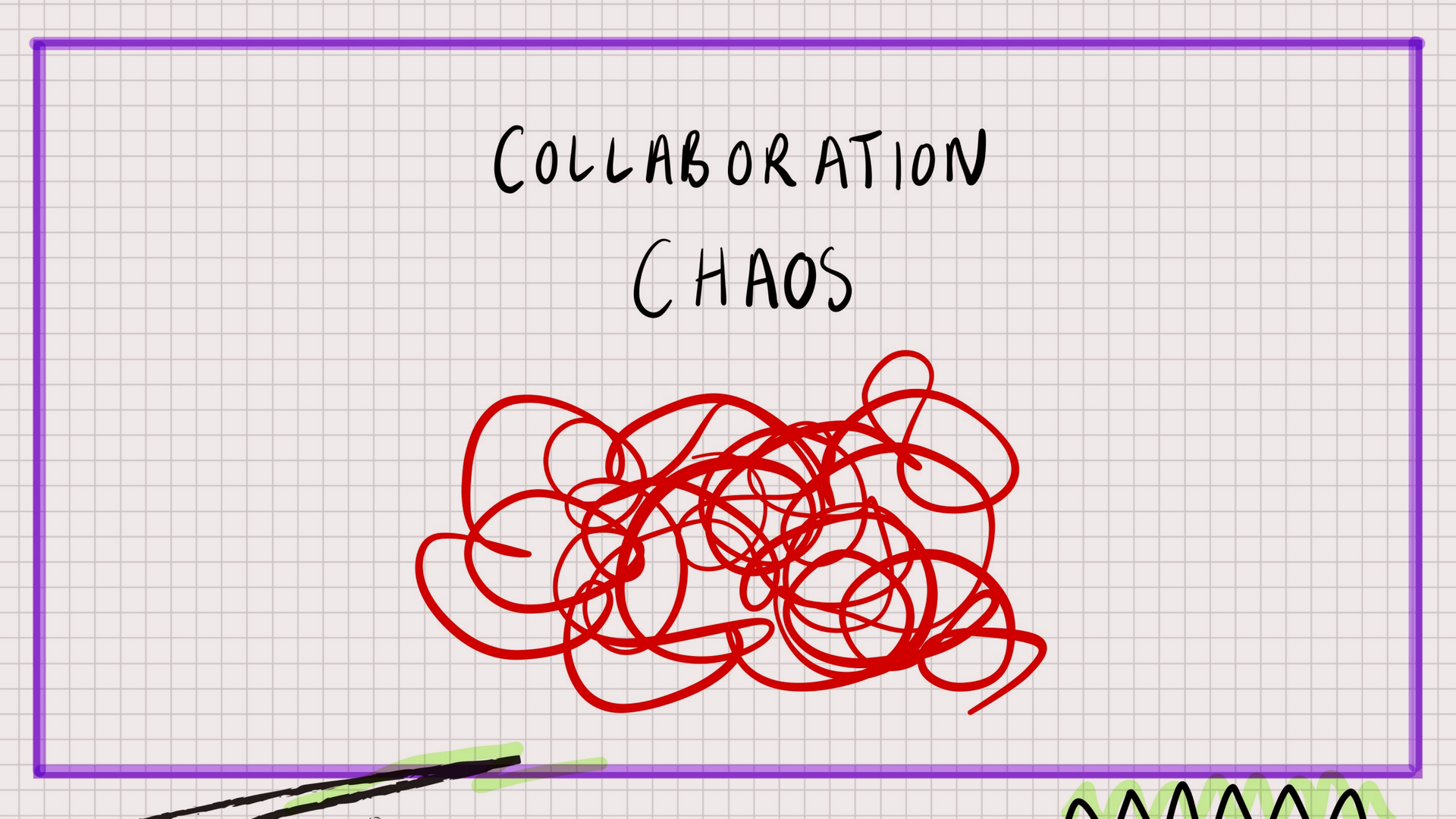
Then the diagnostic that hit hardest:
"We've always had meetings. We just got good at vibing through the chaos because we're used to it."
Rebecca made the cost concrete. For companies, $1 million is wasted every 20 seconds collectively across organisations due to ineffective collaboration. For individuals, poor collaboration is threatening our thinking and our sense of mattering. Our thinking is stagnating, and we are losing the muscle.
She landed it with a Leo Rosten quote:
"The purpose of life is not to be happy, but to matter, to be productive, to be useful, to have it make some difference that you lived at all."
The fix she walked the room through was a simple model: how groups make decisions. Diverge first (explore the topic, generate options) before you converge (narrow down, decide). Most teams skip diverge entirely or get stuck inside it. Both fail.
That's where facilitation lives. Not in generating more options. In knowing when to stop, when to push, and when to converge.
Her conclusion:
"AI can generate ideas and draft decisions in seconds. But collaboration is still broken. Facilitation is the missing skill, and the one AI cannot replace."
Then she put the theory in front of us. Everyone in the room got a sheet of paper. The prompt was simple: write down one thing you had learned at flowConf so far. Then crumple it up. Then throw it at someone else. We ended up in a paper-snowball fight across the Main Stage, picking up other people's takeaways, unfolding them, and reading what someone else had taken from the day.
Bhanu Chawla: AEO, MCP, Claude Code, and the new marketing stack
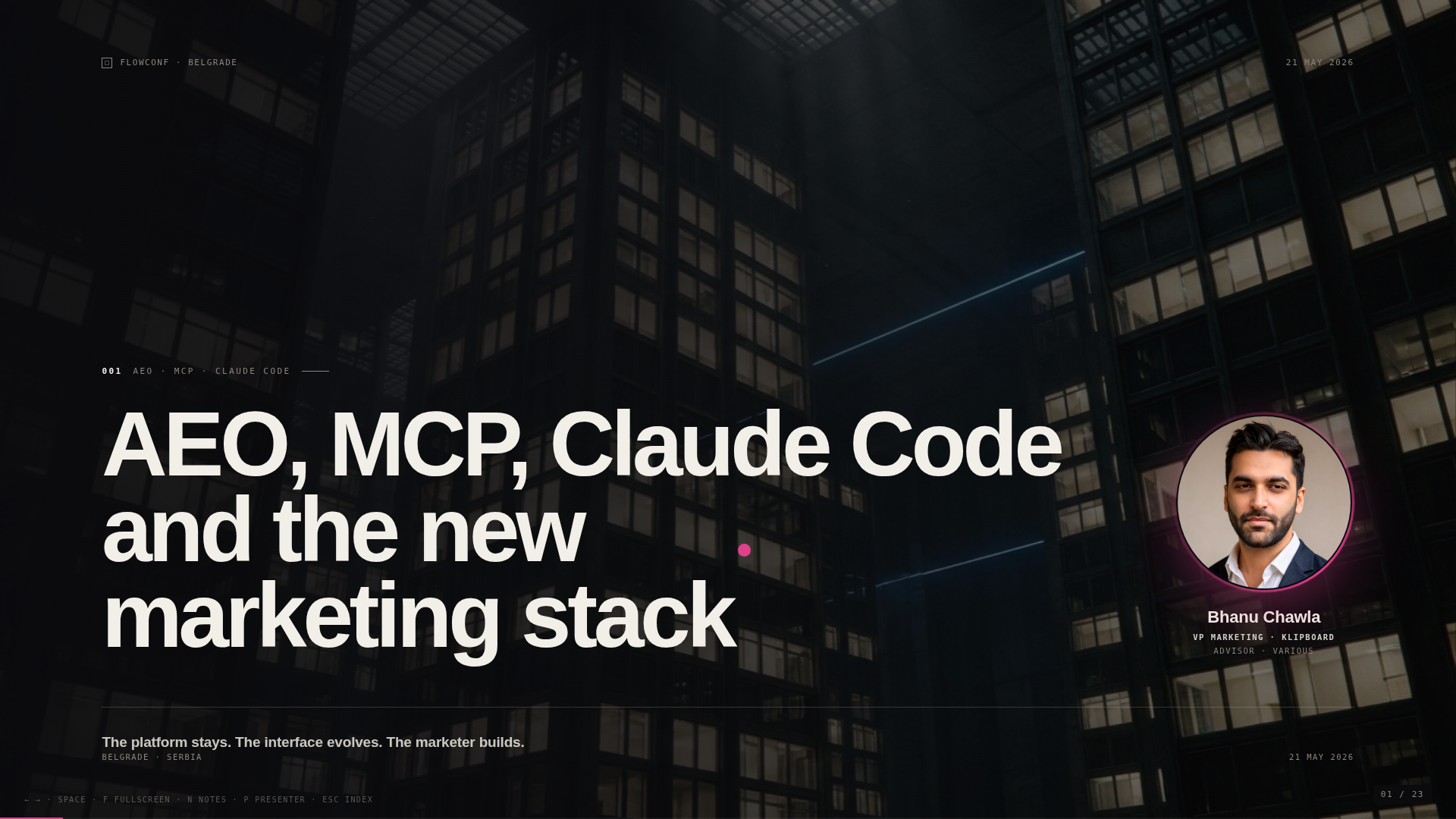
Bhanu Chawla, VP of Global Marketing at Klipboard (a $1.5B+ SaaS serving 55,000+ customers), gave what I think will be remembered as the talk of the year.
Bhanu opened with a single, brutal reframe:
"Two deaths. SEO is dying into AEO. APIs are dying into MCP. The consumer of your content and your data is no longer a human clicking. It is a model calling."
He then ran a sixteen-minute clinic on the new marketing stack. I will not try to fit the whole talk in this section. I will give you the parts I have already started using.
The AEO playbook, six moves:
- Don't block AI. Block the wrong AI. Allow OAI-SearchBot and Claude-SearchBot for live citations. Block GPTBot if you must. 71% of news sites accidentally hid themselves from ChatGPT.
- First Contentful Paint under 0.4s is an AEO ranking factor. ChatGPT's retrieval crawler times out on slow pages. Pages under 0.4s average 6.7 citations. Over 1.1s, just 2.1.
- Year-stamp your URL slugs. ChatGPT auto-appends the current year to its Bing query. Put 2026 in the slug, title, and H1. +20% citation lift. This is the opposite of the old SEO rule.
- Get on G2, Capterra, TrustRadius before fixing your site. Review presence pushes citation rate 4-6x. 68% of AI citations come from third-party sources. Your homepage is not the asset it used to be.
- Refresh top pages every four to six weeks. Content decay in AEO is around 60 days, not 12 months. 76% of ChatGPT's top-cited pages were updated in the last 30 days.
- Translate everything. Non-English AEO is a land grab.
The MCP playbook, six moves, in one sentence each:
- Your stack already has MCP. You're just not using it. 17,468 MCP servers were indexed in Q1 2026.
- Composio is the cheat code. One config wraps 8,000+ SaaS apps and 40,000+ actions as MCP servers.
- Build your own MCP server in a weekend. The cost of building just dropped to roughly zero.
- MCP servers compose. One /abm-page skill can call HubSpot, Webflow, and Slack in one prompt.
- Read-only MCP is the compliance move. Scope agents with --allowedTools for scheduled runs.
- Schedule a morning intel routine. Cron a 7am Claude Code job. Coffee in hand. Intel in Slack.
The slide that drew the loudest reaction was Bhanu's "before and after" table for actual marketing work. I am putting it in this recap because it is the clearest representation of where this is heading.
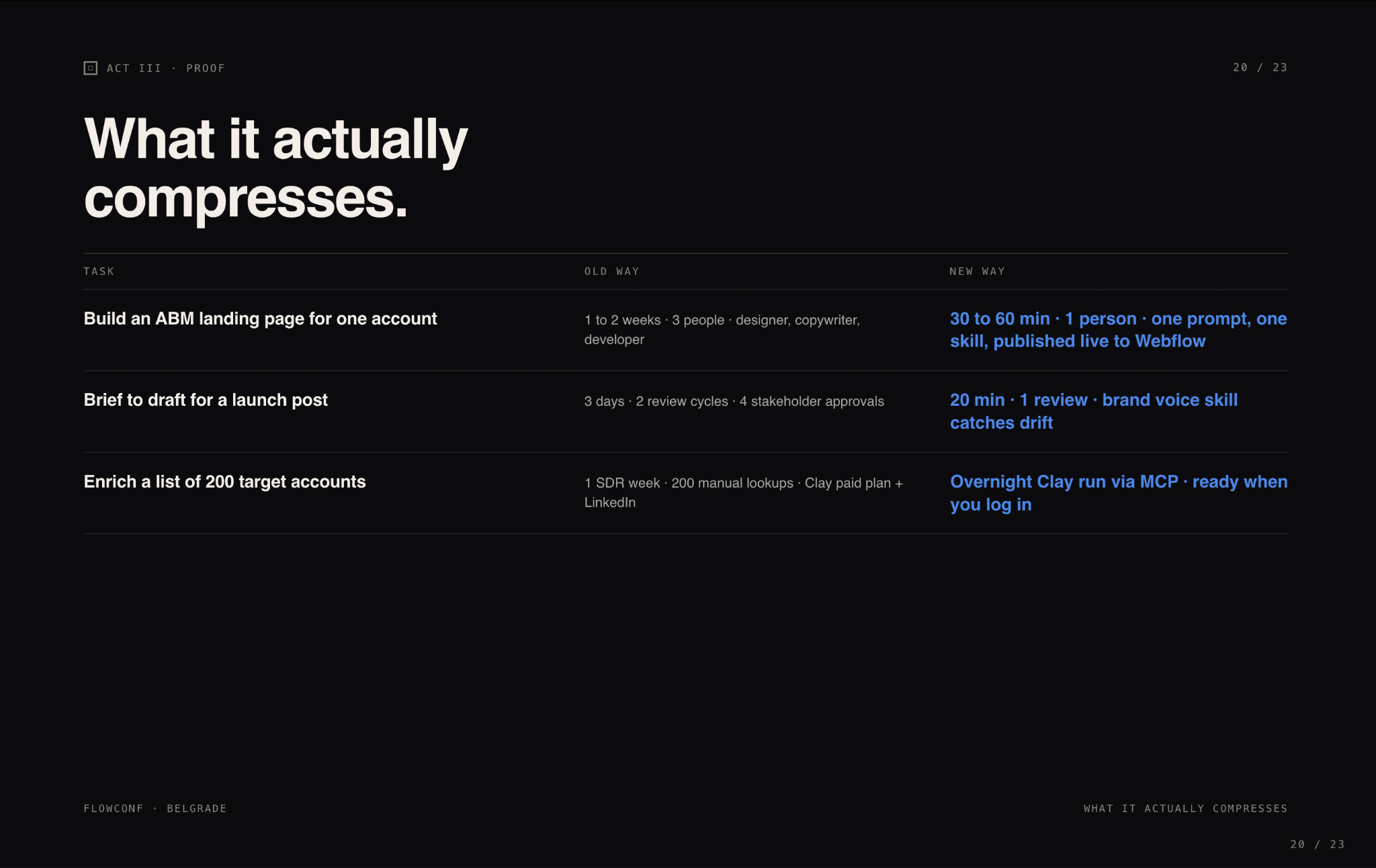
Bhanu also walked us through the Klipboard Content Engine, built on Claude Code. Five parts. Built in a weekend.
- Ingest. 62 PDFs in the knowledgebase. Brand rules, personas, product specs, win-loss notes.
- Retrieve. RAG, semantic search, citations attached. No hallucinated facts.
- Generate. Multi-agent generation. Research, write, brand-check.
- Gate. Human in the loop. Marketer reviews in Slack. Full audit trail.
- Publish. Webflow, email, Slack. Same prompt, different destination, brand voice intact.
Bhanu's three-line close, which I have already typed into a Slack reaction more than once:
"The 2027 marketing stack isn't a stack. It's a terminal and the things you built inside it. The platform stays. The clicks go away. Your next marketing hire isn't a person. It's a protocol."
He also gave the room a free ten-skill Claude Code kit. If you were not there, you can still grab it at bhanuchawla.com/flowconf.
For a deeper read on how Claude and Webflow work together, we have written about it here.
Sïmon Saneback: from browsing to delegating
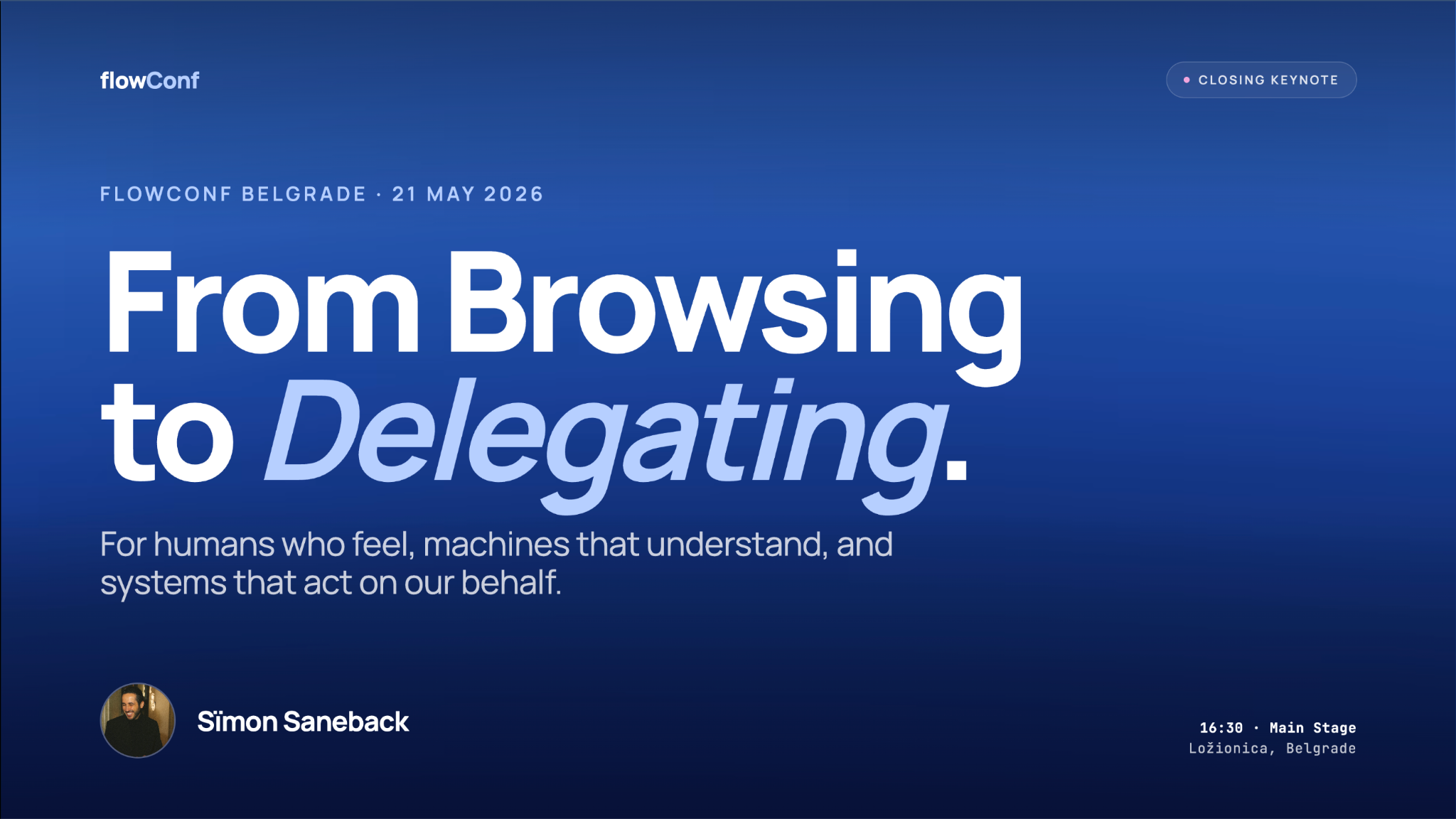
Sïmon Saneback, a tech entrepreneur, investor, and doctoral researcher focused on emerging technologies, closed the Main Stage with the wide-angle bookend to Uros's opening.
He opened with a question that hung in the room:
"When did you last actually browse the web?"
His point: the web was built for humans to browse, and that assumption is being challenged. We have moved from browse (1995-2010) to search (2010-2024) to delegate (2025+). Five years from now, the browser is no longer the default front door.
The brief is expanding. Old brief: "Make us a website people want to visit." New brief: "Make us a presence humans trust and agents can understand."
Three numbers from the last twelve months:
- Human traffic grew 3.1% in 2025. Automated traffic grew 23.5%. AI-driven traffic alone grew 187% between January and December.
- OpenAI's bot crawls 1,091 pages for every visitor it sends back. Anthropic's ClaudeBot, 38,000 to 1. Google's baseline is 15:1.
- 65% of Google searches now end without a click. When an AI Overview appears, zero-click jumps to 83%, and the #1 result loses 58% of its clicks.
The middle layer goes first. Aggregators, comparison sites, content farms, SEO portals. HubSpot lost 75% of organic traffic between November 2024 and Q2 2025. The average publisher, 33%.
Then the reframe that defined the talk:
"AEO gets you cited. Callable interfaces get you called."
The old agent visit: load your page, screenshot the DOM, guess which field is "departure city," fail quietly. Where it is going: read your tool manifest, call book_flight(origin, destination, date, passengers), get a structured response, done in milliseconds.
The web is not ready. Cloudflare's 2026 audit of the top 100 sites found an average score of 55 out of 100. Zero A grades. 65% still have no llms.txt file.
The conceptual move that landed hardest:
"You now serve two audiences. Humans need beauty. Agents need clarity. The two are not in conflict."
Humans need emotion, trust, hover states, photography. Agents need clean HTML, schema markup, llms.txt, callable actions. Design is also what systems can understand.
And the answer to the elephant in the room. If agents do everything, what is the point of beautiful design?
"The airline still flies the plane. The restaurant still cooks the food. The real thing survives. What compresses is the interface between you and the real thing, and that's where we live."
The shape of the modern visit. Agents pre-qualify (eleven sites visited, three shortlisted). Humans decide (one of three arrives, already filtered in, ready to act). The moment a human sees your site is more consequential than before, not less.
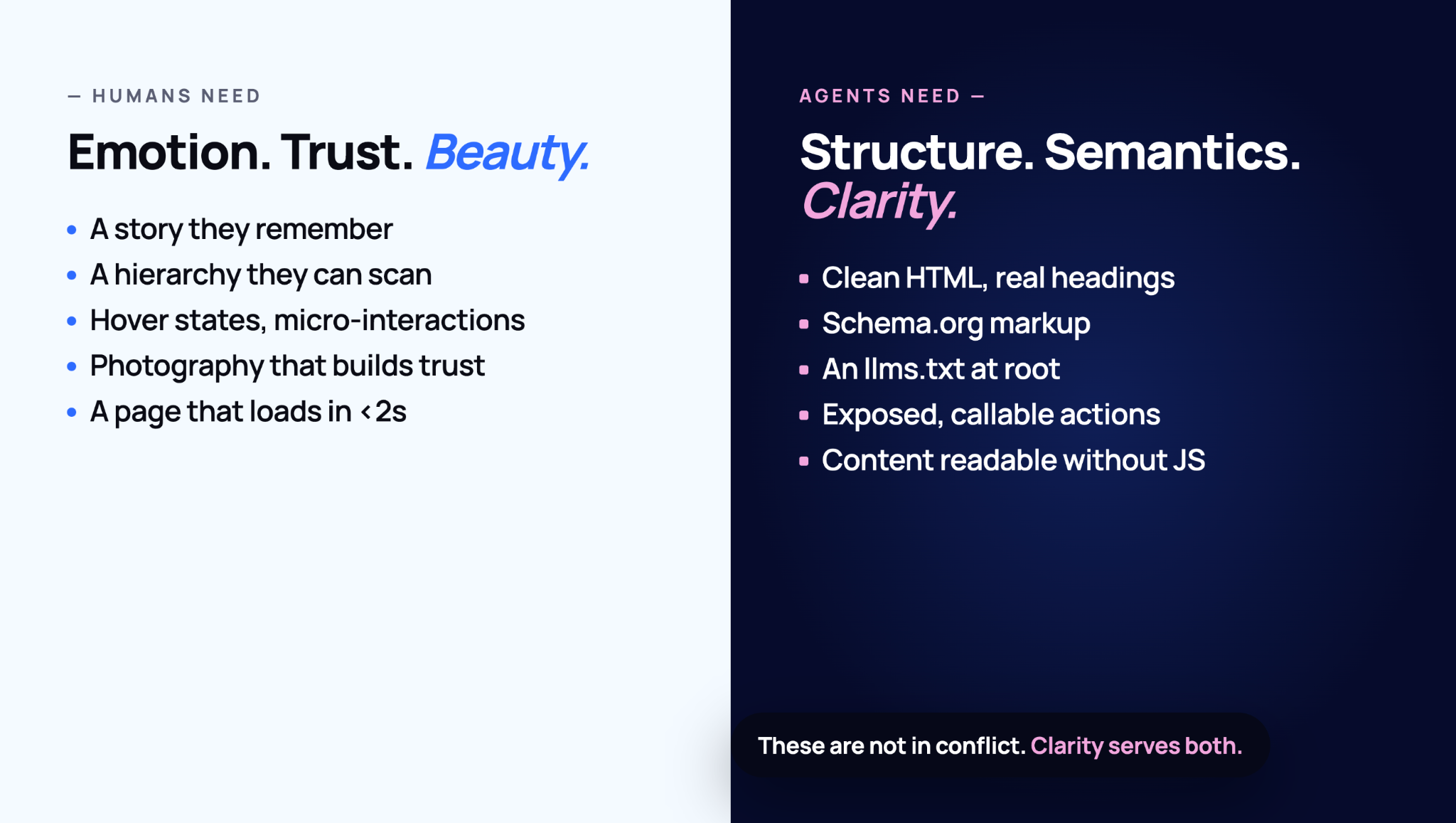
He closed with three Monday-morning moves:
- Make your site explain itself. Add an llms.txt, fix titles and schema, write clear answer blocks, render without heavy JS.
- Expose one useful action. Booking, lookup, quote request, order status. An agent should not have to guess what your site can do.
- Change the client brief. Add four questions to your next discovery call: Who needs to understand this site? What should an agent be able to summarise? What should it be allowed to do? What must require human confirmation first?
His closing slide tied the whole day together:
"Build it for humans. Make it readable by machines. The craft is knowing the difference."
Where Uros opened asking what stays human, Sïmon closed by showing what changes around the human. Pages become systems. Visitors become agents. Marketing becomes about being selected, not just being found. Exactly what a closing keynote should do.
Webflow Room: the technical sessions
The Webflow Room was the second stage, smaller, deeper, more practitioner-focused. Longer Q&As. More live code. More of the conversations you cannot have in a 20-minute Main Stage slot.
Aleksa Mladenovic and Filip Nicic: advanced Webflow, when no-code isn't enough
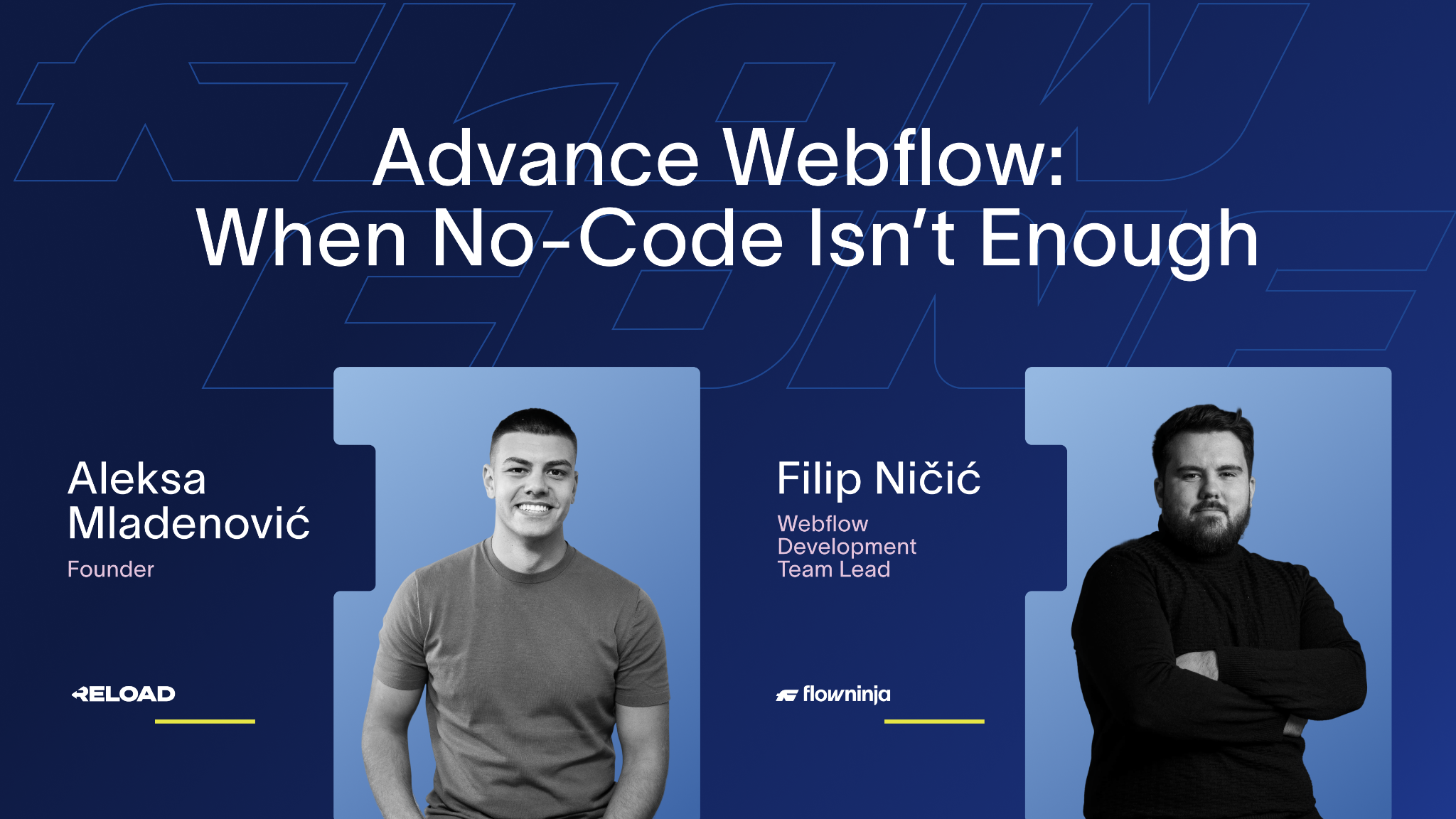
Aleksa Mladenovic, founder of Reload Agency with 8+ years building on Webflow, sat down with Filip Nicic, Webflow Development Team Lead at Flow Ninja, for a deep technical session that walked the room through real client work.
Their core argument:
"No-code is not the opposite of code."
The question is not whether to code, but how. What is the lightest extension that solves the problem without breaking editor usability? Clients hate to see their site become unmaintainable. The skill is knowing what stays no-code, what gets custom code, and what should leave Webflow entirely.
They walked through four real examples that pushed builds past default Webflow:
- A gradient-border button with a transparent background and animated hover state. Simple looking on paper. Needs careful CSS and a hover trick that does not collapse the editor. Their advice: don't be afraid to ask your client if the effect is actually worth it.
- A multistep form with validation and API connection. The point where Webflow's native form handling stops, and you start orchestrating client-side state and external endpoints.
- A location picker tied to Google Maps and Mapbox APIs. Latitude and longitude to address conversion. The kind of feature where the API contract drives the whole UX. Their warning: sometimes you have to pay for your mistakes here.
- A directory build with 20,000+ items, 40,000+ filters, custom filter logic, geolocation, sorting, analytics, and live sync with production data. This was the slide that made the room quiet. Webflow as the interface, custom code as the engine underneath.
Their closing frame is the line I keep coming back to:
"In serious Webflow work, no-code is the interface. Code is the extension layer. And you shouldn't be afraid of it. The real skill is knowing where one should end and the other should begin."
The Q&A pushed the session past its time slot, which is the best signal you can get from a technical talk.
Vladimir Vujakovic: web design with a product mindset
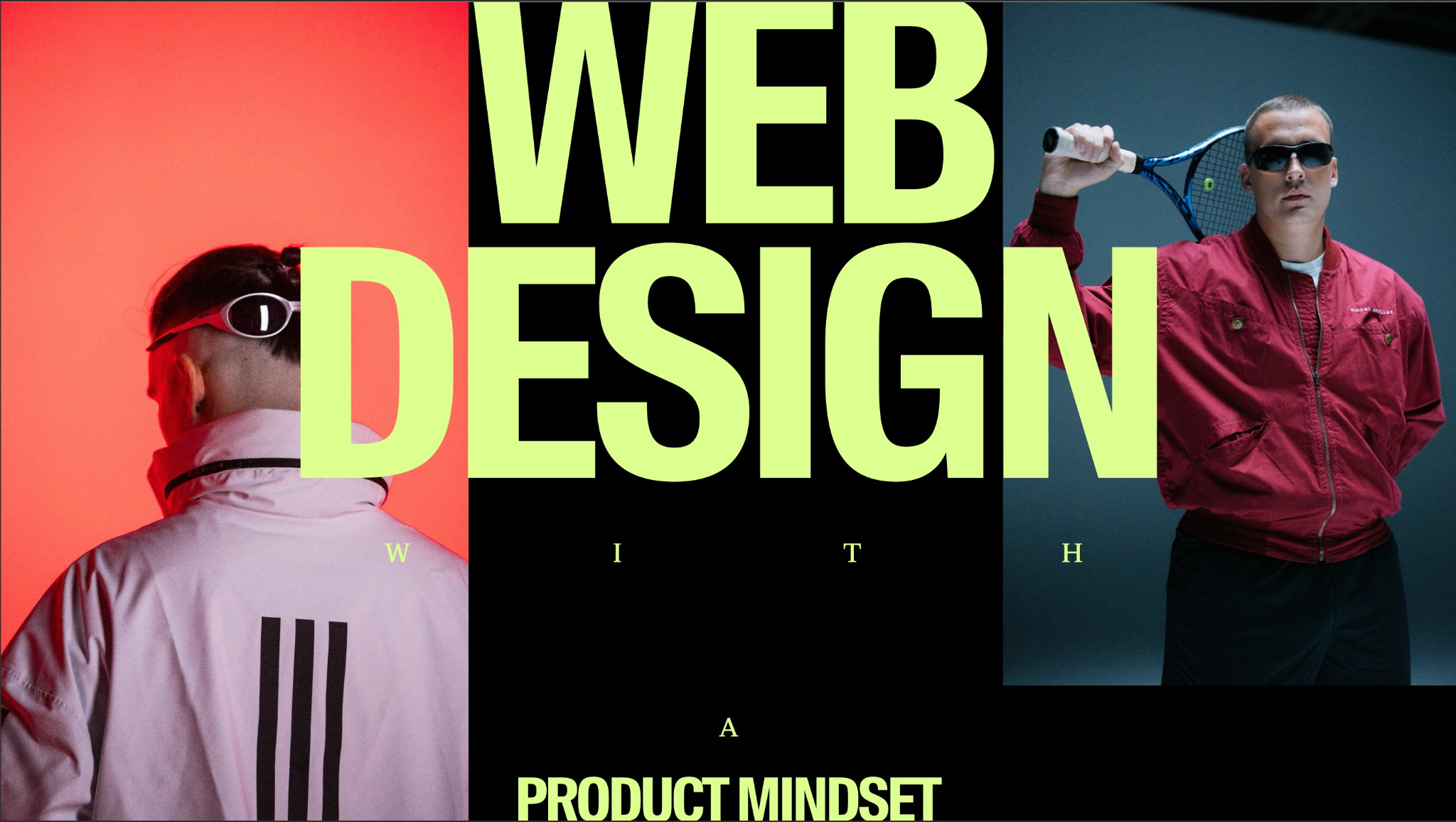
Vladimir Vujakovic, founder of Studio Direction, gave the talk I want every web design lead at a growing company to watch.
Vladimir opened with a confession. Until a few days before flowConf, his talk was going to look completely different. He had planned to walk the room through a familiar set of shifts: from pages to journeys, from launches to iterations, from opinions to evidence, from conversions to outcomes.
Then both of his products, Podyx and Propellyst, got copied by AI. Not the rough idea. Everything. Feature set, interface, even colours and typography. The only thing AI could not copy was the website. The thing that carried the brand, the point of view, and the trust.
That detour set up the line that anchored the rest of the talk:
"Brand is the moat. The website is the highest leverage surface one company owns."
But here is the new reality, and Vladimir put a number on it. Features are shipped in a day. Products in a week. If the website is the moat, and the moat now has to ship at the same speed as the product, the old way of running web projects falls apart.
He showed the old way as a familiar product workflow: Idea, Hypothesis, Discovery, Validate, Epics, Stories, Design, Development, Testing, Production, Metrics. Linear. Slow. Built for a world where shipping took quarters, not days.
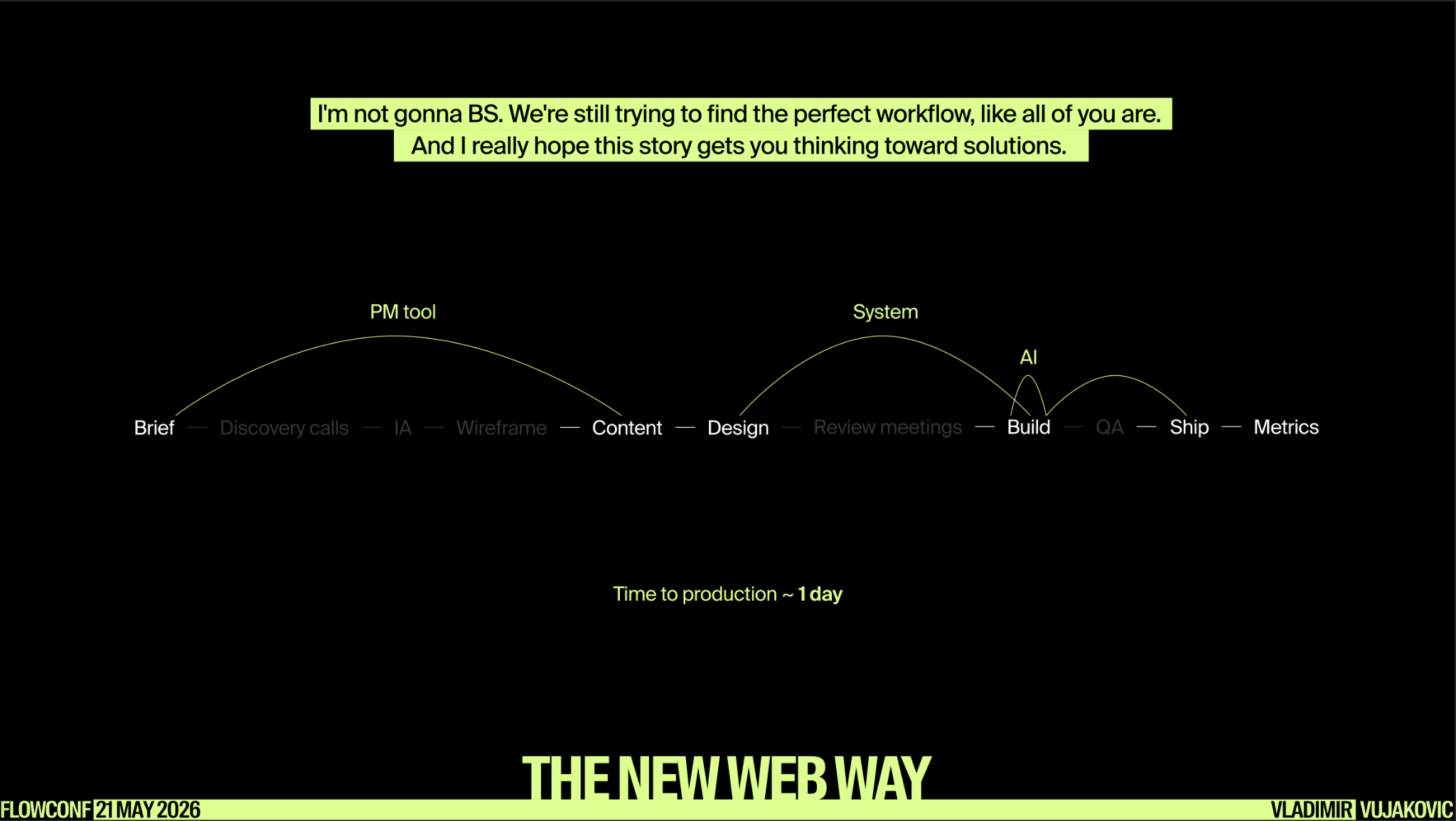
The new way, the one Studio Direction is iterating toward, compresses the same loop using AI and a robust design system at the centre. Time to production: roughly one day.
He walked the room through what that actually looks like for a web project:
- Brief
- Discovery calls and PM tool
- AI wireframes
- Content + design pulled from a system
- Build
- Ship
- Metrics
Vladimir was refreshingly honest about it:
"I'm not gonna BS. We're still trying to find the perfect workflow, like all of you are."
But his takeaway list was concrete enough that the room wrote it down:
- Audit your current cycle. Find the steps that no longer earn their place.
- Build the infrastructure that lets you ship that fast. Design systems, AI tooling, content pipelines.
- Pick a metric. Watch it move. A product mindset on the web only works if you are measuring what matters.
Studio Direction ships 20+ websites a year across SaaS, real estate, crypto and Web3, fintech, and others. The shift Vladimir is describing is not theoretical for his team.
His closing line is the one I keep coming back to:
"Website is what, product mindset is how. Earn the cadence."
His session also reads differently once you know what Uros announced the same day. Studio Direction joined New Web Group as a 20% partner. Vladimir's design-systems-and-AI argument is the operating thesis under that announcement, just from another angle.
Tadija Markovic: $10k, $30k, $100k. Same website. Different conversation.
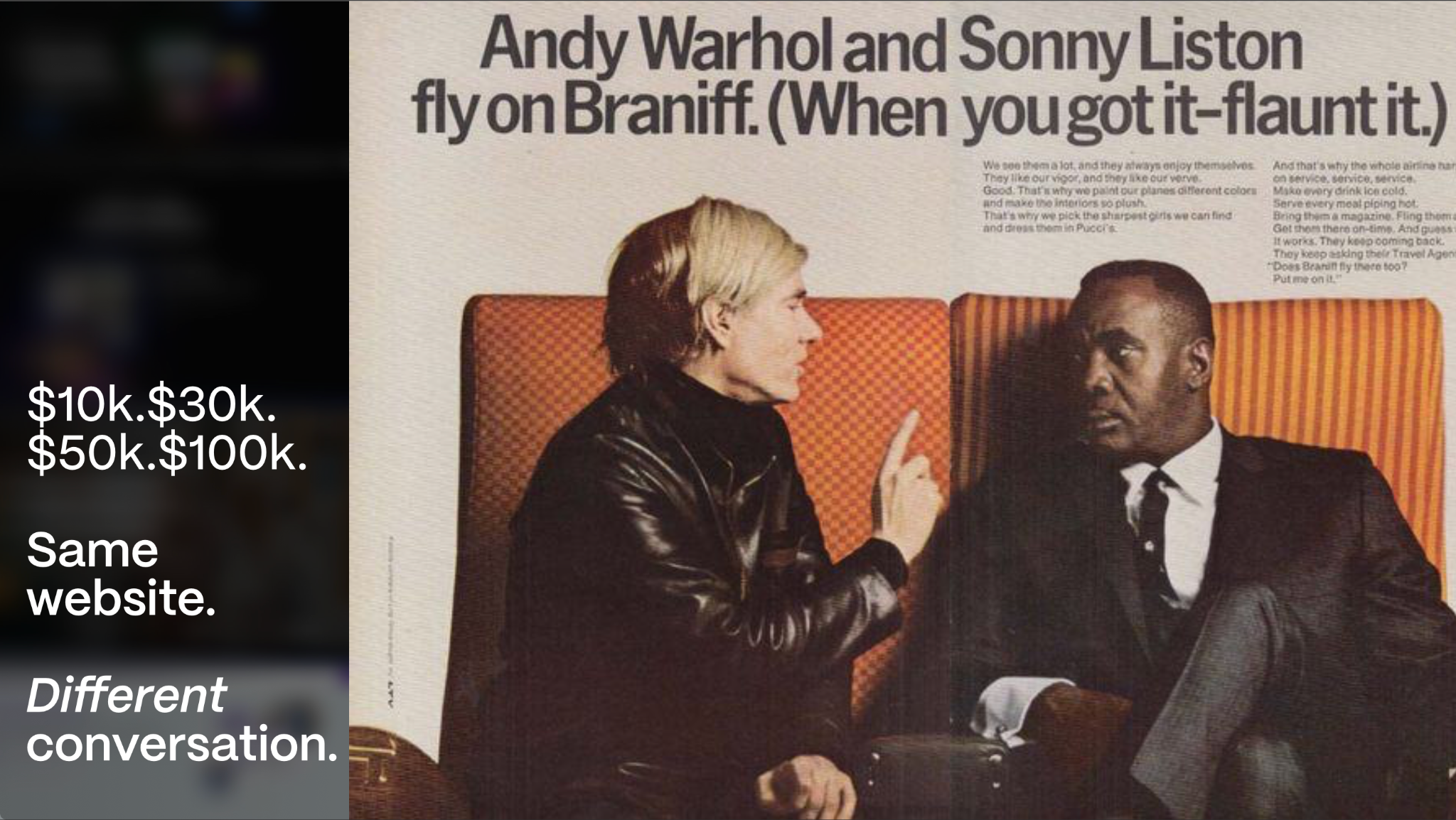
Tadija Markovic, Account Executive at Flow Ninja, gave the talk every founder selling agency services should watch on repeat.
His central argument: the gap between what a freelancer charges and what an agency charges for the same Webflow build is rarely about the quality of the work. It is about the process around it. The talk walked the room through three price brackets, and what changes in the conversation at each.
His opening frame, in three lines:
- Qualify early.
- Actually, disqualify early.
- Company fit. Use case. Vibes. "If something feels off in 30 minutes, it'll feel worse in 6 months."
That last line is the one that landed hardest with the agency founders in the room. The instinct is to chase every brief that lands in the inbox. Tadija's argument is the opposite. Discipline at the top of the funnel pays off harder than any pitch optimisation downstream.
The $10k to $30k conversation:
- Your only job on call one is BANT (budget, authority, need, timing). Nothing else.
- Have a well-established sales process. Do not improvise.
- Don't talk about the website. Talk about the business.
- You can object. Tadija's example: "Budget of $12K. Average deal size $1M. If the website closes one new client, is it worth it?"
- And the line he used to push back on cosmetic redesign briefs: "I don't think the logo is your biggest problem."
The $50k to $100k conversation:
- Learn the business. Make your champion the hero.
- The cheapest option sets the floor, not the ceiling.
- Senior buyers are testing your confidence, not your pitch.
- The champion can't approve this alone. Plan for that.
- Don't pitch faster. Mirror. Raise the bar they set.
Then the part of the talk I think every sales team should rewatch. "We all lose, so be yourself." The framework will not save you from yourself. The question Tadija asks before every meaningful conversation:
"How can I lose this?"
His advice in that mode: don't be plain. Your prospect is talking to six agencies. Be the one they remember. His example of how to do that without overplaying it:
"I'd like to get something scheduled, but I'm not going to force anything by the end of this week."
He also gave the room a list of things he actually said to prospects that should not have worked. In his words, "please do laugh."
- "I thought if you're in Europe, I'll just get on a plane and meet you wherever."
- "I've already done my sales homework and know everything about every single one of you."
- "I'm going to get your WhatsApp. I have the CEO's number. I'm going to start texting you, start calling you, because I want this to be very successful."
- "I'm going to be a little bit psychoish and work on everything on my end."
The pattern Tadija was pointing to: none of those lines are in a framework. None were calculated. They worked because the person on the other end could feel he was genuinely in it with them. Not performing. Just there.
The $100k+ conversation:
- The first project is the introduction. The relationship is the real deal.
That is the whole framing. At this level, you are not selling a build. You are signing up for a multi-year working relationship. The first project just earns you the right to that.
Tadija's closing line is one of those one-liners that sticks:
"We close because we're there."
Show up. Stay credible. Don't be plain. Your prospect is talking to six agencies. Be the one they remember.
Mihajlo Ivanovic, Ognjen Grujic, Stefan Ivic: is SEO becoming obsolete?
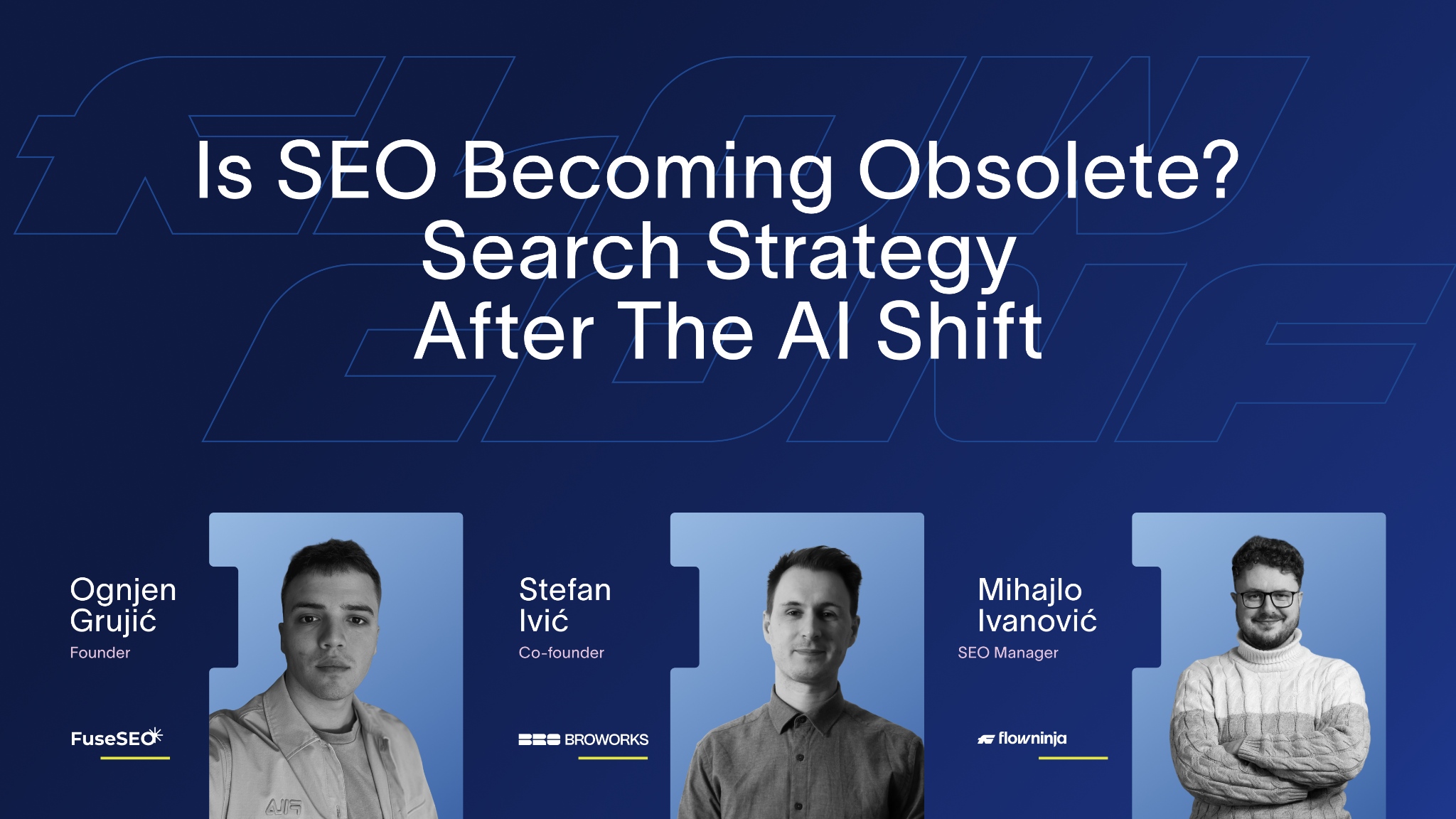
This was the session I was on stage for, and the one closest to my day job.
I joined Ognjen Grujic, founder of FuseSEO, and Stefan Ivic, founder and CEO of Broworks, for a panel on what AI search is actually doing to organic strategy.
We worked through four questions.
1. Is SEO actually dying, or are we just mislabeling what's happening?
Where we landed: most of SEO still stands. The fundamentals (content quality, technical health, authority signals) are still doing the work they always did. AEO is a layer on top of that, not a replacement. The layer is moving fast. The base is not.
2. Is traffic becoming a vanity metric in the age of AI search?
Where we landed: traffic still matters, but it is no longer the only thing that matters. You also need to measure citations, position in LLM responses, sentiment, and share of voice. A search strategy that only measures clicks is going to miss the value AEO is creating, especially since AI traffic converts a lot better. Guy's data earlier in the day (6x better conversion on his side) is the reason we kept coming back to this.
3. What are most companies still doing wrong right now?
Where we landed: three patterns. Chasing buzzwords. Skipping fundamentals that still matter. Underweighting authority. The authority point matters more than ever. Bhanu's stat that 68% of AI citations come from third-party sources is the line that sums it up. Brand mentions have exploded in importance since the age of AI, and many teams are still treating mentions as a vanity layer instead of a ranking layer.
4. If you had to rebuild your search strategy from scratch today, what would you do differently?
Three answers, one each.
- Ognjen would focus on jobs-to-be-done, bottom-of-the-funnel queries. The kind of searches a buyer makes right before they decide. High intent. Less noise. Better conversion.
- Stefan would focus on off-page and PR. Authority, mentions, brand presence in the places LLMs actually trust.
- I would invest more into brand strategy. Brand has become inseparable from search. LLMs reward consensus and popularity. If your brand has no point of view, you have no AEO strategy.
If you missed Guy's line earlier in the day, "Brand is back, because LLMs value consensus and popularity," that is the panel's argument in one sentence.
We have written more about SEO and AEO for SaaS websites if you want a longer read on what this looks like in practice.
Andrija Djuric: build smart, validating an AI tool with ChatGPT and Webflow
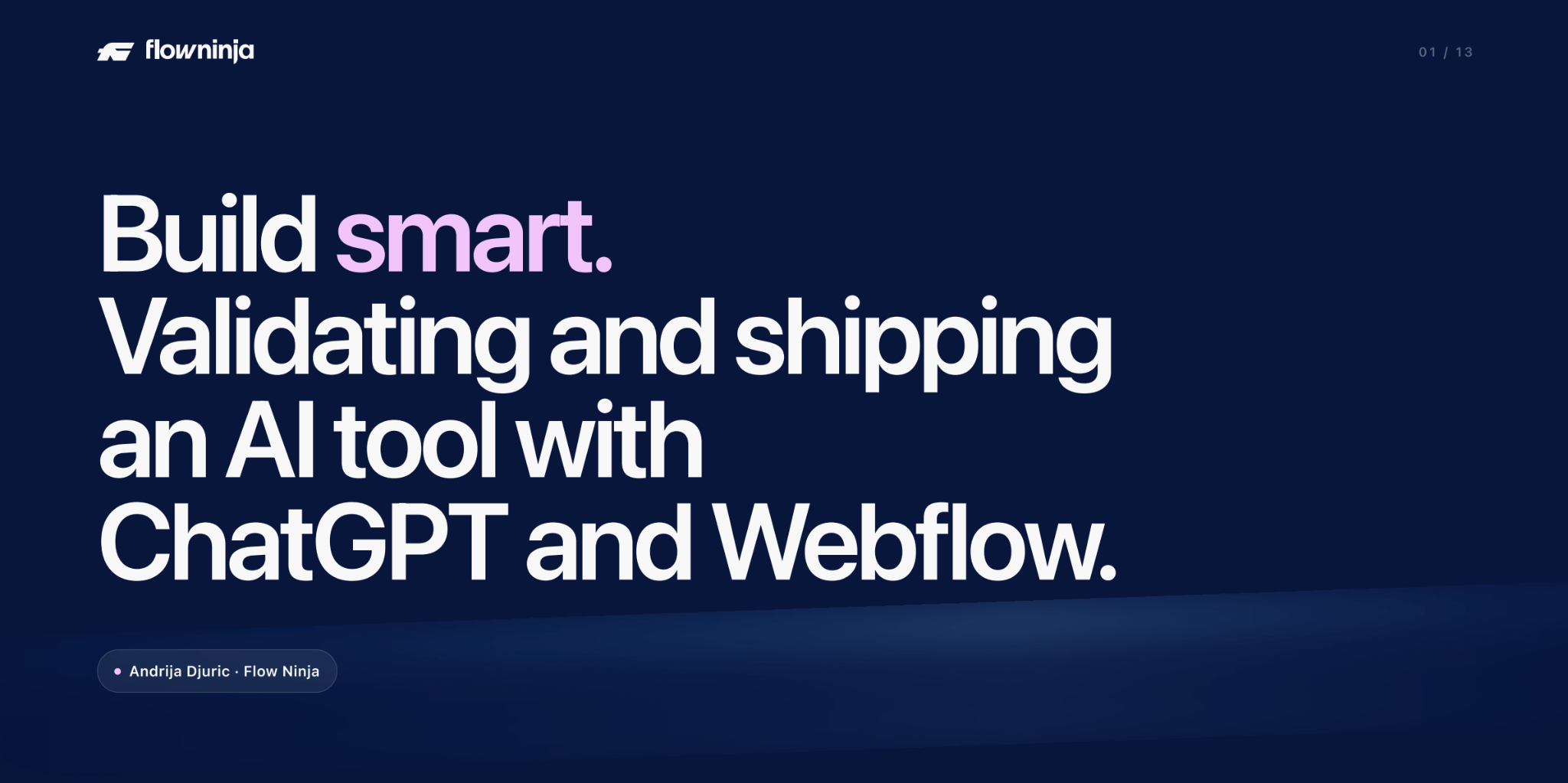
Andrija Djuric, Webflow Development Team Lead at Flow Ninja, walked the room through how we actually built Foresight, and how we went from agency services to shipping a product.
His opening line:
"While you're thinking about your idea, someone else is already charging for it."
He framed the problem we had set out to solve. Agency knowledge lives in too many places. SEO playbooks in one person's head. Site structure rules in another's. Content guidelines buried in Slack. Analytics in someone's Drive. The move was to consolidate it all into one tool and give it back to the community.
Foresight in one minute: an AI audit across 10 categories (SEO, content, structure, performance, accessibility, and the rest), a score per category so you know exactly where you are strong and where you are not, an overall health score, and prioritised recommendations. Not a 40-page report. What to fix first, second, third.
The framework he walked through was two phases, one goal: ship fast.
Phase 1: Validate. Two weeks. No UI. No database. One form.
- Step 1: URL + email form. Two fields. That was the entire interface.
- Step 2: ChatGPT API + a basic scraper running server-side.
- Step 3: 15 minute wait. No realtime UI. People just walked away.
- Step 4: PDF delivered to inbox.
We pushed it through the channels we already controlled. Site CTA. Marketing campaigns. Social. Newsletter. Zero net-new audience work.
The numbers that proved the demand:
- 300 reports in the first two weeks. No paid acquisition.
- 50 failed on first run. We manually re-ran every one and emailed them back.
- 1,500 reports two months in. Still no UI. Still no database. Still ugly.
Andrija's framing of why this worked:
"We didn't ask people if they'd use it. We watched them use it."
Phase 2: Scale. Real UX, real stack, real data. The PDF gave us validation, but it told us nothing about behaviour. Which sections did people read? Where did they get stuck? What did they come back for? No idea. That is why Phase 2 had to be a web app.
The tech stack: Webflow Cloud and Next.js on the front end, Railway for hosting, MongoDB for the database, OpenAI API for the audit. The loading experience became its own design problem. 15 minutes cannot feel like dead air.
Today: 50 clients using it. ~300 monthly users, growing month over month, still organic. Free, because it is our sales starter. Total investment end to end: 6-8 weeks and $3k.
He closed with five steps anyone can apply tomorrow:
- Spot the pattern. Find a repetitive task you already do manually.
- Reframe. Ask how AI could do it for you.
- Constrain time. Ship something ugly in two weeks.
- Watch behaviour. Do not ask. Measure who is using it.
- Earn the right. Only then invest in UI, scale, and monetisation.
His closing line:
"Your next idea, try to ship it in two weeks. Even if it's ugly."
If you have not tried Foresight yet, it is free and takes about three minutes. The full origin story is also in our launch post.
Ilja van Eck: the taste layer
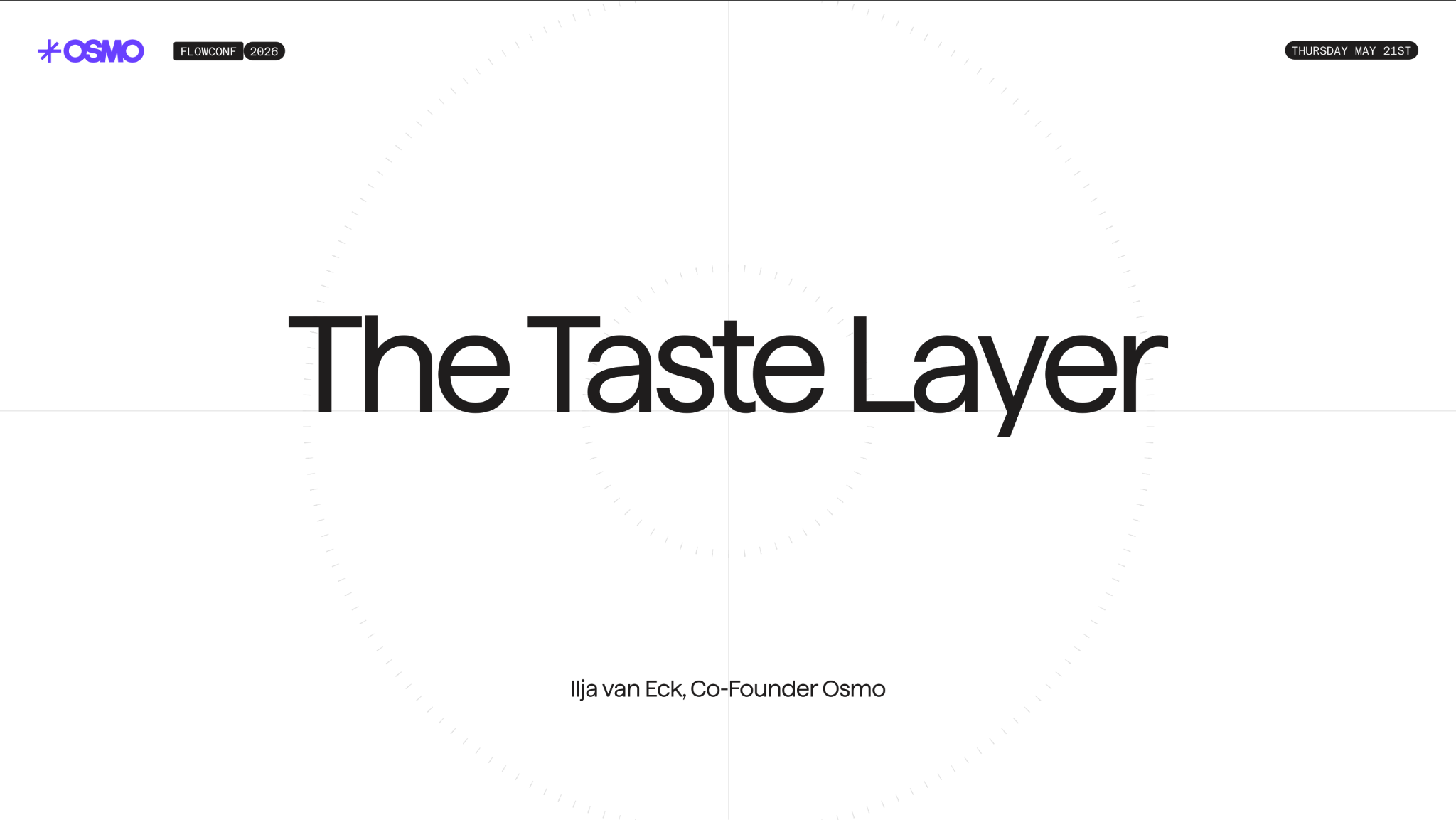
Ilja van Eck, co-founder of Osmo Supply, gave what I think was the most quietly important talk of the day.
He opened with a small story. The team at Osmo had been working on a custom easing curve, the kind of small motion detail nobody asks for and most people never notice. Smooth Curve. Wiggle. Elastic Bounce. Cubic In-Out. Then Osmo Ease: a curve they could not quite explain why they preferred, but they did. He asked Claude to articulate it. The model could not.
That was the gap he had come to talk about.
His structural beat: every time tools got better, scarcity moved upstream.
"Knowing how. Then knowing where. Then knowing what. Then knowing how to assemble. Now: knowing whether."
He quoted Wensen Wu:
"Every drop in the cost of execution is a corresponding increase in the demand for taste."
And the line that made the room laugh and nod at the same time, from Paul Graham:
"If taste is just personal preference, then everyone's is already perfect."
The point: taste is not the same as preference. It is the ability to decide whether the work was right. Ilja called the alternative the fog of execution. When you can ship anything at any speed, the fog gets thicker, not thinner. Jevons paradox kicks in. The cheaper execution gets, the more of it people demand. Constraints used to mask the latent demand for craft. Now they do not.
He mapped the work into three layers:
- Execution. Building the thing.
- Assembly. Composing what was built.
- Taste. Deciding whether what was assembled is any good.
Tools are taking over Execution and Assembly. The Taste Layer is yours. It always was.
Then Ilja pushed the room a little further. Taste is not just one big judgment at the end. It is a sequence of small decisions, made constantly, about every component, section, line of copy, animation, and so on. The question behind each one:
"Does this belong here?"
He warned the room about a failure mode that has multiplied since AI tools went mainstream. Models like to give the average answer to the average version of a problem. Then they soften it with phrases like "You're absolutely right..." that read as confidence and are actually the opposite. Leverage just changes how fast you arrive at the moment where you have to decide whether what you're making is any good.
His framework for getting through that moment was three questions, taught not as a checklist but as a discipline:
- What's this for?
- What can I cut?
- What's mine in this?
Ilja closed by pushing back on the two loudest voices in the AI conversation. The fear mongers who think this is the end. The loud optimists who think every problem is now solved. He argued neither is right.
"Tools are taking over execution and assembly. The taste layer is yours. It always was."
The other headline: New Web Group launches
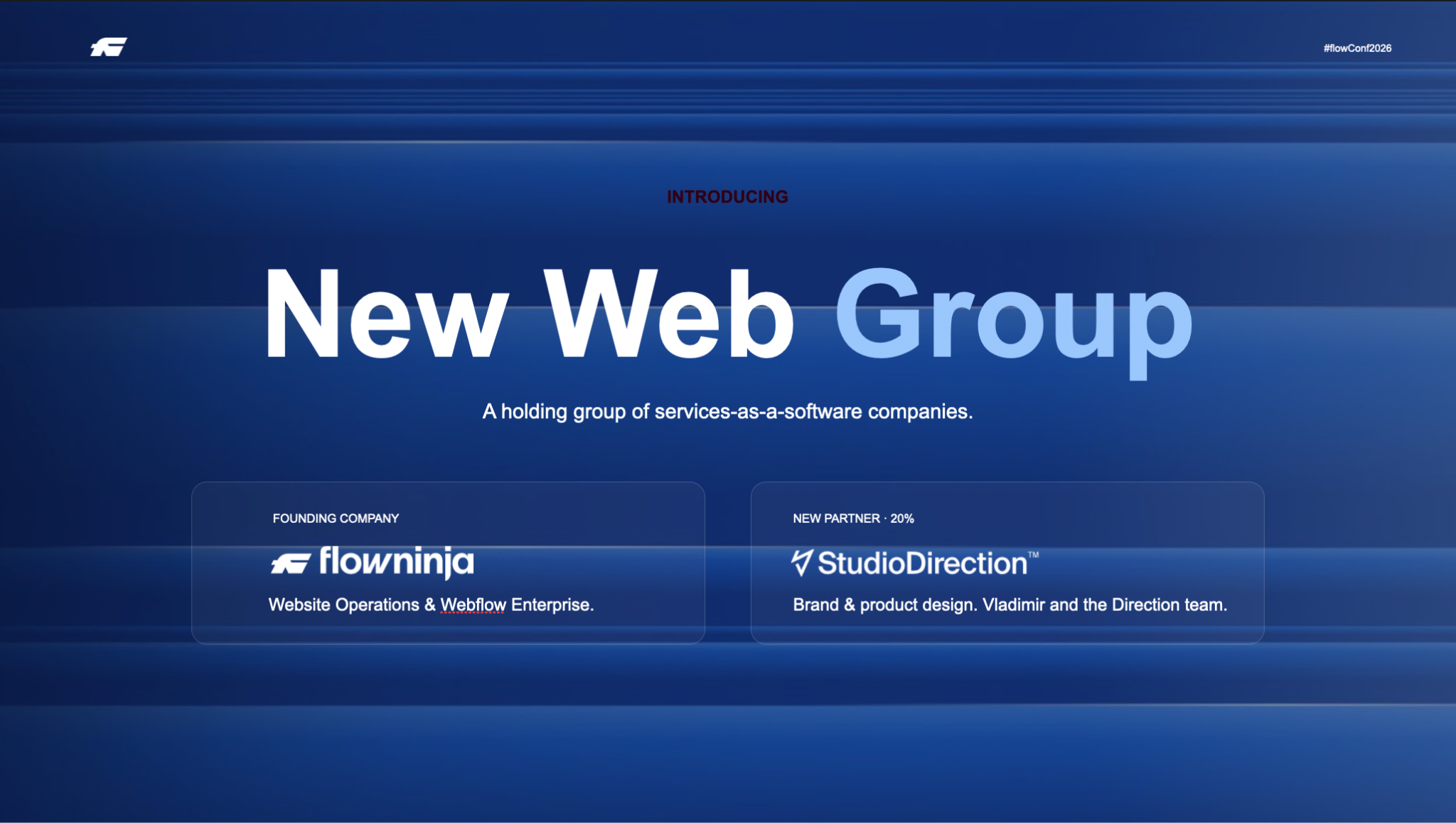
At the end of his opening keynote, Uros made the announcement nobody in the room saw coming.
New Web Group is a holding group of services-as-a-software companies. At launch, it is two:
- Flow Ninja. Focused on website operations and Webflow Enterprise. Founding company.
- Studio Direction. Founded by Vladimir Vujakovic, focused on brand and product design. New partner, 20%.
There will be more, in time.
Uros's thesis, on stage:
"Pure code is becoming a commodity. Taste, brand, and craft are not. That's why New Web Group exists. Not to get bigger, but to be better at the one thing that can't be automated: caring about how something feels."
When execution becomes a commodity, the only durable advantage is the layer above execution. Taste. Brand. Craft. Judgment. The work that does not get cheaper just because the tools did.
We will share more about how the group operates over the next few months. For now, the announcement speaks for itself.
What I'll remember
A few honest reflections from the back of the room.
The energy in the lunch line was the part I did not expect. 400+ people, most of them strangers an hour earlier, holding plates and arguing about MCP configs. That is the version of the web I want to live in.
The second thing I will remember is the people who made it possible. Uros and the Flow Ninja team for putting it together. Ran Segall for hosting the Main Stage with the kind of warmth you cannot fake. Every speaker for showing up generous with their actual playbook instead of pitching a product.
The third thing I will remember is the four threads tying it all together. AEO is the new SEO, but it is not SEO. Agents are eating the dashboard. Taste is the moat. Webflow is the platform. I keep coming back to those four sentences. They are how I am explaining this year to clients who could not be there.
And the last thing. Uros opened the day with the kolo, the chain that grows when people choose to be part of it. By the time the afterparty ended, that chain had grown by a few hundred. The web has always worked that way. We just got reminded.
Thank you, and see you next year
To everyone who flew in, drove in, gave a talk, asked a question, stayed late, or shared a coffee in the hallway, thank you. The whole point of putting flowConf together is the room. You were the room.
We are already thinking about flowConf 2027. Same kolo. New questions. We hope to see you there.

Mihajlo Ivanovic
SEO and Content Manager at Flow Ninja, writing on technical SEO for Webflow, programmatic SEO, and how to earn citations in AI search.


See your website the way a senior strategist does
Foresight scans your site across 10 strategy dimensions. You get a scored breakdown of every gap costing you leads.
Continue reading





Ready to escape your CMS nightmare
100+ successful migrations. 0 ranking disasters at launch. One embedded team that's done this before.