Best AI visibility tools: Profound, Searchable and 7 others compared
The best AI visibility tools for B2B teams are Profound, which we use to track our own site and our clients' sites, Searchable and Peec AI for published prices, Otterly.AI from $29 a month, and the Semrush and Ahrefs add-ons for existing users. The prompt set decides whether any score means something: many clients we report on for the first time rank first in AI answers, then fall to around 50th once branded prompts come out.
Key takeaways
- Referral clicks undercount AI search, since 51% of B2B software buyers in G2's 2026 report start research with an AI chatbot more often than with Google.
- Divide plan price by included prompts before you compare: Searchable Pro works out to $1.25 a prompt per model month to month, the Semrush toolkit about $3.96.
- Ask every vendor how it runs a prompt, from where and how often, because every tool scrapes answers from the outside and two tools can disagree on the same day.
- Give leadership non-branded share of voice against named competitors, month over month, and keep branded prompts on their own line.
- Before reporting a jump in AI visibility, check for model updates, since SparkToro found in January 2026 that assistants repeat the same brand list under 1 in 100 times.
- Build prompts from a matrix of industry, use case and service with real search volume, and give every tracked prompt a page that can answer it.
- Use Search Console's AI Overviews and AI Mode impressions and Bing's Copilot citations for your own site, then pay a tool for prompts and competitors.
- Add a “how did you hear about us” field to your forms, because buyers who research in ChatGPT often land in direct or branded search.
Updated November 2026. Prices checked on vendor pages November 15 and 16, 2026.
What AI visibility tools measure
AI visibility tools measure how often AI assistants such as ChatGPT, Gemini, Perplexity and Google's AI Overviews mention, cite and recommend your brand for the prompts your buyers type. They work from the outside: the tool runs a fixed set of prompts on a schedule, saves every answer and counts who shows up and which sources get linked.
Buyers on our sales calls often start with the same guess: “So basically, it's how the website is indexed by the LLM search, right?” Those are two separate checks. Indexing is whether an AI crawler can read your pages. Visibility is whether the answer names you once it has. The tools on this list track visibility, and the better ones also show crawling through CDN and analytics data.
Mentions, citations and share of voice
Every tool here reports some version of five numbers:
- Mention rate is the share of answers to your prompts that name your brand.
- Citations are the URLs an answer links as sources, yours and your competitors'.
- Share of voice is your mentions measured against competitors' across the same prompt set.
- Position is where your brand sits in the answer, from first recommendation to a passing mention.
- Sentiment is whether the answer describes you the way you'd want a buyer to hear it.
Citations get less attention than they deserve. Your brand is mentioned on other sites, and when an assistant cites those sites, you gain visibility without a page of your own. A useful tool shows both sides: how your website performs and how your brand performs against other brands for the commercial prompts that matter.
Hidden AI traffic in analytics
Most teams we talk to measure AI search by the referral clicks Google Analytics shows from ChatGPT and similar sources. That number undercounts. Buyers research a shortlist in ChatGPT or Gemini, then type your URL into the browser or search your name on Google. The visit lands in direct or branded search, and the research that produced it never shows up as AI.

Google blurs it further. Its documentation on AI features in Search says AI Overviews and AI Mode traffic is counted in the overall Performance report under the “Web” search type. Clicks also fall when an AI summary appears: in Pew Research's July 2025 study, users clicked a traditional result in 8% of visits where an AI summary showed up.
Buyers have already moved. In G2's 2026 AI search report, 51% of B2B software buyers said they start research with an AI chatbot more often than with Google. A report that stops at referral clicks measures the smallest part of that behavior.
That's why, when we run AI search work as a B2B SEO and AEO partner that tracks AI visibility, citations and share of voice sit in the same report as organic pipeline.
Engine coverage and run frequency
The engines worth covering for a B2B buyer are ChatGPT, Google AI Overviews, Google AI Mode, Gemini, Perplexity, Claude and Microsoft Copilot. ChatGPT alone has more than 900 million weekly active users, according to OpenAI as reported by Search Engine Land in February 2026. Entry plans usually cover three or four engines, so start with the ones your buyers use and add from there.
How often a tool runs your prompts matters as much as which engines it checks. Profound Enterprise, custom prompts in Ahrefs Brand Radar and Semrush's Prompt Tracking run daily. Semrush's Brand Performance report updates weekly, and the Ahrefs index is re-tested monthly. Answers change between runs, so every number a tool reports is a rate across many runs. Read it like a poll: the trend tells you more than any single reading.
AI visibility tools compared at a glance
Profound is our pick for B2B teams that need citation-level data across many engines and can live with custom pricing. Searchable and Peec AI suit teams that want a published price, Otterly.AI is the cheapest place to start, and the Semrush and Ahrefs add-ons make sense if you already pay for either suite.
We use Profound to track our own site and our clients' sites. We chose it on our own research and pay for our own subscription. We aren't a Profound partner, and no vendor paid to be on this list. We checked every price on the vendor's own pages on November 15 and 16, 2026. Where a vendor's pricing page wouldn't open, the entry names the page we used instead.
| Tool | Best for | Engines included | Starting price |
|---|---|---|---|
| Profound | Enterprise B2B teams that want tracking, AI traffic data and agents | Up to 10 on Enterprise, no Copilot | Free Trial, then custom Enterprise |
| Searchable | In-house teams that want tracking, fixes and content in one tool | ChatGPT, AI Overviews, Perplexity; others as add-ons | $125/mo, or $100/mo billed annually; 100 prompts per model |
| Peec AI | Mid-market teams tracking several countries | 3 of your choice on Starter | $95/mo, 50 prompts |
| Otterly.AI | Small teams buying a first tool | 3 or 4 you choose from 7 | $29/mo, 20 prompts on 3 engines |
| Semrush AI Visibility Toolkit | Teams already on Semrush | ChatGPT Search, Gemini, AI Overviews, AI Mode | $99/mo, 25 prompts, no free trial |
| Ahrefs Brand Radar | Category share of voice and Ahrefs users | 6 in the index, plus Claude on custom prompts | $50/mo custom prompts, $699/mo all models |
| Scrunch | Enterprise brands and Sitecore users | ChatGPT, Perplexity, AI Overviews, Copilot | $250/mo, 125 prompts |
| AthenaHQ | Growth-stage B2B SaaS teams that want recommended actions | ChatGPT, Perplexity, Gemini, AI Overviews, Copilot; 5 more on paid plans | Free Essential plan; Starter $295/mo |
| Rankscale | Agencies and enterprise teams that want every engine without per-engine add-ons | 17+ on all plans | $99/mo Pro to $780/mo Enterprise, credit-based |
Plan prices hide very different prompt allowances, so divide each price by the prompts it includes before you compare. On entry plans, Searchable Pro works out to $1.25 a prompt per model on its monthly price, Otterly.AI Lite about $1.45, Peec AI Starter $1.90, Scrunch Core $2 and the Semrush toolkit about $3.96 before extra users. Check how many engines each prompt runs on, too, because that number changes from plan to plan.
How we compared AI visibility tools
We judged every tool on five criteria, in the order we weigh them: a measurement method we can see, the engines tracked and how granular the data is, page-level citation data, sentiment with opportunities drawn from the data, and integrations that show crawler and traffic data.
- A visible method comes first, because there's no Search Console for prompts. Every tool on this list scrapes answers from the outside, so two tools can report different numbers for the same brand on the same day. If a vendor can't tell you how it runs a prompt, from where, how many times and how it turns answers into a score, you can't defend that score to your CEO.
- Engine coverage and granularity decide what you can act on. For a prompt like “what is the best customer support outsourcing service for finance”, the tool should show where your brand sits in the answer, which of your pages are cited and which competitors are cited, for each engine separately.
- Page-level citation data shows, across weeks of daily runs, which pages on your site and on competitors' sites get cited most. It also shows whether your name appears in the most-cited third-party sources, whether those are listicles, directories, YouTube videos or Reddit threads, which tells you where to earn a mention next.
- Sentiment and opportunities matter because a mention that describes you badly can hurt a shortlist. The better tools also read the data back to you and suggest what to fix first.
- Crawler and traffic integrations connect visibility to what happens on your site. Through a CDN such as Cloudflare and through Google Analytics, a tool can show how AI bots crawl each page, whether for search or for training, and flag when something on the site goes wrong.
We use Profound hands-on to track our own site and our clients' sites. We haven't used Searchable, Peec AI or the other six tools hands-on, so we judged them from their documentation, pricing pages and published case studies, all checked in November 2026. That makes this list strongest on method and weakest on day-to-day usability for the tools we don't run ourselves, and we'd rather say so up front.
The 9 best AI visibility tools
We ranked these by fit for a B2B marketing team that has to report one number to leadership every month, and we use the first one ourselves.
Profound
Profound tracks how AI answers mention and cite your brand, measures the traffic AI assistants and agents send to your site through its Agent Analytics product, and runs marketing agents it calls AI Marketer. Agent Analytics connects to Akamai, AWS, Cloudflare, Fastly, Google Analytics, Google Cloud Platform, Netlify, Vercel and WordPress. It's our first choice because it's as complete as these tools get today: we connect Cloudflare and Google Analytics, so crawler visits, AI referrals and citations sit in one view, and the agents help with the SEO and AEO work that follows the measurement.

- Best for enterprise B2B teams that want tracking, AI traffic attribution and content agents in one platform.
- Engines tracked on Enterprise go up to 10: ChatGPT, Perplexity, Google AI Mode, Gemini, DeepSeek, Claude, Google AI Overviews, Exa Search, Muse Spark and Qwen. Microsoft Copilot isn't on the list.
- Pricing is a free Trial or custom Enterprise, per Profound's pricing page. The Trial runs 50 prompts daily for 7 days on ChatGPT, Gemini and AI Overviews. Enterprise adds daily tracking, CSV and JSON exports, an API, SSO and SOC 2. Older comparisons still quote a $99 Starter plan that no longer appears on the pricing page.
- Customer proof comes from Ramp, whose visibility for accounts payable went from 3.2% to 22.2% in one month, per Profound's Ramp case study.
- Watch out for the Trial's fixed prompts. Trial users get an industry prompt set and can't customize it, so the trial measures Profound's idea of your market. With no public price, budgeting starts with a sales call.
Searchable
Searchable pairs AI visibility tracking with technical audits and AI-written articles, so the tool that finds a gap also suggests the fix and drafts content for it.

- Best for in-house teams that want tracking, fix recommendations and content in one tool at a published price.
- Engines tracked on every plan are ChatGPT, Google AI Overviews and Perplexity. Claude, Copilot, DeepSeek, Gemini, Google AI Mode, Grok and Meta Muse are paid add-ons.
- Pricing on Searchable's pricing page starts with Pro at $125 a month, or $100 a month billed annually, for 100 prompts per model, one project and a 14-day free trial. Scale costs $400 a month ($320 billed annually) for 500 prompts per model, Looker Studio and white-label reports, and Enterprise $999 a month ($799 billed annually) for 1,250 prompts per model.
- Customer proof comes from the agency 303, whose case study headline reads “£1m+ Pipeline and 206% Share of Voice”.
- Watch out for the add-on engines. If your buyers start in Google, Gemini and AI Mode cost extra. We haven't used Searchable hands-on.
Peec AI
Peec AI tracks prompts and competitors for brands and agencies, and says it's trusted by 4,000+ brands and agencies, including Attio and n8n.

- Best for mid-market teams tracking prompts across several countries.
- Engines tracked on Starter are 3 of your choice, with extra models as a paid add-on. We couldn't confirm the full engine list on Peec's own pages, so ask for it in the demo.
- Pricing on Peec's AI instructions page runs from Starter at $95 a month for 50 prompts to Pro at $245 for 150 and Advanced at $495 for 350, with Enterprise on request. We couldn't open the live pricing page, so confirm there before you budget.
- Customer proof comes from Merge, a B2B SaaS company that reported a 7x increase in demo requests and a 10x boost in LLM search traffic in its Peec AI case study.
- Watch out for the Starter allowance. Fifty prompts covers one service in a handful of industries, and the matrix we describe below outgrows it fast. We haven't used Peec AI hands-on.
Otterly.AI
Otterly.AI reports brand mentions and link citations at the lowest entry price on this list, and since November 10, 2026, it lets you choose which engines you pay for.

- Best for small teams buying their first tool.
- Engines tracked are at least 3 you pick from ChatGPT, Google AI Overviews, Google AI Mode, Gemini, Perplexity, Copilot and Claude.
- Pricing under Otterly.AI's new pricing starts with Lite at $29 a month for 20 prompts on 3 engines or 16 on 4. Standard costs $189 for 160 or 120 prompts, Premium $489 for 535 or 400, and Enterprise is custom. Lists that show $29 with fixed engines predate the change.
- Customer proof comes from Bacula Enterprise, which sells backup software for HPC environments and published a GEO case study with Otterly.AI.
- Watch out for the run schedule. The choice of daily or weekly tracking comes only with Premium and Enterprise.
Semrush AI Visibility Toolkit
The Semrush AI Visibility Toolkit adds prompt tracking and brand performance reports to a Semrush account, built on a database of over 317 million prompts across ChatGPT, Gemini, AI Overviews and AI Mode. Adobe completed its acquisition of Semrush in April 2026.

- Best for teams already on Semrush who want SEO and AI data in one account.
- Engines tracked by Prompt Tracking are AI Mode, AI Overviews, Gemini and ChatGPT Search, run daily. Perplexity, Claude and Copilot aren't on that list.
- Pricing is $99 a month with 25 prompts. Fifty more prompts cost $60 a month, each extra user needs another $99 license, and Semrush states the toolkit doesn't offer a free trial.
- Customer proof is thin: we found no public case study for this toolkit.
- Watch out for the weekly Brand Performance report and the cost of a bigger prompt set. At 25 prompts, the matrix below won't fit without add-ons.
Ahrefs Brand Radar
Ahrefs Brand Radar measures share of voice across a whole category from an index of 572 million+ prompts built from Ahrefs keyword data, with custom prompts on top.

- Best for category-wide share of voice, and for teams already on Ahrefs.
- Engines tracked in the index are AI Overviews, AI Mode, ChatGPT, Perplexity, Gemini and Copilot. Custom prompts also cover Claude.
- Pricing for custom prompts starts at $50 a month, or $699 a month for all models, and the AI Visibility Index costs $199 a month. Paid Ahrefs plans include a daily custom-prompt quota of 5 on Lite, 10 on Standard and 20 on Advanced.
- Customer proof comes from Ahrefs' own count of 3,000+ companies using Brand Radar, with an Octopus Energy case study linked from the product page.
- Watch out for the index cadence and coverage. It's re-tested monthly on a 90-day reporting window, and Ahrefs says it “may have limited coverage for brands with little or no search volume”. A lot of niche B2B sits in that group.
Scrunch
Scrunch monitors how AI assistants describe your brand, and Sitecore acquired Scrunch on June 3, 2026.
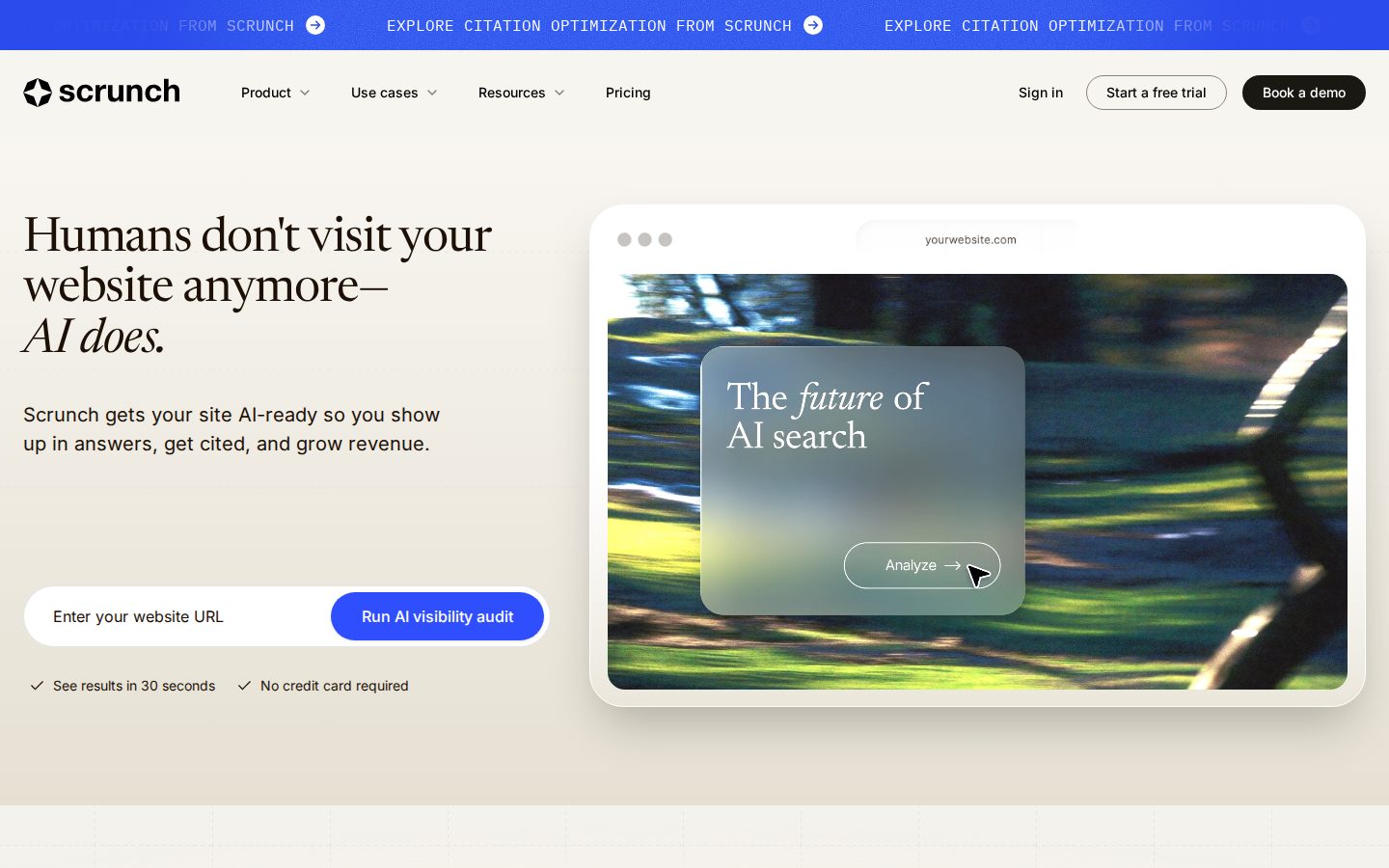
- Best for enterprise brands, especially teams already on Sitecore.
- Engines tracked on Core are ChatGPT, Perplexity, Google AI Overviews and Copilot.
- Pricing starts with Core at $250 a month for 125 prompts and 5 users, with Enterprise on request, per Scrunch's pricing FAQ.
- Customer proof comes from the B2B agency Stratabeat, which took a B2B fintech SaaS client from 1% visibility on tracked non-branded prompts to 40%, with custom prompts “based on voice-of-customer research”. Reporting non-branded prompts on their own is the habit we argue for below.
- Watch out for the Core engine list. Gemini and Google AI Mode aren't on it, a gap if your buyers start in Google.
AthenaHQ
AthenaHQ turns AI visibility data into recommended actions the team can work through.

- Best for growth-stage B2B SaaS teams that want a to-do list to go with the dashboard.
- Engines tracked on every plan are ChatGPT, Perplexity, Gemini, Google AI Overviews and Copilot. Paid plans add Google AI Mode, Claude, Grok, DeepSeek and Meta AI.
- Pricing starts with a free Essential plan, then Starter at $295 a month, with 17% off billed annually, as checked on AthenaHQ's site in November 2026.
- Customer proof comes from Lago, a B2B billing company whose AI Overview impressions in tracked prompt cohorts grew 11x, from 3% to 33%, between March and September 2025, per AthenaHQ's Lago case study. Lago linked about half of booked demos to AI visibility, a figure the case study itself calls “directional”.
- Watch out for the Starter add-ons. API access and extra credits cost extra on Starter, so price the plan with the integrations your reporting needs.
Rankscale
Rankscale describes itself as “The AI visibility platform for agencies and enterprise teams”. It connects GA4 and Search Console (in beta) and runs 94+ technical checkpoints next to its visibility tracking, and its enterprise page shows logos including Bosch, UBS, Cartier, Michelin, BNP Paribas and Akamai.
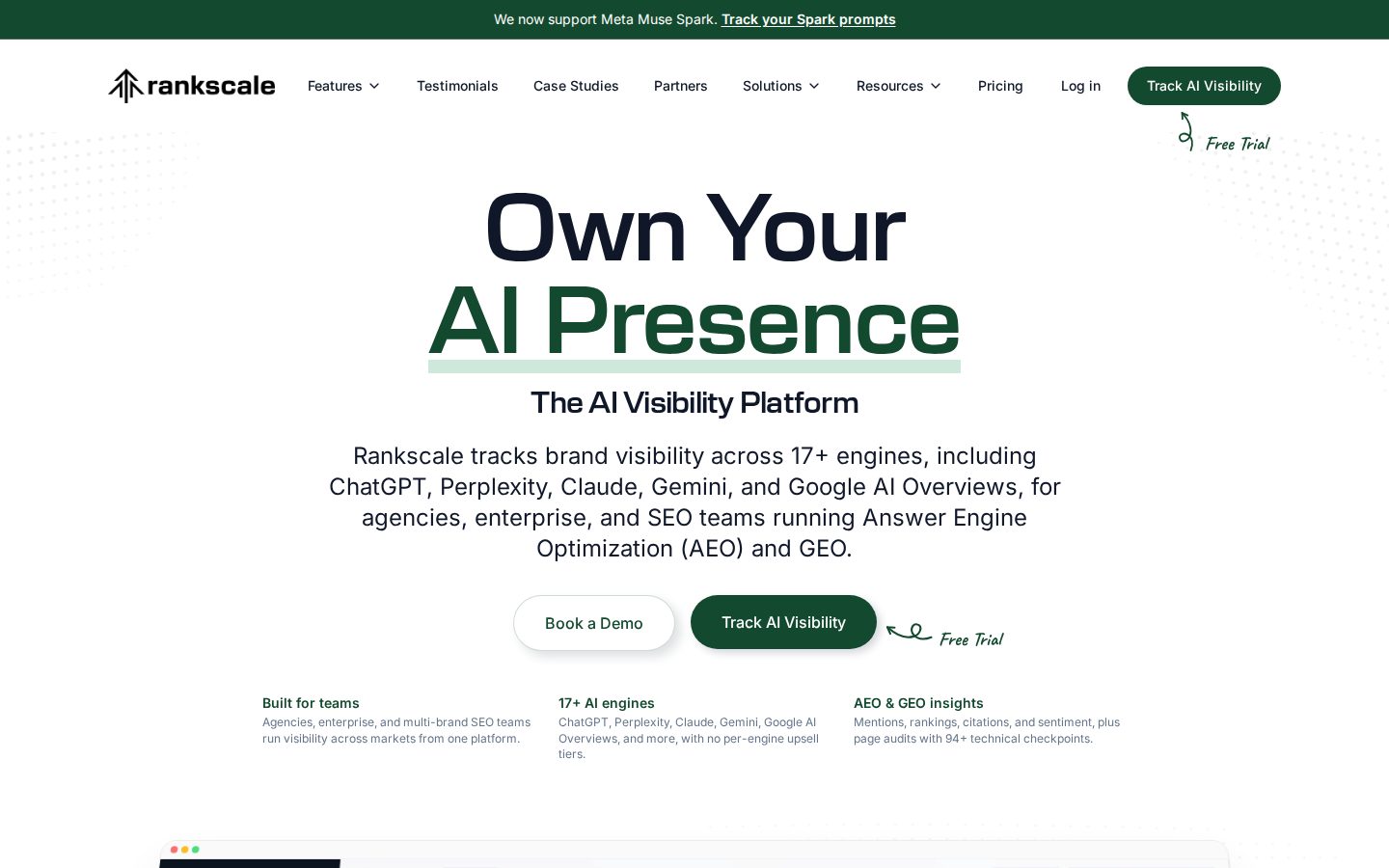
- Best for agencies and enterprise teams that want every engine without per-engine add-ons.
- Engines tracked number 17+ on all plans, per Rankscale's homepage.
- Pricing runs from $99 a month on Pro to $780 a month on Enterprise, credit-based with no per-engine upsells, and Rankscale offers a free trial.
- Watch out for the credits. Pricing is credit-based, so ask how many credits one prompt run on one engine uses before you compare Rankscale with per-prompt plans. The Search Console connection is still in beta.
Does 'top brand in AI answers' mean you're winning?
A “top brand in AI answers” score means you're winning only if the prompt set behind it is honest. The score ranks you within the prompts someone chose to track, so a set full of your own brand name can put a small company first in a category it doesn't lead. We've seen it with our clients, and early on we reported it that way ourselves.
Share of voice depends on prompts
Ahrefs defines AI share of voice as “the percentage of AI responses within your topic set that mention or cite your brand versus competitors”. Everything in that definition hangs on “within your topic set”: change the set and the score changes with it. Every tool on this list works the same way, because each one only sees the prompts it runs. Ahrefs also warns that when you write your own brand prompts, you're engineering what you expect to see.
Branded prompts inflate the score
Early in our AEO work, we reported all of a client's prompts together, and many of them contained the client's name. One client, much smaller than the industry leaders, with far fewer articles, a lower domain rating and a smaller SEO footprint overall, came out first by far. It looked superb. It also looked suspicious.
When we excluded every prompt with a brand name in it, that client dropped a couple of positions against competitors. For them, the gap was small. For many clients we report on for the first time, the gap is enormous: they rank first with branded prompts and around 50th without them.
A prompt with your name in it is a question you've already won.
We haven't found a published study that measures this effect, so the pattern above comes from our own client reports. Since that early mistake, we report branded and non-branded prompts separately.
Answers change from run to run
AI assistants rarely give the same answer twice. SparkToro research from January 2026 found they return the same list of brands less than 1 in 100 times, and the same list in the same order less than 1 in 1,000 times. One answer tells you almost nothing, and a sudden jump in a weekly report may come from a model change.
Your own ChatGPT is personalized
When a CEO forwards a screenshot of ChatGPT recommending the company, the question behind it is the one a buyer asked us on a call: “is it actually like pulling us as the primary solution for everybody across the board”. Often it isn't. With reference chat history turned on, ChatGPT can draw on your past conversations to personalize later answers. Someone who spends weeks asking ChatGPT about their own company can get answers shaped by that history.
A tracking tool runs the same prompts on a schedule and reports the rate, which is the closest you'll get to what buyers see. Give leadership one number: non-branded share of voice against named competitors, month over month, with branded prompts on their own line.
Which prompts should you track?
Track commercial prompts built from your money keywords, expand them across the industries, use cases and services you sell, and add a smaller set of informational prompts that show whether your blog gets cited. Keep branded prompts in a separate report.
One buyer put the problem plainly on a sales call: “The issue we're having right now is how to identify the prompts that we track for.” None of the lists ranking for AI visibility tools answers that, and keyword exports alone won't either. SparkToro found in February 2026 that prompts written by different people for the same intent had an average semantic similarity of 0.081, which is very low. We run a separate system for prompt selection, built in four layers.
Money keywords as commercial prompts
Start with the keywords that carry real business value. Say the client sells customer support outsourcing. We track the keyword “customer support outsourcing” in search and, next to it, the prompt “what are the best customer support outsourcing services”. Commercial prompts like this show how the client places against competitors at the moment a buyer builds a shortlist.
Industry, use case and service matrix
Next, we cross every industry the client sells to with every use case and every service, and keep the combinations that have real search volume as keywords. Each one becomes a prompt: “best customer support outsourcing services for financial services”, then the same for every other vertical with demand. The matrix shows how a B2B company performs across verticals and across services, so you can see where you lead in one industry and don't appear at all in another.
If you sell in several countries, set location and language per prompt and treat each market as its own set. Our guide to localizing content for AEO covers what changes from market to market.
Informational prompts for blog citations
A smaller set covers top-of-funnel questions such as “what is customer support outsourcing”. These tell you whether your blog gets cited for the broad prompts. We also run a few experimental prompts to test new angles before they earn a place in the main set.
Every tracked prompt needs a page that can answer it. If you track “best customer support outsourcing services” and have no page built to answer that question, the report can only show you missing, and it can't tell you what to improve.
Branded prompts in a separate report
Brand prompts such as “is [your company] good for [use case]” still earn a place, because buyers ask them late in a decision and you want the answer to be accurate. Report them on their own line, and keep them out of the share-of-voice number you show leadership.
If you'd like a second pair of eyes on your matrix before you sign a tool contract, talk to a strategist about your prompt set.
Can free AI reports replace a paid tool?
Free first-party reports now cover part of the job: Google Search Console, Bing Webmaster Tools and ChatGPT's Business Hub beta all show AI data about your own site at no cost. None of them shows the prompts behind that data or how your competitors do, and that's what you pay a tool for.
We used to tell clients there's no Search Console for LLMs and every tool is scraping. For prompts and competitors, that still holds. For your own impressions and citations, it stopped being true in 2026, and none of the top-ranking tool lists we read explains it.
Search Console's generative AI report
Google launched generative AI performance reports in Search Console on June 3, 2026, with impressions for AI Overviews and AI Mode. The Search Console help page lists impressions by page, device and country. According to Search Engine Journal, the report has no query or click data, so you learn that a page appeared without learning what was asked.
Bing AI Performance and Citation Share
Bing Webmaster Tools added AI Performance in public preview in February 2026, showing citations across Copilot and Bing's AI summaries. In June 2026, Microsoft added Citation Share, which it describes as an observational measure rather than a ranking system.
ChatGPT Business Hub beta
OpenAI began rolling out a Business Hub beta on November 10, 2026, with profile views, business mentions and website clicks, per TechCrunch. Digiday reports that the beta dashboard “omits the prompts and competitor rankings” tracking vendors sell. We haven't found an OpenAI page documenting it yet, so treat the details as early.
What only paid tools show
Paid tools still own prompts and competitor share of voice. Use the free reports for the truth about your own site and a paid tool for the market around it.
| Report | What it shows | What it can't tell you | Cost |
|---|---|---|---|
| Search Console generative AI report | AI Overviews and AI Mode impressions by page, device and country | Queries, clicks and other engines | Free |
| Bing AI Performance | Citations in Copilot and Bing AI summaries, plus Citation Share | Google and ChatGPT answers | Free |
| ChatGPT Business Hub (beta) | Profile views, business mentions and website clicks | Prompts and competitor rankings | Free |
| Paid tracking tool | Mentions, citations, share of voice and sentiment for prompts you choose | Google's and Microsoft's own impression data | $29 to $999 a month on published plans, or custom |
How to choose an AI visibility tool
Choose the tool whose method you can see, whose prompts you control and whose engines match where your buyers ask, then compare what one tracked prompt costs at your volume. Run every vendor demo against the same list of questions.
Questions to ask in the demo
- Can you show me how a prompt is run, from which location, how many times and how the answers become a score?
- Which engines do you track, and how granular is the data for each one?
- Can we load and edit our own prompts?
- Can we split branded and non-branded prompts in every report?
- Do you show the cited URLs for us and for competitors, including listicles, directories, YouTube and Reddit?
- How often does each prompt run? Semrush's Brand Performance report is weekly and the Ahrefs index monthly, so ask.
- Do you report sentiment and point out opportunities from the data?
- Can you read crawler data through Cloudflare or another CDN?
- What does one tracked prompt cost per month at our volume, with the engines and users we need?
Red flags that should end the demo
- Prompt sets you can't edit. Profound's own Trial works this way, which is fine for a week and a problem in a contract.
- A score with no method behind it. If the vendor can't explain how its “AI rank” or “visibility score” is calculated, the number won't survive your CFO's first question.
- No split between branded and non-branded prompts. Without it, the headline number flatters you.
- No citation data. Mentions without sources tell you that you appear and leave out why.
- Big swings nobody explains. A score that jumps overnight while the vendor calls it progress deserves a second look.
When to stop trusting the numbers
Stop trusting a report the moment it shows a big change you can't tie to something you did. LLMs answer differently from day to day, and a model update can move every brand in a category at once, so check for a change in the engines before you celebrate or start rewriting pages. Be just as wary when the headline number includes branded prompts, or when a company much smaller than the leaders comes out first by far. Check the prompt set before that slide goes to the board.
Which tool fits your team
- Enterprise teams with a security review should start with Profound, which offers SSO and SOC 2 on Enterprise, or Scrunch, especially on Sitecore.
- Mid-market teams in several markets should compare Peec AI and Searchable, both with published prices.
- Small teams buying a first tool can start on Otterly.AI Lite at $29 a month and move up as the prompt set grows.
- Teams already on Semrush or Ahrefs should price the add-on for their suite first, since the data sits next to their SEO reports.
Do you need a partner on top of a tool?
You need a partner when the dashboard has to turn into pipeline and nobody in-house has the hours for it. A tool tells you where you're mentioned and cited. Someone still has to build the prompt set, match visibility to leads, fix the pages that lose and explain the number to leadership.

A visibility report says little until you put it next to how many leads arrive through organic search and what those leads tell you. Ask buyers to self-declare on your forms with a “how did you hear about us” field, because buyers who researched in ChatGPT will often answer AI even when analytics files the visit under direct or branded search. Then compare what buyers say with what the metrics say. Our AEO analytics stack shows how we match AI search data to deals in the CRM.
One buyer asked us for “the subset of things that really matter versus the list of 117 things we could do.” Content can stay in-house. The work that's hard to staff is the prompt matrix, the technical fixes and the reporting that ties both to revenue. When the data shows gaps, a GEO audit of your content and site finds why competitors' pages get cited and yours don't, and many of the fixes land in the site itself, which our guide to AEO on Webflow walks through.
We run the same system on our own site, where AI search went from 6.5% to 66% of our search revenue. We call this WebOps, and our retainers for it start from $6,000 a month on a 12-month term. Our published pricing has the full ranges for retainers and projects.
Before you buy any tool, get a baseline. Scan your website free to see where you stand in AI answers today, or talk to a strategist about building a prompt set your leadership can trust.
How much does AI visibility tracking cost per prompt for a B2B team?
AI visibility tracking costs roughly $1.20 to $2 per prompt a month on mid-tier published plans, as checked in November 2026. Otterly.AI Standard is $189 for 160 prompts on 3 engines, Peec AI Pro $245 for 150 prompts and Scrunch Core $250 for 125 prompts. Semrush's toolkit costs more per prompt at $99 for 25, plus $60 for each 50 more, and Profound Enterprise has no public price. Budget separately for extra engines and extra users, which several vendors charge as add-ons.
How often should a B2B marketing team review AI visibility reports?
Let the tool run your prompts daily and review the accumulated trend on a fixed schedule, because a single day's answers mean little. SparkToro found AI assistants return the same brand list less than 1 in 100 times, so one run is noise. Look sooner only when a number moves sharply, and check for a model update first.
How is AI visibility different from SEO rankings?
An SEO ranking is one position on a results page for a keyword, while AI visibility is the share of AI answers that mention or cite your brand across many runs of a prompt. Because AI answers vary from run to run, visibility is reported as a rate and read as a trend. The two connect: Ahrefs Brand Radar builds its prompt index from search keyword data, and Google counts AI Overviews and AI Mode traffic inside Search Console's Web search type.
How many AI engines should a B2B company track?
Track at least three AI engines and add more as the budget allows, starting with the assistants your buyers use. Three is the minimum on Otterly.AI's plans and the number Peec AI Starter and Searchable include, while Profound Enterprise covers up to 10. ChatGPT belongs in every set, since OpenAI reports more than 900 million weekly active users. Google AI Overviews and AI Mode matter for anyone whose buyers still start in Google.
Should we track AI visibility in every country and language we sell in?
Track every market that brings real pipeline, with location and language set per prompt, and add smaller markets later. Each market multiplies your prompt count: 50 prompts across three markets becomes 150, which moves Peec AI from its $95 Starter plan to its $245 Pro plan. Start with your biggest revenue market and expand once the first set shows you where the gaps are.
Can we run AI visibility tracking in-house and hire help only for strategy?
Yes, as long as someone in-house owns the tool and the report every month. A workable split is an in-house team reading the dashboard and writing content, with a partner building the prompt matrix, fixing technical issues and tying visibility to pipeline. Our retainers for that work start from $6,000 a month on a 12-month term, and the tool subscription sits on top.
Which AI visibility tools offer a free trial?
As of November 2026, five of the nine tools let you try before paying: Profound (50 fixed prompts daily for 7 days), Searchable (14 days), Scrunch (7 days), Rankscale (free trial) and AthenaHQ (a free Essential plan). Semrush states its AI Visibility Toolkit has no free trial. Profound's trial uses a fixed industry prompt set, so ask any vendor to run your own prompts before you sign.
Do AI crawlers blocked in robots.txt or a CDN lower our AI visibility?
They can, and a visibility tool that only reads AI answers won't show you why. If an assistant's crawler can't fetch a page, that assistant can't read the page when it looks for sources. A tool that reads CDN data, such as Profound's Agent Analytics with Cloudflare, Akamai or Fastly, shows which AI bots reach which pages, so check robots.txt and CDN bot rules whenever citations drop on pages that used to earn them.

SEO and Content Manager at Flow Ninja, writing on technical SEO for Webflow, programmatic SEO, and how to earn citations in AI search.


See your website the way a senior strategist does
Foresight scans your site across 10 strategy dimensions. You get a scored breakdown of every gap costing you leads.
Continue reading






Ready to escape your CMS nightmare?
100+ successful migrations. 0 ranking disasters at launch. One embedded team that's done this before.