
.svg)
Website Intelligence
Your website's own business intelligence
It shows what your website contributes to pipeline and growth, by reading every page and journey against your CRM.
Weeks
To your first answers
One row
Per buyer, not per session
No SQL
Ask in plain English

.avif)
Four things your web analytics has never told you
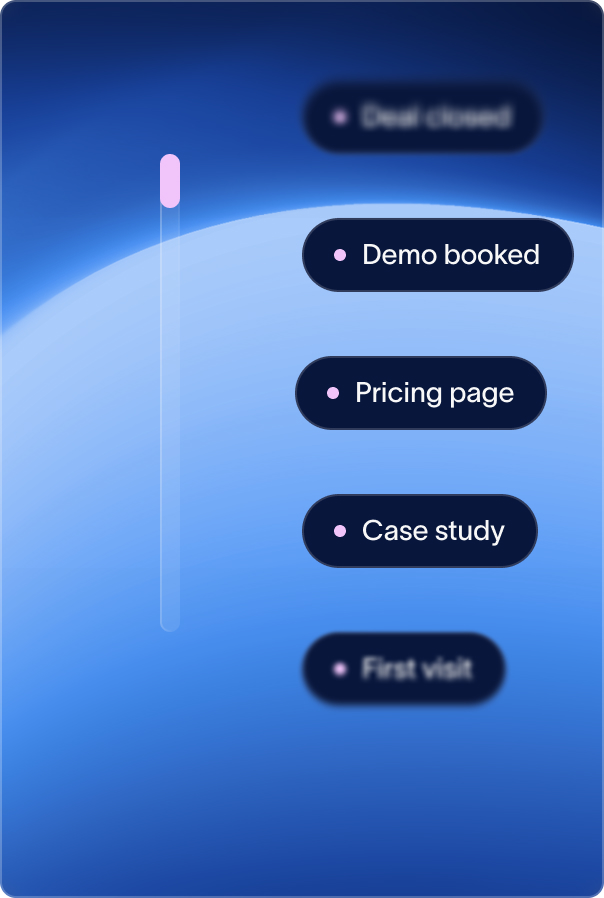
Read deals backwards
Open any deal and read every page and session that came before it, including the visits from weeks before anyone knew their name.

ROI, page by page
Every page ranked by the revenue that followed it rather than the traffic it collected. The list reorders more than you would like.
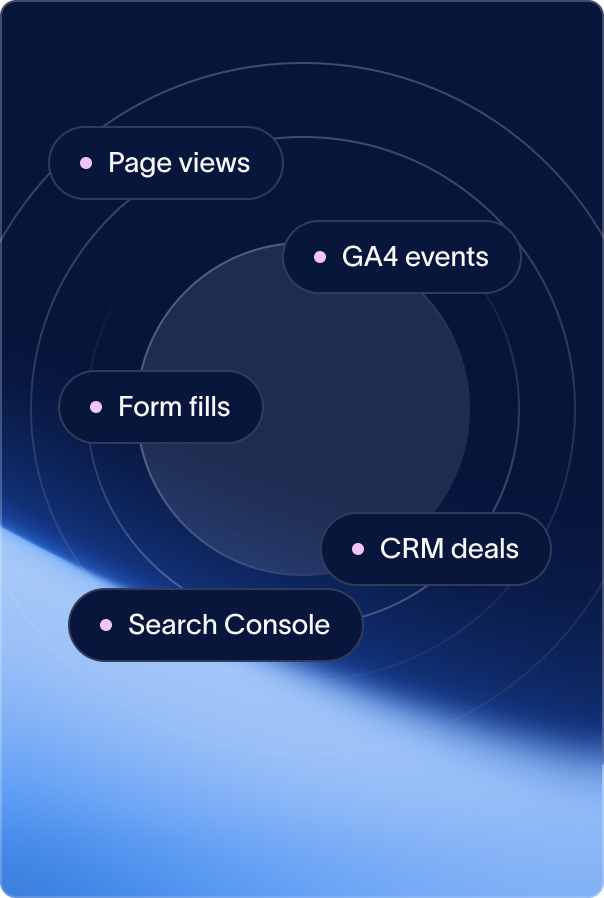
Fragmented data, joined
GA4 events, Search Console queries and CRM deals in one record. The search someone typed and the deal they signed, in the same row.

After the conversion
Web analytics records the conversion and stops. Here the same person keeps going: stage reached, deal value, whether it closed.
What this gets you
Your roadmap stops being opinion
Every page carries what it produced in deals, so decisions rest on revenue rather than page views.
Sales sees what you see
How they arrived and what they read, joined to what happened after the meeting was booked. One record, both teams.
Ask Claude about your website
Connect the table to Claude and ask in plain English. Every answer comes back with the query that produced it.
Made for people who own websites
Website Intelligence is for teams who are accountable for what the website produces, not just for what it publishes.
Heads of marketing
See which channels pay
Retire the dead pages

Revenue and sales teams
Read a lead before calling
Spot who read pricing

In-house web teams
Prove your last release
Stop rebuilding what works
.avif)


The WebOps team behind Website Intelligence
Flow Ninja has built and run Webflow sites for B2B companies since 2015. Website Intelligence came out of 200+ of those projects rather than a product roadmap, and it answers the question every one of them eventually asked. We're opening it to a small number of sites first.







65+
Specialists on the team
$200K+
Spent on R&D annually
100+
Migrations, zero disasters
200+
Enterprise sites shipped




.webp)
What is your website's ROI?
Hardly anyone can answer it yet. We'll show you what the answer looks like on your own site.

FAQ
What is Website Intelligence?
Website Intelligence is business intelligence for your website. It joins the behavior data your site collects to the deal data in your CRM, producing one row per person that shows everything they read before they were identified and everything they became after. That single table is what lets you rank pages, channels and campaigns by revenue instead of traffic.
Why doesn't GA4 show which pages produce revenue?
Because Google Analytics 4 stops at the form. GA4 records what an anonymous visitor did and your CRM records what a named customer paid, and no shared key connects them, so neither system can tell you they are the same person. Website Intelligence writes that key at the moment someone submits a form, then joins both sides in BigQuery.
Do I need Webflow to use Website Intelligence?
No. It reads whatever first-party visitor ID your site already issues, so it works with GA4 and Google Tag Manager on any platform. Webflow sites get more out of it, because Webflow Analyze exports clicks already named the way you named them in the Designer and records which visitor saw which test variation. Neither is available in GA4 without extensive manual tagging.
Which CRMs does Website Intelligence work with?
Any CRM that can export deals with an email address, including HubSpot, Salesforce and Pipedrive. The join happens on a hashed email rather than a vendor-specific ID, so the CRM is interchangeable. What varies is how your CRM data reaches your warehouse, which is why it's the first thing we ask about.
How long does website revenue attribution take to set up?
Weeks rather than months. The tracking bridge is a single tag and a small endpoint, written once and reused across sites, and the join is a handful of scheduled BigQuery queries. What moves the timeline is how your CRM data reaches the warehouse. A CRM that already syncs is the fast case.
Do you need a data analyst to run revenue attribution?
No. The output is one flat table with columns named in plain English, readable without SQL. It's also why you can point a language model at it and ask questions directly, and every answer comes back with the query that produced it, so a surprising number can be checked rather than believed.
Is website to CRM attribution GDPR compliant, and where is the data stored?
The data stays in your own BigQuery instance, in the region your policy requires. Emails are stored as a one-way SHA-256 hash and never in the clear, and nothing is captured before your visitor's consent choice is read. The AI layer runs on a read-only account scoped to your dataset, so it can read your data and cannot change it.
How is this different from a customer data platform?
A customer data platform connects many systems and asks you to set up the tracking and adopt its schema first. Website Intelligence connects two, your website and your CRM, and the tracking setup is included because the team building it also builds your site. That narrower scope is why it takes weeks rather than a platform rollout.