The future of SEO when B2B buyers ask AI first
SEO matters more when B2B buyers ask AI first, because in our Search Console and Profound data, top-10 pages are twice as likely to be cited by AI as pages below position 20 (45% vs 23%). In our own business, AI search grew from 6.5% to 66% of search revenue. Ranking only pays in AI answers on the topics buyers actually prompt about.
Key takeaways
- G2 found 82% of B2B software buyers got AI chatbot recommendations, but Forrester finds buyers then verify those answers.
- In our Search Console and Profound data, 45% of top-10 Google pages earned AI citations, against 23% of pages ranking below position 20.
- Put about 90% of SEO effort into first-page Google rankings and about 10% into work aimed at AI citations.
- G2 found review sites (38%) now edge out AI chatbots (37%) in shaping B2B shortlists, so your review profiles shape how AI compares you.
- Our 306,000-impression software list earns zero AI citations, while two position-18 pages on topics buyers prompt about earn about 650 to 730 each.
- Fold one-question posts into deep guides with H3s and FAQs, because hundreds of thin AI posts risk Google's scaled content abuse policy.
- Teams that cut SEO budget in December 2025 cut at the bottom, since AI Overview CTR recovered from 1.3% to 2.4% by February 2026, per Seer.
- Ask any AEO vendor what they promise in month one, because anyone promising a citation spike by then is guessing.
Here are seven predictions for the future of SEO over the next two years, each backed by our data or a named study.
1. SEO grows as buyers ask AI
SEO matters more when B2B buyers ask AI first, because AI answers draw on web pages, and the pages that rank on the topics buyers ask about get cited more often. Alphabet's Q3 2026 results show that Google's year-on-year Search query growth was the highest it has been in five years, and that Search and other revenue reached $63,350M against $56,567M a year earlier. The same filing says the Gemini app has reached one billion users. People are asking more questions, in more places.

The belief we run into most among B2B marketers outside SEO is that the organic channel will dry up, or stop bringing leads worth having. Buyers have moved part of their research, that much is true. G2's 2026 Buyer Behavior Report found that 82% of B2B software buyers sourced recommendations from an AI chatbot in the last 24 months, and half of them said AI had its biggest impact when they were narrowing and comparing options. Forrester's State of Business Buying 2026 puts AI use at 94% of business buyers, who then check what it told them with peers, experts and analysts because answer engines can give incomplete or unreliable information.
Search didn't lose those people either. In Tinuiti's 2026 AI Trends Study, more than 1 in 3 people said they use search engines more since AI tools arrived, against 14% who use them less.
We see the shift in our own numbers. AI search went from 6.5% to 66% of our search revenue, and the pages AI cites for us are mostly the ones we built to answer buyer questions on agencies, migrations and pricing.
We also think AI will make the leads that reach your site better qualified. Buyers use it to break down their options before they click, so the visitor who lands on your pricing page has already done the narrowing. No open study measures the quality of AI-referred leads yet, so read that as our view from the work.
What changes is how much content a competitive site needs. A couple of landing pages and a handful of blog posts won't hold up when buyers can keep asking an AI follow-up questions until they run out. Knowledge bases that answer every question the buying committee asks are the new floor, and a site without a strong SEO base won't compete in Google or in AI answers. That's the brief behind our B2B SEO and AEO services: we start from the questions buyers ask and build the pages that answer them.
2. Rankings still raise citation odds
Ranking on Google is still worth it, because it's the clearest signal of how algorithms judge your site, and in our data top-10 pages are about twice as likely to be cited by AI as pages below position 20. A poorly ranked site usually has a reason, such as thin content, weak authority or broken technical SEO, and the systems that pick AI citations read those same signals.


We matched Google Search Console against Profound page citations for every page of ours with 100+ impressions, from 17 August to 15 November 2026.
| Average Google position | Pages cited | Share cited | Citations |
|---|---|---|---|
| Top 10 | 44 of 97 | 45% | 7,421 |
| 11 to 20 | 45 of 118 | 38% | 4,603 |
| Below 20 | 21 of 92 | 23% | 693 |
Top-10 pages get the best odds and collect most of the citations. The link gets weaker once you look at ranking strength across all pages, though. The rank correlation between Google position and citation count is only -0.17 (a better position brings slightly more citations), and between impressions and citations it's 0.20. Ranking roughly doubles a page's chance of being cited, and it guarantees nothing.
That helps read a contradiction in the published research. In July 2025, Ahrefs found that 76.10% of pages cited in AI Overviews ranked in the top 10. In its March 2026 update across 863,000 keywords, only 37.9% of cited URLs ranked in the top 10, while 31.2% ranked 11 to 100 and 31.0% ranked beyond 100. Our data says both findings can hold at once. The top 10 wins the best odds, and a large share of citations still goes to pages further down that answer the prompt.
Getting cited pays. Seer Interactive found that on searches where an AI Overview appears, the pages it cites get about 2.1% CTR against about 0.9% for pages it leaves out. With no AI Overview at all, CTR is about 3.3%.
So we split the effort about 90 to 10. Ninety percent still goes into getting pages onto the first page of Google, and the remaining 10% goes into work that earns more LLM citations and better positions in AI answers. We track both in Profound, for our own site and for clients, and our AEO analytics stack for tracking citations shows how the reports fit together.
No shortcut buys brand longevity, and HubSpot shows why. HubSpot built its marketing on informational queries long before AI answers. Those queries don't get clicked the way they used to, yet HubSpot is still ranked high and cited a lot, because the algorithms' view of a brand tends to match what people think of it. A newer company selling similar products would need years to get close. Backlinks, content, mentions and PR all count, and so does how long a domain and a brand have been trusted. That's our read of the market; we haven't seen published traffic or citation data on HubSpot specifically.
3. Citations and sentiment decide shortlists
You get recommended in AI answers by being cited often on the topics buyers prompt about, ranking high when AI compares you with competitors, and making sure what AI says about you matches your site. "How do we get our company to show up and be recommended in ChatGPT and other AI answers?" is the question we hear most on sales calls. It has come up on 20 calls, and in 4 deals we lost. These are the signals we expect to matter most over the next two years.
Citation count
How often AI cites your brand and your website is the most direct tell of whether AI crawlers trust you as a source. We watch it page by page in Profound. A page that ranks on a topic buyers ask about and still never gets cited tells you the page needs work.
Position in comparison prompts
Where your brand sits when a buyer asks AI to compare vendors decides whether you make the shortlist. Those prompts come from many people at once. Forrester counts 13 internal stakeholders and 9 external participants influencing the average B2B purchase, and each of them prompts AI differently. A CFO might ask about cost while a security lead asks about compliance, and your brand has to surface in both answers.
Reviews feed those comparisons. G2 found that review sites (38%) have overtaken AI chatbots (37%) as the top source shaping B2B shortlists, so your review profiles are part of your AI visibility whether you manage them or not.
Sentiment and positioning
For big brands, and for any company where reputation decides the deal, the third signal is how AI describes you. Tools can now measure the sentiment of AI answers and the positioning they give a brand, and show whether that matches your website and what people write about your products and services across the web. When the description drifts, the fix sits in the pages and mentions AI draws on, so you act on both the negative and the positive.
One client credited its website and our SEO and AEO work in an $11M government contract win, the largest deal in the company's history.
4. Topic coverage beats page count
Topic coverage beats page count because AI can only cite you on the questions buyers actually ask it, however well a page ranks. Our Profound tracking covers prompts about agencies, migrations and pricing, and the results are blunt. Our biggest ranking page, a 2023 list of graphic design software with 306,000 impressions at position 5.8, has zero citations. Our Webflow partner page and our enterprise page, both around position 18, hold about 650 to 730 citations each, because buyers ask AI about exactly those topics.
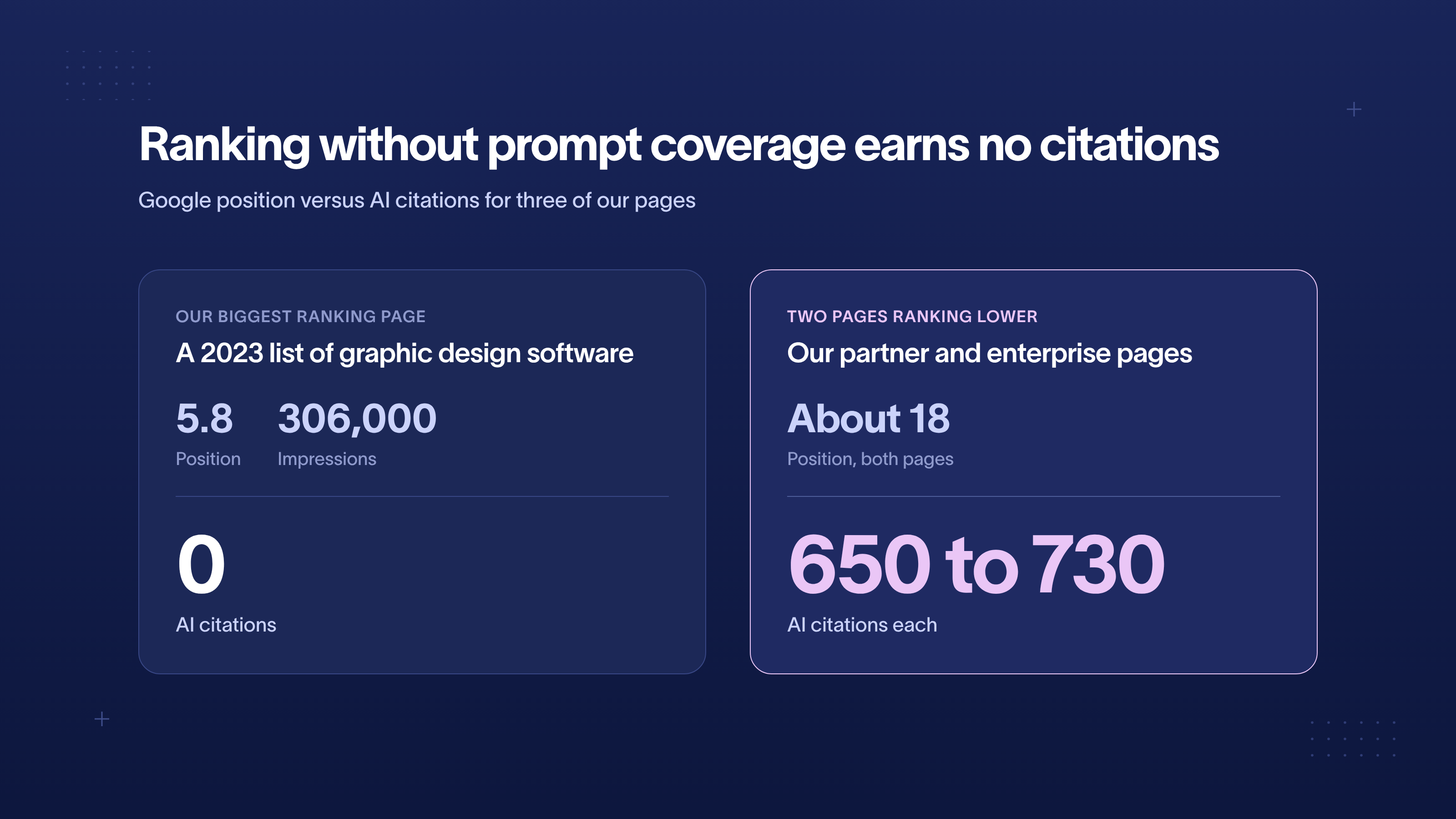
Ranking well roughly doubles a page's chance of being cited, but only on topics the prompts cover.
Informational pages lose the most, because Ahrefs found AI Overviews on 21% of all keywords and 57.9% of question queries. When one shows, the #1 result's click-through rate is 58% lower, on Ahrefs data as of December 2025. The Pew Research Center found that users clicked a regular result on 8% of visits when an AI summary appeared, against 15% when none did, and clicked a link inside the summary on just 1% (a US panel of 900 adults, March 2025 data).
So the work moves from many pages to deep coverage. Take the questions from sales calls, lost deals and Semrush, group them by topic in an SEO content strategy, and build fewer, deeper guides where each question gets an H3 or an FAQ answer. A guide that answers the whole buying committee's questions on one topic gives AI one strong page to cite, and gives Google one page to rank where you used to have five competing with each other.
5. Mass AI content gets penalized
Mass-produced AI content backfires because search algorithms still recognize slop, and hundreds of thin pages pull down the site they sit on. It's the costliest mistake we see teams make while chasing AI visibility, and it usually arrives right after they've paid for the strategy, design and build.
We keep seeing teams publish hundreds of 2,000 to 3,000 word posts, each answering a simple question that belonged as an H3 or an FAQ inside one ultimate guide. They feed the questions into Claude with no workflow and no added knowledge. Nobody with SEO experience checks the URL structure, the interlinking, the meta titles or the meta descriptions before hundreds of pages go live.
Pulling those questions from Semrush and sales calls is the right part of the strategy, and it's the step we'd keep. The damage happens in everything after it.
Google's own guidance on AI-generated content says AI is useful for research and for structuring original content. It also says that using AI to generate many pages without adding value for users may violate its spam policy on scaled content abuse. Google judges the page a reader gets and an AI can cite, and the same test applies to text from ChatGPT, Claude or a person. Its core updates keep going after exactly this kind of content bloat.
Scale works when each page adds something. Programmatic pages built from real data, where every page gives the reader a fact they can't get elsewhere, can rank and earn citations.
6. SEO budgets get judged on pipeline
Budget SEO on month, quarter-on-quarter and year-on-year trends judged against pipeline, and don't react to one bad or one good week. SEO and AEO have always been a long-term play, and the budget mistakes we see come from both directions.
Some clients drop SEO after a week or two of weak numbers, on a channel that had been bringing results. Others see a spike, decide to 100x the number of blogs and pages, and watch the quality of what they publish thin out with the volume. Both decisions rest on a window too short to read.
Short-term swings mislead most right now: Seer Interactive data, reported by Search Engine Land, shows organic CTR on searches with an AI Overview fell to 1.3% in December 2025 and recovered to 2.4% by February 2026, an 85% recovery in two months. A team that cut its budget in December cut it at the bottom.
We give clients four rules for budget calls:
- Read the right windows. Compare the last month, quarter on quarter and year on year before deciding anything.
- Look past clicks and impressions. Check how rankings and citations moved pipeline and deals in your CRM.
- Change the strategy before the budget. If performance falls, get someone who understands the wider changes in search to rework the plan before you cut the channel.
- Treat a spike as a reason to deepen what works. Multiplying the page count is how quality thins out.
Sometimes the numbers point at the site itself, such as templates that can't hold the depth buyers need. A rebuild typically takes 8 to 16 weeks, with projects on our published pricing from $25,000 for Webflow development and from $50,000 for Transform, which adds strategy and design. As your Website Operating Partner, we run ongoing SEO and AEO on a retainer from $6,000 a month on a 12-month term; we call this WebOps.
7. AEO quick fixes get exposed
You spot an AEO quick-fix pitch by its promise of fast results in LLMs, explained with crawler techno-babble and buzzwords that almost make sense. SEO has always carried plenty of sales noise, and AEO has handed it a fresh vocabulary. We've watched marketing leaders buy an approach because it sounded right and was doing the rounds on LinkedIn. Pitches that promise huge jumps in citations often end in even bigger dips over the longer term.
Before you sign, have an independent SEO expert check the offer, and ask the vendor these five questions:
- How do you measure citations, and with which tool? A good answer names the tool, the prompts it tracks and how often you'll see the report.
- What content will you produce, and who reviews it? Listen for research, a question map and an SEO review of every page before it goes live.
- How do you handle technical SEO, schema and crawlability? Expect specifics on schema types, canonicals, crawl access and indexing.
- What do you promise in month one, and why? Month one should buy an audit, foundations and a plan, and anyone promising a citation spike by then is guessing.
- How do you tie the results to pipeline? The answer should end in your CRM, with deals next to rankings and citations.
A partner worth hiring builds authority, publishes high-quality content and writes a strategy around your ICP, and won't promise quick ROI. Buyers ask us on sales calls how our AEO approach differs from other vendors. These five questions are our honest answer, and we expect to be asked every one of them.
What to do in the next 90 days
Start with an audit of where you rank and where AI cites you, then fix the foundations before you publish anything new.
- Audit rankings and AI citations. Run a GEO audit of your rankings and AI citations to see which pages rank, which get cited, and which topics have neither.
- Map buyer questions to topics. Pull questions from sales calls and lost deals first, then Semrush, and group them by the topics buyers prompt AI about.
- Consolidate thin posts into guides. Fold one-question posts into the guide where each belongs as an H3 or FAQ, and 301 redirect the old URLs.
- Fix technical foundations first. Schema, canonicals and crawlability came up on 12 of our sales calls and in 3 lost deals, and the AEO foundations we build on Webflow decide whether AI can read your pages at all.
- Track citations in a tool. Set up Profound or a similar tracker on the prompts your buying committee uses, next to Search Console.
- Report quarterly against pipeline. Put rankings, citations and CRM pipeline on one page and review it quarter on quarter.
If you'd rather not run the audit alone, talk to a strategist about your rankings, citations and pipeline, or scan your website free and start from what the scan finds.
What is the difference between SEO, AEO and GEO?
SEO is the work of ranking web pages in search engines such as Google. AEO (answer engine optimization) and GEO (generative engine optimization) are two names for getting those pages cited and your brand recommended in AI answers from ChatGPT, Gemini and Google's AI Overviews. In practice they share one foundation: pages that rank and answer buyer questions. We run them as one program and split the effort roughly 90 to 10 between rankings and citation work.
Will AI agents change how B2B buyers find vendors?
Yes, though people still make the final call for now. G2's 2026 Buyer Behavior Report found that 61% of B2B software buyers use or plan to use AI agents in buying, and 47% would let an agent research and recommend while humans decide. Only 9% would let an agent complete a purchase within approved guardrails. Agents read your pages the way AI answers do, so pricing, specs and comparisons written in plain text on your site get more valuable.
Can we keep content writing in-house and buy only technical SEO, AEO and strategy?
Yes, and many B2B teams work that way. A healthcare client's Chief Growth Officer described on Clutch how our team handled everything except content creation, with the new site optimized for SEO and AEO. The split works when your writers get a question map, briefs and an SEO review of URLs, interlinking and meta fields before anything goes live.
Which AI visibility tracking tool should we use, and do we need it on top of an SEO partner?
We use Profound to track AI citations for our own site and for clients, and we match it against Google Search Console. You need a tracking tool whoever does the work, because Search Console doesn't report ChatGPT citations. A good partner runs the tool and puts citations in the same report as rankings and pipeline. Check which prompts it tracks: ours covers agencies, migrations and pricing, so pages on other topics show zero citations.
Will we lose rankings and AI visibility when we redesign or migrate the site?
You lose them when ranking URLs change without redirects, when pages that earn citations get cut, or when schema and canonicals go missing at launch. Keep every URL with impressions or citations, map 301 redirects for anything that moves, and compare Search Console and citation data before and after. It's the fear behind more of our lost deals than any other SEO question.
How long do SEO and AEO take to show results, and what does it cost?
SEO and AEO take 3 to 6 months on average to show results, and we judge the program year on year against pipeline, because weekly numbers swing too much to decide anything. Ongoing SEO and AEO work runs on a retainer from $6,000 a month on a 12-month term. If the site needs rebuilding first, builds typically take 8 to 16 weeks, with projects from $25,000 for development or $50,000 with strategy and design.
Can we phase in SEO and AEO if we can't fund a full program yet?
Yes. Start with the technical foundations and the pages buyers prompt AI about, usually pricing, comparisons and the service pages behind your money queries. In our data, two pages at position 18 on agency and enterprise topics earned about 650 to 730 citations each, so a few of the right pages carry a lot. Add depth in quarterly steps, and don't buy volume to make up the gap, since mass-produced AI pages are the costliest mistake we see.
How do we prove SEO and AEO ROI to leadership?
Report quarterly on one page that joins three sources: Google Search Console for rankings and clicks, a citation tracker such as Profound for AI visibility, and your CRM for the pipeline and deals those visits touched. Leadership trusts SEO once it shows up in deals, so match website visits to opportunities in the CRM. Our own AI search share grew from 6.5% to 66% of search revenue, and a single number like that is what leadership reads first.

SEO and Content Manager at Flow Ninja, writing on technical SEO for Webflow, programmatic SEO, and how to earn citations in AI search.



See your website the way a senior strategist does
Foresight scans your site across 10 strategy dimensions. You get a scored breakdown of every gap costing you leads.
Continue reading







Ready to escape your CMS nightmare?
100+ successful migrations. 0 ranking disasters at launch. One embedded team that's done this before.