AI Overviews traffic drop: what B2B sites should do first
An AI overviews traffic drop is only a real problem for a B2B site when pipeline, conversions or Search Console positions fell along with the clicks. On our own site, clicks on some non-branded informational queries fell by more than 50% while impressions held, and AI search grew from 6.5% to 66% of our search revenue. Check pipeline first, then fix the lead model that broke, usually gated content on informational posts.
Key takeaways
- Split your queries by whether they show an AI Overview, because Seer found CTR fell 41% even on queries without one.
- Check organic pipeline, demo requests and branded search for the months clicks fell before anyone signs a new budget line.
- 92% of B2B buyers say AI shaped their vendor shortlist, per Semrush, so getting cited at the research stage decides who gets the later click.
- Gated content and lead magnets on informational blog posts are the lead model that breaks, because buyers read the AI summary and never reach the form.
- AI Overviews now appear on 88% of the 400 commercial keywords Semrush tracks, so shifting budget to commercial pages won't bring the clicks back.
- Mass-producing thin or programmatic pages is the costliest reaction we've seen; Google's AI guide ranks non-commodity content above every other tactic it lists.
- Report organic- and AI-sourced pipeline instead of sessions; per Ahrefs, AI search brought 0.5% of its visitors but 12.1% of its signups.
- Google's own AI optimization guide says to ignore llms.txt, content chunking and special schema, so treat AEO pitches built on them as a red flag.
Why AI overviews are cutting B2B clicks
AI Overviews cut B2B clicks because Google now answers the informational question on the results page, and most searchers take the answer and move on. Ahrefs compared 300,000 keywords between December 2023 and December 2025 and found that the top-ranking page gets a 58% lower average click-through rate when an AI Overview appears. On keywords that show an AI Overview, position-one CTR fell from 0.073 to 0.016, and even informational keywords without one fell from 0.076 to 0.039.
Searcher behavior tells the same story. Pew Research Center tracked the browsing of 900 US adults in March 2025, and people who saw an AI summary clicked a result in 8% of visits, against 15% for people who didn't see one. A link inside the summary itself got clicked in 1% of visits. Being cited is good for your brand, and it's still rarely a visit.
We watched this happen on our own site. On some non-branded informational queries, our clicks fell by more than 50% while impressions held steady. Our rankings held, and readers got what they needed without visiting.
Most of the companies we run B2B SEO and AI search for show the same shape in Search Console: a flat impressions line above a falling clicks line, and a head of marketing asking what broke.
Usually, nothing broke.
Is your traffic drop a real problem?
An AI overviews traffic drop is a real problem only when something besides clicks moved with it: pipeline, conversions or your average position in Search Console. If those held, you're looking at a change in how people search, and your site is doing the job it did last year.
The first instinct we see in almost every team is to assume the website stopped performing. It's an understandable reflex, because the site performed well for years and the click graph is the first chart anyone opens. Look one column over before you act. If average position is flat and impressions are flat or rising, the pages still rank. Ahrefs explains the split in its study of the great decoupling: an AI Overview cites several URLs, each of them can be credited with an impression, and so impressions climb while clicks fall.
How to separate AI overviews from other losses
Not every lost click belongs to AI Overviews. Seer Interactive tracked 3,119 queries across 42 client organizations and found that organic CTR on informational queries with an AI Overview fell from 1.76% in June 2024 to 0.61% in September 2025. On queries without an AI Overview, CTR dropped 41% over the same period, from 2.72% to 1.62%. The whole results page got harder to click through, so split your queries into those that show an AI Overview and those that don't before you assign the blame.
Google, for its part, says total organic click volume has been “relatively stable year-over-year”. That's Google grading its own homework, so trust your Search Console export over the press release.
How to check pipeline before clicks
Pull organic-sourced pipeline, demo requests and signups for the months your clicks fell, and put them next to the click graph. Then check branded search, because that's where the late-stage buyer still clicks. If pipeline is unaffected, the other metrics are healthy and your positions didn't change, we tell clients the drop in clicks isn't worth worrying about.
| What Search Console shows | Pipeline | What it means | What to do |
|---|---|---|---|
| Positions steady, impressions steady or up, clicks down | Steady | AI Overviews answer your informational queries | Keep publishing and change what you report |
| Positions steady, clicks down | Down | Your lead model relied on informational clicks | Rework how informational pages produce leads |
| Positions down, clicks down | Steady or down | A ranking problem from technical issues, content or an update | Run a full audit before blaming AI |
If positions fell too, you have a ranking problem, and it needs a full audit before anyone touches the content plan.
Does lost traffic hurt B2B pipeline?
Lost traffic hurts B2B pipeline only when your leads depended on informational clicks. B2B buyers now do their early research inside AI tools and click through to a website when they're already looking at a specific brand, near the bottom of the funnel.
The buyer research backs this up from several directions:
- Gartner. 45% of B2B buyers used GenAI in a recent purchase, mainly to gather information on vendors and products, and they used seven information sources on average. The same survey of 645 buyers found 69% prefer to check AI-generated insights with sales reps.
- Semrush. In a survey of 643 US B2B professionals in March and April 2026, 66% regularly use AI to research vendors and 92% say AI has shaped their vendor shortlist. 75% trust AI vendor recommendations, and nearly all verify before committing.
- Forrester. 94% of business buyers use AI in their buying process, per its 2025 Buyers' Journey Survey.
That matches the journey we see in our own reports. A buyer asks ChatGPT, Gemini, Perplexity or Google's AI Overview who solves their problem, reads the answer, builds a shortlist and then searches the brand name. The click moved to the brand stage, where it was always more likely to convert.
When the drop hurts pipeline
If your content strategy pulled in lots of clicks on informational keywords and converted them right there on the blog, the drop is a real problem. People won't click those top-of-funnel posts the way they used to, unless the cited article looks interesting enough to open. They'll take the answer from the AI Overview or from ChatGPT instead. If that was your main lead source, pipeline will follow the clicks down.
When competitors lost the clicks too
The other half of the picture is relative. If you still have strong topical authority and your posts still get cited, your position against competitors probably hasn't changed much, because their clicks dropped as well. Everyone in your category is staring at the same falling line. The shortlist goes to whoever gets cited, and that's still a contest you can win.
Why gated content on blogs stops working
Gated content on blogs stops working because the buyer who used to land on your informational post and trade an email for a PDF now reads the answer in an AI summary and never arrives. The lead model breaks at the first step, so no amount of form testing fixes it.
The model ran like this for a decade. Rank for a top-of-funnel question, get the visit, offer an ebook, checklist or template, collect the email and hand it to nurture. Every step depended on that first click. With Pew measuring a 1% click rate on links inside AI summaries, the first step is now the weakest one in the funnel, and the MQL count built on it shrinks with it.
When a client's pipeline did fall, this is the model we look for first. A CMO who finds lead magnets sitting on informational pages has found the strategy that the new search behavior broke.
What to replace gated blog content with
- Open the content up. Put the substance of the old PDF on the page, ungated, so AI tools can read and cite it. A gated asset can't be quoted in an answer.
- Move the conversion to where buyers verify. Gartner's 69% want to check AI answers with a sales rep, so make the pages buyers reach at the brand stage (pricing, comparisons, case studies) answer those checking questions and make talking to sales the obvious next step.
- Judge informational posts by citations and influenced pipeline. Downloads stopped being the right count once the click went away.
What to prioritize after an AI overviews traffic drop
After an AI overviews traffic drop, prioritize the same things that won before it: high-quality content that AI scores high and cites often, deeper topical authority, and a stronger domain built on backlinks and earned mentions. There's no huge shift in SEO strategy when this happens, whatever the weekly report makes it feel like.
The initial hunch usually points the other way. Publish much more, and build pages that don't trigger AI Overviews so people have to click. We push back on both, for reasons the data below makes plain.
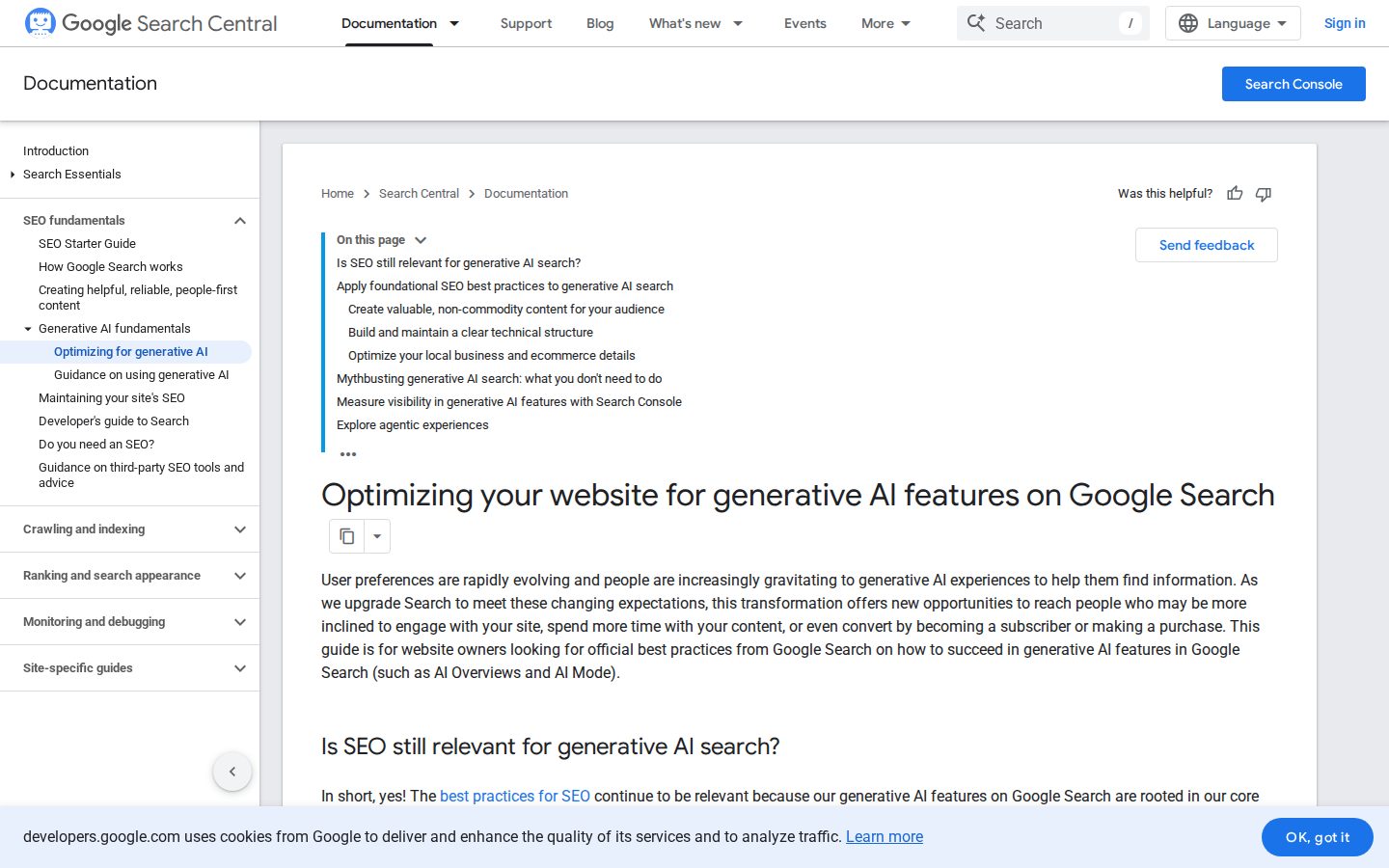
Google's own guidance agrees with us. Its guide to optimizing for AI features in Search says those features are “rooted in our core Search ranking and quality systems”, and that unique, valuable “non-commodity” content will likely influence your presence in AI search “more than any of the other suggestions in this guide.”
The priority order we use with clients:
- Content AI cites often. Keep producing the best answer on the topics your buyers ask about, with your own data and opinions in it. A content strategy built around topics and search intent still decides what you publish and in what order.
- Topical authority. Cover your subject in depth, so Google and AI tools see one site that owns it instead of scattered posts.
- Domain strength. Keep earning backlinks and brand mentions from sites your buyers already trust.
- Earned mentions in directories and listicles. Getting listed in the relevant directories and best-of lists puts your name in the sources AI tools draw on when buyers ask for a shortlist. Earn them, because Google warns against inauthentic mentions and bought or faked placements become a liability.
- Pages built to be cited. Clear structure, answer-first sections and clean technical SEO make a page easy to quote. Our guide to AEO on Webflow covers the build side.
This is the work behind one of our clearest results. ShyftOff built $11M in pipeline through AEO with us. In about four months we rebranded and rebuilt ShyftOff's site, 22 pages across 10 templates, and restructured its content around category themes so AI tools could cite it. AI search now brings 60% of its qualified leads. A rebuild with strategy and design like that starts from $50,000 with us, and a development-only project starts from $25,000.
Why commercial pages won't escape AI overviews
Commercial pages won't escape AI Overviews because Google now shows them on most commercial searches too. Semrush tracked 400 commercial keywords (alternatives, X vs Y, best X for Y, pricing and reviews) and found that AI Overview coverage reached 88% in August 2026, up from 45.75% in September 2025.
The instinct makes sense on paper. Informational queries got eaten, so shift budget to pages with buying intent, where someone has to click to compare vendors or see a price. That window has mostly closed. In the same Semrush study, every commercial modifier showed an AI Overview between 82% and 96% of the time, and software, banking and ecommerce all landed between 85% and 91%.
For readers in financial services and B2B SaaS, those are your categories.
Commercial pages still matter a great deal. Buyers reach them at the brand stage, after an AI tool has handed them a shortlist, and that's where they decide whether to talk to sales. Build them because a buyer needs them to decide. A page built only to dodge AI Overviews will probably meet one anyway.
The costliest reaction we've seen
The costliest reaction to an AI overviews traffic drop is paying for a large volume of new, low-quality pages to cover more prompts and keywords, in the hope of showing up in more AI Overviews or winning back the clicks. It costs a lot and can bring no result at all.
We've seen it take two forms. Some teams commission a flood of thin informational posts, one per prompt variation, because more pages feel like more chances to be cited. Others pay for programmatic batches of commercial pages, every best X for Y and X alternative combination they can generate, chasing the clicks their informational content lost.
Both run into the same wall. Google's guide puts non-commodity content above every other suggestion it makes, and a page that repeats what dozens of other pages already say gives an AI tool nothing new to cite. Every one of those pages also needs updating, merging or redirecting later, so the bill keeps arriving long after the launch. And as the Semrush numbers show, the commercial versions will meet an AI Overview anyway.
When programmatic pages do work
Programmatic pages work when each page carries data a buyer can't get elsewhere, such as a real integration, a real location or a comparison with real numbers behind it. They fail when the template is the only thing that changes from page to page. These programmatic SEO examples show what the good version looks like.
How to measure AI search instead of clicks
Measure AI search by pipeline, branded search and visibility in AI answers, and treat organic clicks as one signal among several. Clicks were always a proxy for revenue, and AI search has made them a weaker one.
Start with Google's own data. Search Console's Generative AI performance report covers AI Overviews and AI Mode and rolled out to all websites worldwide as of 31 August 2026. It shows impressions by page, country, device and date. We found no click or query-level data in it. Search Console tells you where you appear in AI Overviews, a GEO audit shows whether ChatGPT and Perplexity cite you too, and your CRM has to tell you what that's worth.
Then follow the revenue. Ahrefs published its own numbers for a 30-day window: AI search drove 0.5% of its visitors but 12.1% of its signups, and AI visitors converted 23 times better than traditional organic visitors. That's one company, so read it as a data point. Our own data points the same way, with AI search growing from 6.5% to 66% of our search revenue.
| Stop leading with | Lead with instead | Why |
|---|---|---|
| Organic sessions | Organic- and AI-sourced pipeline | Sessions fell for everyone, and pipeline is what the board funds |
| Clicks per blog post | Impressions and citations in AI answers | Informational posts now earn visibility more than visits |
| Content downloads | Branded search and demo requests | Late-stage buyers search your name and click |
| Average CTR | Revenue by channel, AI search included | AI visitors convert better, per Ahrefs |
Our analytics match your website to the deals in your CRM, and the AEO analytics stack we use lists the tools behind that view.
What should a CMO check before moving budget?
Before moving budget because of AI Overviews or LLMs, a CMO should check pipeline first: if pipeline is unaffected and only clicks went down, there's no real problem to fund a fix for. If pipeline did move, find the strategy the new search behavior broke, such as gated content on informational pages, and change that.
Run through these before anyone signs a new budget line:
- Organic pipeline. Has organic- and AI-sourced pipeline changed, or only clicks?
- Rankings. Did average position move in Search Console, or just CTR?
- Query type. Did the drop land on non-branded informational queries, or on branded and commercial ones?
- Lead model. Did informational pages carry gated content or lead magnets that fed the funnel?
- The new plan. Does the proposal keep technical SEO, content quality and links, or swap them for tactics?
How to spot AEO buzzword traps
When you choose an SEO partner, be careful with pitches for a shiny new AEO strategy that quietly drops traditional SEO best practices. Google's guide has a mythbusting section that does most of the vetting for you. It says you can ignore llms.txt files, “chunking” your content and special schema for AI, and it lists “pursuing inauthentic mentions” among the things to skip. It tells site owners to put SEO ahead of “AEO/GEO hacks” and to “be wary of third-party tools that promise ranking success.”
If a proposal leads with llms.txt and chunking, ask what it does about rankings, content and links. Those still decide whether AI tools cite you.
How to budget for SEO and AI search
SEO and AI search belong on one budget line, because the same pages, authority and technical health drive both. We run them for clients as ongoing work on the website. We call this WebOps, and our retainers start from $6,000 a month on a 12-month term, with website projects from $25,000. Our pricing for projects and retainers has the details.
If your clicks are falling and nobody can yet say whether pipeline moved with them, talk to a strategist. We'll put your Search Console data next to the deals in your CRM and tell you which of these problems you have, if any.
Should we opt out of AI overviews with nosnippet to get our clicks back?
We don't recommend it for B2B sites. Opting a page out with the nosnippet directive keeps your text out of the AI Overview, but buyers still read the summary, with a competitor cited instead of you. Per Seer Interactive, brands cited in an AI Overview get 35% more organic clicks and 91% more paid clicks than brands that aren't. Seer notes that's a correlation, so treat it as a signal, but giving up the citation trades visibility you can measure for clicks you may never get back.
How do we tell an AI overviews traffic drop from a Google core update?
Compare average position with clicks, page by page. An AI overviews traffic drop leaves positions and impressions steady while clicks fall, mostly on non-branded informational queries. A ranking loss from a core update shows positions falling on the affected pages, across query types, starting around the date Google announced the update. If positions fell, audit the site before blaming AI; the Search Console Generative AI report helps confirm where AI Overviews show your pages.
Can we recover traffic lost to AI overviews?
Mostly not, and for B2B the leads matter more than the traffic. Clicks on informational queries that now show an AI Overview rarely come back, because readers take the answer on the results page. What you can grow is AI-sourced pipeline: per Ahrefs, AI search brought 0.5% of its visitors but 12.1% of its signups. On our own site, AI search grew from 6.5% to 66% of our search revenue while informational clicks fell.
Is being cited in an AI overview worth anything if nobody clicks?
Yes, and for B2B it's often worth more than the click. Buyers build vendor shortlists from AI answers: in a 2026 Semrush survey of 643 US B2B professionals, 75% said they trust AI vendor recommendations. A cited brand gets onto the shortlist at the research stage, and the click comes later, when the buyer searches your name. Track citations, branded search and sourced pipeline to see the value.
Which tool should we use to track our visibility in AI answers, and what does it cost?
Start with the free one. Google Search Console's Generative AI performance report, open to all websites since 31 August 2026, shows your impressions in AI Overviews and AI Mode at no cost. It doesn't show clicks or queries, so pair it with your CRM. For ChatGPT, Perplexity and Gemini you need a separate AI visibility tracker; we use Profound for citation data. Paid trackers price by plan, so ask each vendor for a quote based on the number of prompts you want tracked.
Can we start SEO and AEO on a smaller or phased budget?
Yes. Start with the diagnosis and with the pages that already rank and get cited, then fund new content once you know whether pipeline is the issue. Our ongoing retainers start from $6,000 a month on a 12-month term, and website projects start from $25,000, so a phased plan can begin with a project and move to a retainer once the numbers justify it. What you shouldn't cut is the SEO groundwork AI answers depend on.
Is ChatGPT or Perplexity also taking our traffic, or only Google?
Both. B2B buyers research in ChatGPT, Perplexity, Gemini and Google's AI Overviews, then click through to a site when they're looking at a specific brand. Gartner found buyers used seven information sources on average in a recent purchase, so no single assistant explains your drop. The visits these assistants do send tend to be late-stage and convert well, which is why we track AI-sourced pipeline alongside Google clicks.

SEO and Content Manager at Flow Ninja, writing on technical SEO for Webflow, programmatic SEO, and how to earn citations in AI search.


See your website the way a senior strategist does
Foresight scans your site across 10 strategy dimensions. You get a scored breakdown of every gap costing you leads.
Continue reading







Ready to escape your CMS nightmare?
100+ successful migrations. 0 ranking disasters at launch. One embedded team that's done this before.