How much does a B2B website cost in 2026?
B2B website cost in our 2026 projects ran from $19,000 to $130,000, with a median of about $56,000 across 21 websites. The figure that should set your budget is what the website will earn or save over the next few years, because almost every other channel you pay for sends people to it. A $20,000 site that converts poorly holds back every dollar you spend on ads, events and outbound.
Key takeaways
- Across the 21 B2B websites our team built and analized in 2026, the median project cost about $56,000 and the range ran from $19,000 to $130,000.
- Usual benchmark ranges mislead because they strip out what the money was meant to achieve: Clutch's average web development project is $66,499, yet most web design projects it tracks cost under $10,000.
- Paid ads, events, partnerships and outbound all send buyers to the website, so a weak site lowers the return on every other line in the marketing budget.
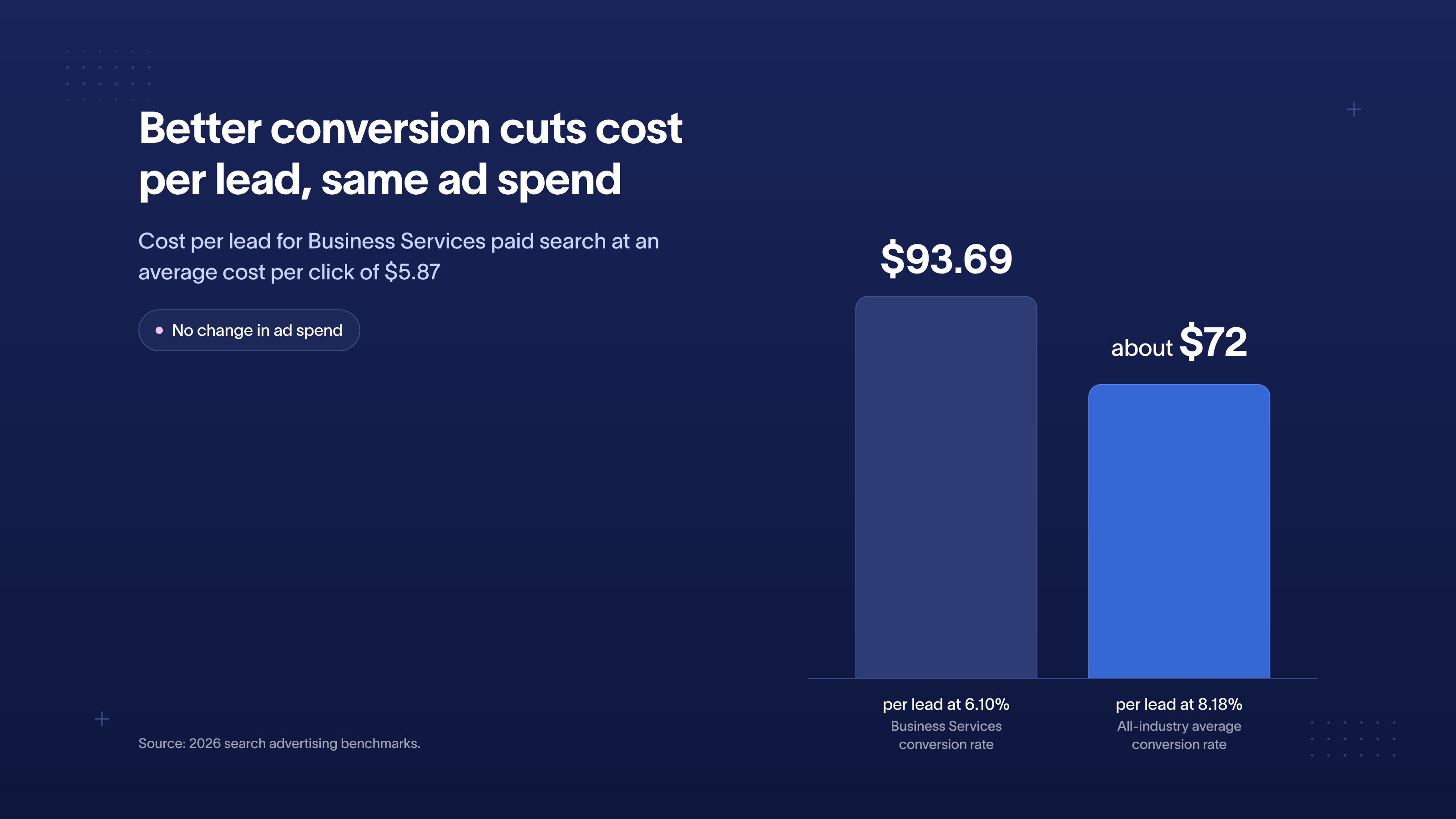
- At LocaliQ's 2026 Business Services cost per click of $5.87, lifting conversion from 6.10% to 8.18% cuts the cost per lead from about $94 to about $72 with no extra ad spend.
- The number of unique page templates drives price more than anything else; in our 2026 scopes, 10 templates came to $35,000 and 20 templates to $75,000.
- A full redesign costs about 60% more than replatforming, because it adds strategy, discovery and custom design to what is mostly development work.
- Two 16-week builds were signed at $75,000 and $126,000, and the gap came from copywriting, a 12-month SEO and AEO strategy, analytics and a large content consolidation.
- The cheapest of three builds we tracked after launch, at about $28,000, produced the biggest result: $11M in pipeline attributed to AI search, with an ongoing SEO and AEO program.
Why benchmark website prices can be misleading
Benchmarking is the biggest myth when it comes to pricing a B2B website. A benchmark price can often mislead you because it hands a plain number produced by an analysis and strips out what the money was supposed to achieve. Search for B2B website cost and you find a dozen almost similar articles and blogs quoting the same research over and over, and some even present one agency's own price range as if it were a market average. Not the best approach.

The public averages show how little a single figure tells you. Clutch's pricing guides published in November 2026 put the average web design project at $38,105.39 and web development project at $66,499.09, both based on verified client reviews. Still, Clutch also claims that most web design projects cost less than $10,000. In GoodFirms' April to May 2026 survey of 300+ web development firms in 31 countries, 63% of firms quote fixed-price projects between $1,000 and $15,000, while 7% quote $200,000 to $500,000 for an enterprise build. The range runs that wide because one word covers both a five-page template site and B2B website development for several teams, markets and compliance rules.
These averages don't show the ROI, just the cost. And what the site earns back is the single most important thing for a B2B marketer. If you intend to spend $20,000 because a report said a website costs $20,000, you kind of missed the point.
Why price only matters next to value
The money you invest in your B2B website should always be put against what it will earn or save over the next couple of years, with launch day as the start of that count.
Plenty of sources claim an enterprise-level website can be developed end-to-end for as little as 10,000 or $20,000. You can pay that, but that website may not:
- improve your visibility in traditional and AI search
- meet the security, permissions and compliance level you need
- make your team work better and faster
- or generate more pipeline
The most important question you can ask: what did the website brought you? In our experience, it often was not worth even the $10,000 or $20,000 you originally invested.
Now let's say you pay five or eight times that. A $100,000 or $150,000 B2B website is realistic, and two of our 2026 projects came in at $126,000 and $130,000; our enterprise website examples show the scale of site that sits behind budgets like these. If that website makes your team two to three times faster, speeds up go-to-market, fills the pipeline with more leads, increases paid ads campagins conversion or improves your search visibility, it's going to be easy to find a positive ROI. When the return figures go to $200,000, $500,000 or $1M in generated opportunities or saved budget, the build has returned many times its cost.
Rebuilding the website is the step zero. A cornerstone, if you will. Everything else you do in the sphere of digital marketing gets built on top of it.
But here is the catch: your website is an ongoing investment. Think of it as a product. You also need to invest in SEO, AEO, CRO, and other things that will improve the site over time and its overall marketing performance. This is also something to take into consideration when researching website cost. And this, too, should be viewed from the angle of investment and ROI, of course.
What a website budget pays for in the age of AI
AI design and coding tools have increased the speed of the production process. Building a website became a commodity, sort of. Your website budget now pays for judgment AND systems building, not just the build. In the age of "more of the same" where anyone can simply spin a website in the matter of hours, you are investing in a website that is made to amplify your marketing efforts.
Cheaper building did not make complex websites cheap as well. GoodFirms found that 98% of the agencies surveyed in 2026 used Artificial Intelligence, yet "complex builds have held their price or increased", and that AI "has split the market". In a METR randomized controlled trial from July 2025, experienced open-source developers using early-2025 AI tools took 19% longer than they did without them. Marketing leaders are spending accordingly: Gartner's 2026 CMO Spend Survey found labor's share of marketing budgets rose from 21.9% in 2025 to 24.5% in 2026. Gartner reads these as AI value depending on people, skills and execution.
You still pay for is the work where a code generator is unreliable or cannot do for you. These include strategy, discovery, positioning, copy, information architecture, and a component system your marketing team can run without developers. Moreover, price includes SEO and AEO foundations, compliance and security, QA, and the people who connect all of it to pipeline. That work separates a $20,000 site from a $120,000 one, and it is the major differentiator in whether the site pays back. Simply put, it is not about pretty pixels anymore. Buyers now pay for judgment and systems.
Your website budget is part of your marketing budget
The website budget is tied to the marketing budget. Why? Well, every other channel that you need to pay for, including paid ads, events, partnerships, and outbound, sends people to the website. The site is one step in a longer customer journey, so what you put into it changes how well every other line performs. A good test for a website is whether it makes every other dollar in the marketing budget work twice as hard.
That trade-off matters more when budgets are flat. The same Gartner 2026 CMO Spend Survey, which covered 401 marketing leaders, found marketing budgets rose only slightly to 7.8% of company revenue in 2026, from 7.7% in 2025. Most teams cannot add a website budget on top of that, so they move money from another line, and the real decision is which line returns more.
Paid search shows the math. LocaliQ's 2026 search advertising benchmarks put Business Services at an average cost per click of $5.87, a conversion rate of 6.10% and a cost per lead of $93.69. If the same clicks converted at the all-industry average of 8.18%, the cost per lead would fall to about $72, with no change in ad spend. Google makes the same point about the click itself: its Ads Help page on ad quality counts the experience people have once they reach your landing page, and says higher quality ads typically cost less per click than lower quality ones. Our B2B landing page examples show what those pages look like when they convert.
If you spend 20% more on paid ads, the real question is how well those ads will perform when they land on a website that doesn't work.
Events work the same way. With a component-based system, your team can build and ship a page for every event, even daily, and get more out of each one. Outbound and partner referrals end in the same place, because a rep's email or a partner's recommendation sends the buyer to your site to check you out. We run the website like any other marketing channel, with copy, positioning and the systems that let the team ship faster. We call this WebOps.
Put $20,000 into a website that converts poorly and you lower the return on everything else you spend this year.
When a smaller website budget is enough
A smaller budget is fine for an early-stage startup that needs a credible presence, a site that shows up when someone types the brand name or URL. An established B2B brand should invest more seriously if any of these apply:
- a mature marketing operation, or several teams that depend on the website
- inbound, outbound or partner pipeline that runs through the site
- a product sold or accessed directly on the website
For those companies the website does much of the selling before sales gets a call. Gartner's survey of 645 B2B buyers, run in August and September 2025 and published in May 2026, found that 67% of B2B buyers prefer a buying experience with no sales rep and 70% prefer a fully digital, self-service one. That makes the website the core of your marketing for the next quarter, the next two or the next full year. The real choice is between a strong investment now and a smaller one followed by a bill to fix things later.
What does our CRM data say about average B2B website cost in 2026
In order to present a factual benchmark for B2B website pricing in 2026, we decided to take a look into our own CRM data and conduct analysis based on 20+ projects that were signed and delivered by our team this year. We looked at some of the lowest and highest priced projects and what are the factors that impacted the price.
What drives the price of a B2B website
Scope decisions clients control drive the price of a B2B website, and the biggest one is how many unique page templates you need. We ranked the drivers by comparing two signed 2026 scopes of work line by line and reading the deal notes for every project in our 2026 data.
Why two 16-week quotes differ by 68%
Two of our 2026 scopes both describe a 16-week enterprise website. Project A was signed at $75,000 over 16 weeks, and Project B at $126,000 over 16 to 18 weeks.
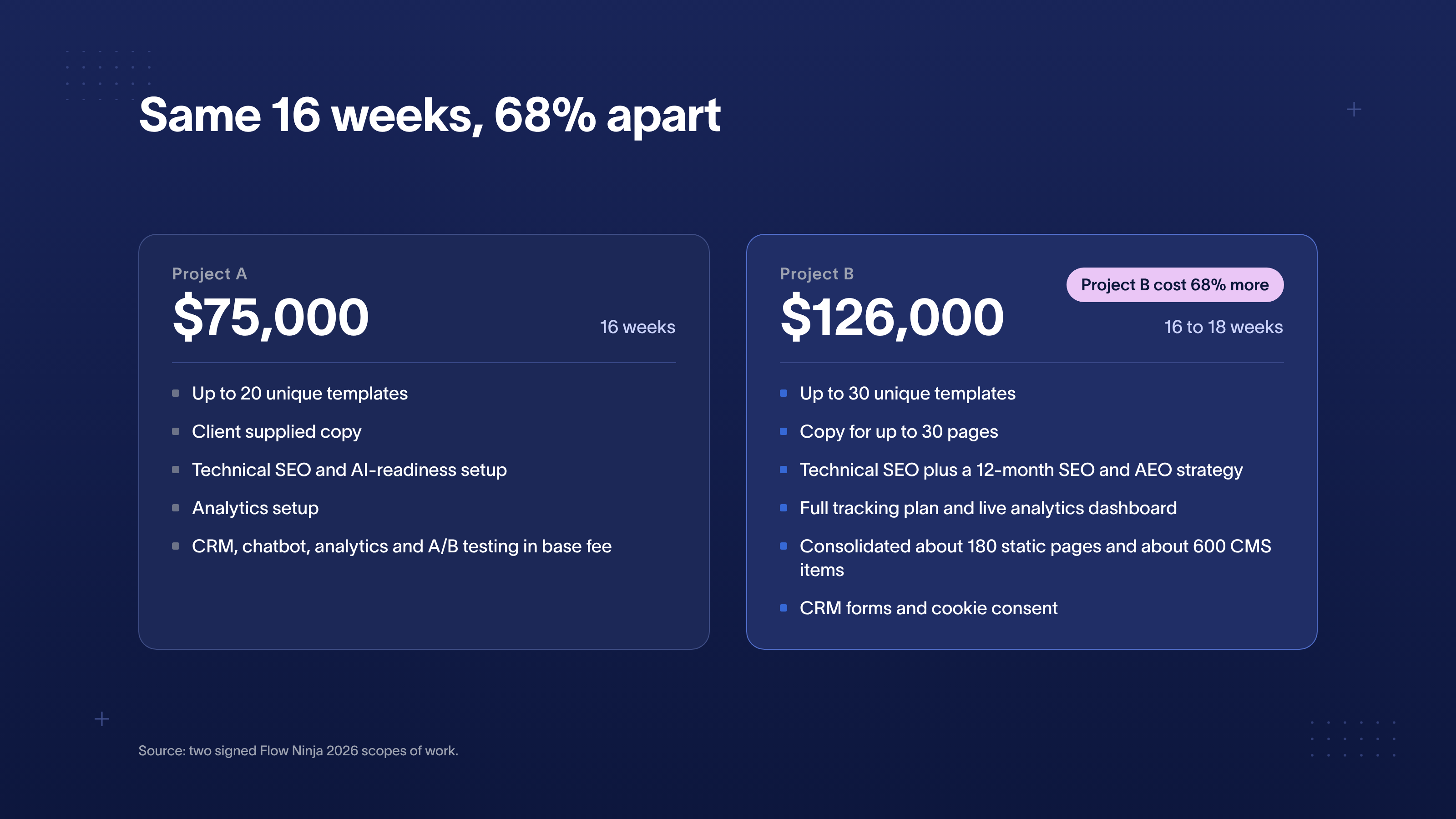
- Templates: up to 20 unique page templates in A, up to 30 in B
- Copywriting: the client supplied its own copy in A; B included copy for up to 30 pages
- SEO and AEO: A got technical SEO and AI-readiness setup; B got the same plus a full 12-month SEO and AEO strategy
- Analytics: A got GA4 setup; B got a full tracking plan and a live analytics dashboard
- Custom visuals: A allowed up to 10 static visuals per page and 5 animated ones; B capped the work at 60 custom assets and 5 animations
- Legacy content: B consolidated about 180 static pages and about 600 CMS items
- Integrations: A included CRM, chatbot, analytics and A/B testing in the base fee; B included CRM forms and cookie consent
Project B cost 68% more because it carried copywriting, a long-term search strategy, measurement and a far bigger content consolidation. Two quotes with the same timeline can hold very different amounts of work, which is why a total on its own tells you so little.
What other companies paid for B2B websites in 2026
Across the 20+ websites we signed in 2026, the median project cost about $56,000 and the average about $57,700, from $19,000 at the low end to $130,000 at the top. Here's what we saw in 2026 across the websites we built: what companies paid, what problems they needed solved, and what they got.
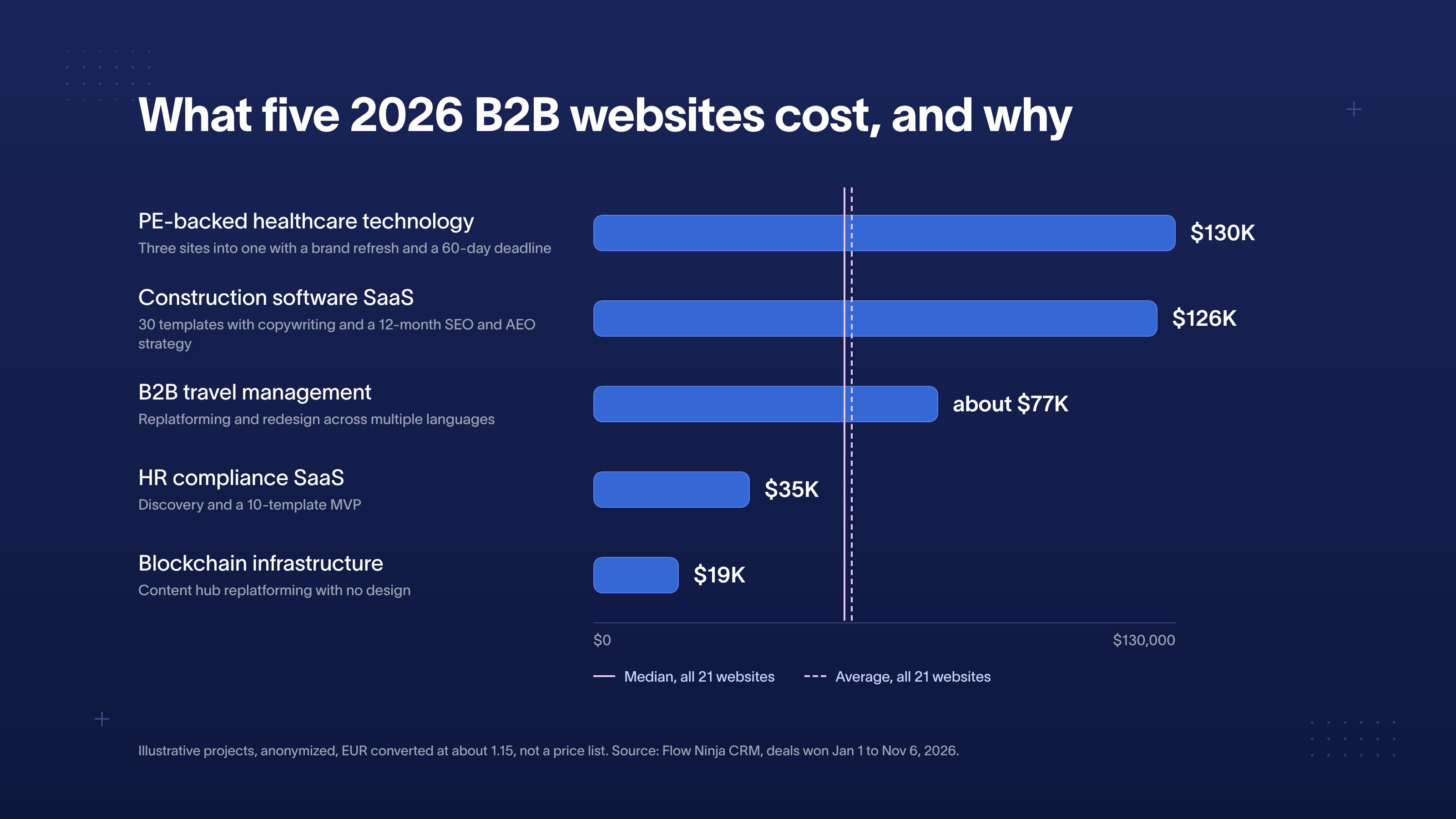
The figures come from our CRM, covering every website deal won between January and November, 2026, checked against deal notes and signed scopes of work and counted at the total contract value of each website project. The set covers new builds, full redesigns, rebuilds and replatforming. We left out retainers, overtime, single-page add-ons, standalone SEO and AEO programs, paid discovery on its own, a template-based one-pager, a single-purpose microsite and any project whose scope we could not confirm.
Price followed the size of the problem. The companies near the top of the range had a bigger site, a bigger problem, more locales, a need for copywriting or a short timeline, and the ones near the bottom needed one focused job done well.
Chart brief: the five projects above as horizontal bars from $0 to $130,000, each labeled with its need, with vertical lines at the $56,000 median and the $57,700 average. Source: Flow Ninja CRM, deals won Jan to Nov, 2026.
What B2B websites returned after launch
The staffing scale-up needed one site to serve employers and job seekers at once, the same two-audience problem you see across most recruitment website examples, and it came to us with a stated budget of $10,000 to $20,000. We built separate buyer and job-seeker journeys on 10 templates. Since launch, qualified web leads have roughly tripled, closed deals from web leads have grown about 45% year over year, and about 60% of qualified leads now come from ChatGPT and Perplexity. The $11M in pipeline attributed to AI search came from the website plus an ongoing SEO and AEO program that started after launch, and we count it that way. The final price was about 3-4 times above what the starting budget was.
The martech company had to move a large multi-language site to a new platform without losing demand. During scoping, it saw the same site priced three ways: a 1:1 replatforming at about $33,000, a hybrid with 5 redesigned pages at about $52,000 and a full redesign at about $63,000. It chose the redesign, with copywriting added, for about $70,000.
The fintech company was paying to run many locale sites. Consolidating them under one domain brought projected savings in the six figures a year, which means the roughly $69,000 build would pay for itself in under a year on savings alone, before any revenue effect.
Ten questions that set your price
Each driver below is a decision you make, so answer the question for yourself before you ask anyone for a quote.
- How many unique page templates do you need? Scopes price by unique layouts, so one blog template counts as one page however many posts it produces. In our 2026 scopes, 10 templates came in at $35,000 for two different clients and 20 templates at $75,000. Spend templates on the pages that carry pipeline.
- Who writes the copy? Copy supplied by your team keeps it out of the scope; copy written by the partner is a line item that grows with every page. Decide whether your team has the time and the positioning work done.
- Do you need a search strategy or only a technical setup? Technical SEO and AI-readiness belong in every build. A 12-month SEO and AEO strategy is a separate decision, and it was one reason Project B cost more.
- Redesign or replatforming? A full redesign costs about 60% more than replatforming, because it adds strategy, discovery and custom design, while replatforming is mostly development work on a site whose design still does its job.
- Does the brand need work? Three of our four highest-priced 2026 projects included a brand refresh or extension; the fourth paid for copy on 30 pages and a 12-month SEO and AEO strategy instead.
- How hard is your deadline? The hard 60-day window on our $130,000 project needed a larger parallel team: UX strategy, project management, 2 designers, 3 developers and 2 QA specialists. Speed costs people, so ask why the date is the date.
- How much legacy content comes with you? Merging several domains, or collapsing hundreds of pages and CMS items into a clean architecture while protecting SEO equity, adds real work, as Project B's 780 pages and items show.
- How many languages and markets? Each language is priced on top of the build, and right-to-left or character-based languages need layout changes. One 2026 project had only 6 to 7 unique layouts but about 49 live pages across languages.
- Which systems must connect? Buyers usually expect integrations to cost more than they do. A CRM connection, a custom API or a reverse-proxy setup rarely moves a project more than 5% to 10%.
- How many custom visuals and animations? Good scopes cap them and price every extra. One past project's uncapped visuals clause led to 250 requested assets that had to be cut back to 80.
Why the cheapest website bid costs more
The cheapest bid usually ends up costing more because the months you lose are worth far more than the gap between invoices. One company in the green energy market learned this when the market was growing fast and speed mattered.
The company chose a single freelancer for a full website redesign. It lost a couple of months in that process, and its team spent a lot of internal hours on it. In the end, it came to us for a complete redesign and sent over the freelancer's design as a guide to exactly what it did not want.
The freelancer's invoice was probably relativly small. The real bill was months without a new website in a fast-moving market, the opportunities missed during that time and the internal hours spent on a process the team then repeated from scratch. Time to market is a cost too, and in a fast-growing market it may be the biggest one.
Red flags in a website quote
- A very cheap bid. If you still choose it, read the agreement closely, check reviews and ratings, talk to past clients and find out why it is so much cheaper.
- A vague scope. If you cannot tell what will be delivered, when, and what is out of scope, expect surprises later.
- Unclear ownership of content and visuals. Ask who writes the copy, who creates the visuals and who moves your existing content, because unclear answers turn into extra cost and delay.
- Missing line items. A cheaper quote may leave out a technical SEO check and redirect plan, launch support or a post-launch support window, or handoff, documentation and training for your team, which you then pay for in time and money.
- Open-ended clauses. Revisions, visuals or animations with no defined limits or overage pricing invite disputes.
Questions to ask on a pricing call
- What exactly is in scope, and what is explicitly out of scope?
- How do you define a page: unique templates or total pages?
- Who produces copy and visuals, and who moves our existing content?
- What does post-launch support include, and for how long?
- How will our team be trained to run the site without you?
- What happens when we need something outside the scope, and how is it priced?
- What experience do you have in our industry, especially with our compliance requirements?
When you compare several proposals, line them up item by item, the way Project A and Project B sit side by side above. You end up choosing on what you will actually get, which beats a hunch or the agency the CEO liked best.
In regulated industries such as fintech and healthcare, a partner with deep industry experience may cost more. "Industry knowledge can't be bought on a line item, but it shows up in every week you don't lose to a compliance surprise," [FILL: interviewee first name] says. That premium buys fewer compliance surprises and faster approvals, and it often shortens the project enough to pay for itself. We hold ISO 27001 certification for the same reason: security questions come up in every regulated scope.
How a good partner scopes and prices a website
A good partner prices a website only after it knows what the site has to do, and backs every proposal with a business case. As a Website Operating Partner, we start with your marketing plan and pick the tech last.
- Start with questions. Every website and client differs in security and compliance needs, industry pain points, internal resources and timeline. We separate the musts from the nice-to-haves first. If you name a deadline, we ask why that deadline; if you name a page count, we ask why that one.
- Research together. Our strategy team reviews your sitemap, analytics, tech stack and design. Clients usually arrive with ideas and requirements, we usually arrive with proposals of our own, and the two often differ. We bring website expertise, you bring expertise in your industry and product, and the final scope is the middle ground that is best for the website.
- Size it by everything it includes. Development only, a full rebrand, a full redesign, replatforming, copywriting, SEO and AEO strategy, how many people use the site and with what permissions, and how many custom animations all shape the price.
- Price for the outcome. Every proposal explains which problems the investment solves and what that is worth to your team. For 21Shares, rebuilding the website on a system marketing could run instead of engineering saved more than $300,000 a year and cut go-to-market time from one month to one week.
- Recommend an MVP when it moves faster. When a smaller first build gets you live sooner, we say so, even if you are ready to spend more upfront, and the rest of the budget funds more pages and growth over time.
After the strategy workshop, clients often expanded their original budget, typically by around 70%, once they saw everything a good website has to cover: sitemap, page strategy, locales, security, accessibility, compliance, integrations and content. Sometimes the advice runs the other way. A blockchain infrastructure company came to us with $25,000 to $30,000 and signed at $19,000, because a focused scope fit its problem better.
Andrea Lotito, Digital Marketing Manager at Uberall, summed up the gap between what clients expect to buy and what a full scope delivers: "We came for a Volkswagen, but you guys delivered a Ferrari."
How to set your B2B website budget
Set your B2B website budget from the result you expect and what that result is worth over the next few years, then size the scope to match. A website is a stakeholder investment that many people will weigh in on: Forrester's 2026 research found the typical B2B buying decision involves 13 internal stakeholders and nine external influencers. Nobody picks it on feel the way they might pick a new car. Building a new website for an enterprise B2B company is a stakeholder investment, and it should be justified like one.
- Write down why you are rebuilding. More pipeline, more conversions and lower operating cost each lead to a different scope.
- Put a value on the result. Estimate what the site should earn or save over two to three years, the way the fintech project's projected six-figure annual savings would pay back its build in under a year.
- Count what the site does for your other channels. Work out what a better conversion rate is worth on the ad, event and outbound spend you already have planned.
- Check your number against real projects. Our 2026 websites ran from $19,000 to $130,000 with a median of about $56,000, and the examples above show what moved a project up or down.
- Compare quotes line by line. Count unique templates, copy, SEO and AEO work, analytics, content consolidation and post-launch support before you compare totals.
Done this way, the $20,000 you planned at the start often turns into a larger number you can defend, because the website sits at the core of your marketing for the year ahead. If you want a second opinion on a scope or a quote you already have, talk to one of our strategists.
FAQs on B2B website cost
What is the minimum budget for a B2B website, and what can $5K to $20K buy?
In our 2026 projects, the smallest full website cost $19,000: a content hub replatforming with development and CMS work only and no new design. A $5,000 to $20,000 budget fits a focused replatforming or paid discovery, which three companies bought for $8,000 to $11,500 before committing to a build. Our minimum project size is $25,000 for Webflow Development and $50,000 for a Transform with strategy and design. One staffing client arrived with $10,000 to $20,000 and signed at about $28,000 after the strategy workshop.
Why do some agencies quote a fraction of the price for the same B2B website?
Very low quotes usually come from lower-cost markets or thinner scopes. In GoodFirms' 2026 survey of 300+ firms, 54% estimate $5,000 to $20,000 for a standard mid-sized site, and 30% cited a $10 to $15 hourly rate. A quote that low rarely covers copy, an SEO redirect plan, QA or team training. Ask each bidder how it defines a page, because a quote for 20 total pages and one for 20 unique templates describe very different builds.
How do we keep a website project alive when budgets get cut or leadership pauses it?
Phase it so the first release is a complete site you can launch and the remaining budget funds a roadmap. One 2026 client was quoted a 6-week sprint covering the core pages against a 12-week, 15-template foundation build priced about 70% higher; if leadership pauses after phase one, the sprint still puts a working site live. Cuts are common: in The CMO Survey 2026, 53.1% of companies make cutting expenses the priority when profits fall short. The same approach protects a fixed launch date, because the date holds when the scope can flex. Build the templates later pages will reuse first.
How long does a B2B website take to build?
Our two 2026 enterprise scopes were planned at 16 weeks for up to 20 templates and 16 to 18 weeks for up to 30. Faster is possible with a bigger parallel team: one $130,000 project had a hard 60-day window, and Judi Health merged two brand sites into one platform in about 2.5 months. Clutch's November 2026 data puts the typical web development project at 9 months. Building 20+ pages in a few weeks works when most pages share a few templates.
Can we work with a website partner in a different time zone instead of a US agency?
Yes, and the rate difference is large. Clutch's 2026 data puts typical web design rates at $100 to $149 an hour in the US, Canada and Australia, $50 to $99 in the UK, $25 to $49 in Poland and Ukraine, and under $25 in India and the Philippines. Check overlap hours and communication on reference calls. Nico Bonassi, Brand Director at Trustly, described working with us this way: "They are incredibly fast and clear, and often over-deliver in terms of communications and expectations."
Is it cheaper to build a B2B website in-house or with an outside partner?
Two in-house hires usually cost more in a year than a full website project. The US Bureau of Labor Statistics puts the May 2025 median wage at $92,650 for web developers and $104,000 for web and digital interface designers, $196,650 in salary before benefits and hiring, against our highest 2026 project at $130,000. Those two hires still leave strategy, copy, SEO and AEO, and QA uncovered, where our team brings 65+ in-house specialists. One fintech CEO reviewing our proposal concluded our cost was roughly the same as an in-house team, without the hiring risk.
Can a new B2B website integrate with Salesforce, HubSpot or Marketo without losing leads?
Yes, and CRM and marketing automation connections are usually a small part of the budget. In our 2026 scopes, integrations rarely moved a project more than 5% to 10%, and one $75,000 build included CRM, chatbot, analytics and A/B testing in its base fee. Ask each bidder to name every system it connects, whether Salesforce, Dynamics, Marketo or HubSpot, and to test every form end to end in QA before launch.
Do I need to budget extra for a B2B website to appear in AI search results?
Plan for AI search as its own line item. In our 2026 scopes, technical SEO and AI-readiness setup sat in the base build, while a full 12-month SEO and AEO strategy was part of what took one quote from $75,000 to $126,000. Semrush's July 2025 study found the average AI search visitor is worth 4.4 times a traditional organic visitor by conversion rate. On our own site, AI search grew from 6.5% to 66% of search-sourced revenue in a year.
What ongoing costs should I expect after launching a B2B website?
Plan for a monthly retainer plus hosting and platform fees, because a site run as a marketing channel needs new pages, updates and support every month. GoodFirms' 2026 survey found nearly 58% of firms price monthly retainers between $500 and $3,000. Our WebOps retainers start at $6,000 a month on a 12-month term. Ask every bidder to list hosting, platform fees and the length of the post-launch support window in the quote.
Will our marketing team be able to build and update pages without developers?
Yes, if the build includes a component system plus handoff, documentation and training, and the quote should name all four. Upwork's resource center, rebuilt with us, launched 1,000+ pages so marketing can publish without engineering, and Trustly runs a modular design system that lets marketing launch pages on its own. If a quote leaves out training, budget for the time your team will spend learning the site by trial and error.

Head of Growth at Flow Ninja and the main voice behind its WebOps model, writing on demand generation, AI in marketing, and websites in regulated industries.



See your website the way a senior strategist does
Foresight scans your site across 10 strategy dimensions. You get a scored breakdown of every gap costing you leads.
Continue reading








Ready to escape your CMS nightmare?
100+ successful migrations. 0 ranking disasters at launch. One embedded team that's done this before.