Enterprise website platform: how to choose between Webflow, Sanity, Next.js and Astro
Choose an enterprise website platform by checking who hosts and secures it, what it costs to run at scale, how your marketers want to edit, and how well it works with AI. Webflow manages everything and edits visually, at a higher cost. Sanity with Astro or Next.js costs less and moves faster with AI, but needs a hosting owner. The partner matters most.
Key takeaways
- Pick the partner before the platform: a good partner makes Webflow or Sanity work, and a bad one breaks either.
- Webflow owns hosting and security for you, which raises total cost of ownership at enterprise scale.
- Sanity with Astro or Next.js is usually cheaper to run, but someone has to own hosting.
- Visual vs component editing is a team preference: test both with your heaviest editors.
- Sanity is faster to extend with AI today, while Webflow is closing the gap with its MCP server and Source.
"You should not be deciding on a platform. You should be deciding based on the partner that you're going to be working with," says Uros Mikić, CEO of Flow Ninja. That is an odd thing to hear from a team that builds on Webflow, Sanity and Astro every week, and it is the most useful sentence in this guide.
Enterprise teams comparing Webflow, Sanity, Next.js and Astro usually start with a feature grid. The grid matters less than three questions most teams skip: who owns hosting and security, how your marketers want to edit, and who will run the site after launch. This guide walks through each one, with the trade-offs we explain on sales calls.
Before you compare platforms, check what your current site is actually costing you in speed, search and conversions.
{{foresight-component}}
What should you check before picking an enterprise website platform?
Check five things in this order: who hosts and secures the site, total cost of ownership, how your team edits pages, how well the stack works with AI, and the partner who will build and run it. The last one decides more outcomes than the other four combined.
Table 1: The enterprise platform scorecard
| Question | Webflow | Sanity with Astro or Next.js |
|---|---|---|
| Who hosts and secures it?Ask this first | Webflow, end to endHosting, CDN and attack protection included | You and your partnerPick a host or run it on your own infrastructure |
| What does it cost to run?Platform, seats, bandwidth, hosting | Higher at enterprise scaleTeam plan from $2,500/mo on an annual contract | Usually lowerGrowth plan $15 per seat/mo, plus hosting |
| How do marketers edit? | Visually, on the page | In the CMS, from pre-built components and sections |
| How well does it work with AI? | MCP server, more setup for long-term work | Faster to set up and extend with AI coding tools |
| Who builds and runs it?The deciding factor | A good partner makes either one work. A bad one breaks either one. | |
Use the scorecard to narrow the field, then pressure-test the answers with a proof of concept on your own content. The sections below explain each row.
Who should own hosting and security?
If you want someone else to own hosting, security and scale, Webflow does that for you. If you would rather own your infrastructure, Sanity with Astro or Next.js lets you host where you want, including on your own platform.
Webflow: the platform carries the risk
"Webflow is an amazing platform. We've been using Webflow for a really long time, and it's amazing because it actually hosts everything for you," Uros says. Webflow handles attack protection, hosting, infrastructure and the global CDN, so traffic spikes are its problem, not your team's.
That matters more than it used to. Self-hosted platforms with plugin ecosystems carry a steady stream of security incidents, as we covered in our breakdown of the PHP2Shell vulnerability. A fully managed platform removes that whole category of work.
Sanity with Astro or Next.js: you choose the host
With Sanity, the content lives in Sanity's hosted content platform, and the front end (built in Astro or Next.js) needs a hosting provider. Some B2B SaaS companies host the site on the same infrastructure as their product, where the website's bandwidth is small next to what the product already uses.
- Upside: control over where the site runs, how it scales and what it costs.
- Trade-off: someone has to own that setup, monitor it and keep it secure.
What does each platform really cost at enterprise scale?
Webflow usually costs more to run at enterprise scale because it does more for you. Sanity is usually cheaper to manage and run, as long as you have a partner or team that owns hosting.
"All of that of course comes with a cost, and the total cost of ownership, specifically if you're an enterprise, is probably bigger than if you go with Sanity and Astro," Uros says. On Webflow, the jump comes with the Team or Enterprise plan and with bandwidth, which is billed with a markup. He thinks that is worth it for some customers. Others don't want to pay it.
- Webflow: the Team plan starts at $2,500 a month on an annual contract and Enterprise is custom-quoted (see our Webflow pricing breakdown).
- Sanity: the Growth plan is $15 per seat a month, with Enterprise custom-quoted, plus hosting for the front end (see our Sanity pricing guide).
What we've seen: On a sales call this month, a 20-person enterprise marketing team told us that removing a single button from their current site required an invoice. When they compared Webflow and Sanity with us, the deciding cost question was not the license. It was whether growing past their seat count would push them into an enterprise plan, versus Sanity's flatter per-seat cost (Flow Ninja sales calls, October 2026).
Do your marketers want to build pages visually or fill in content?
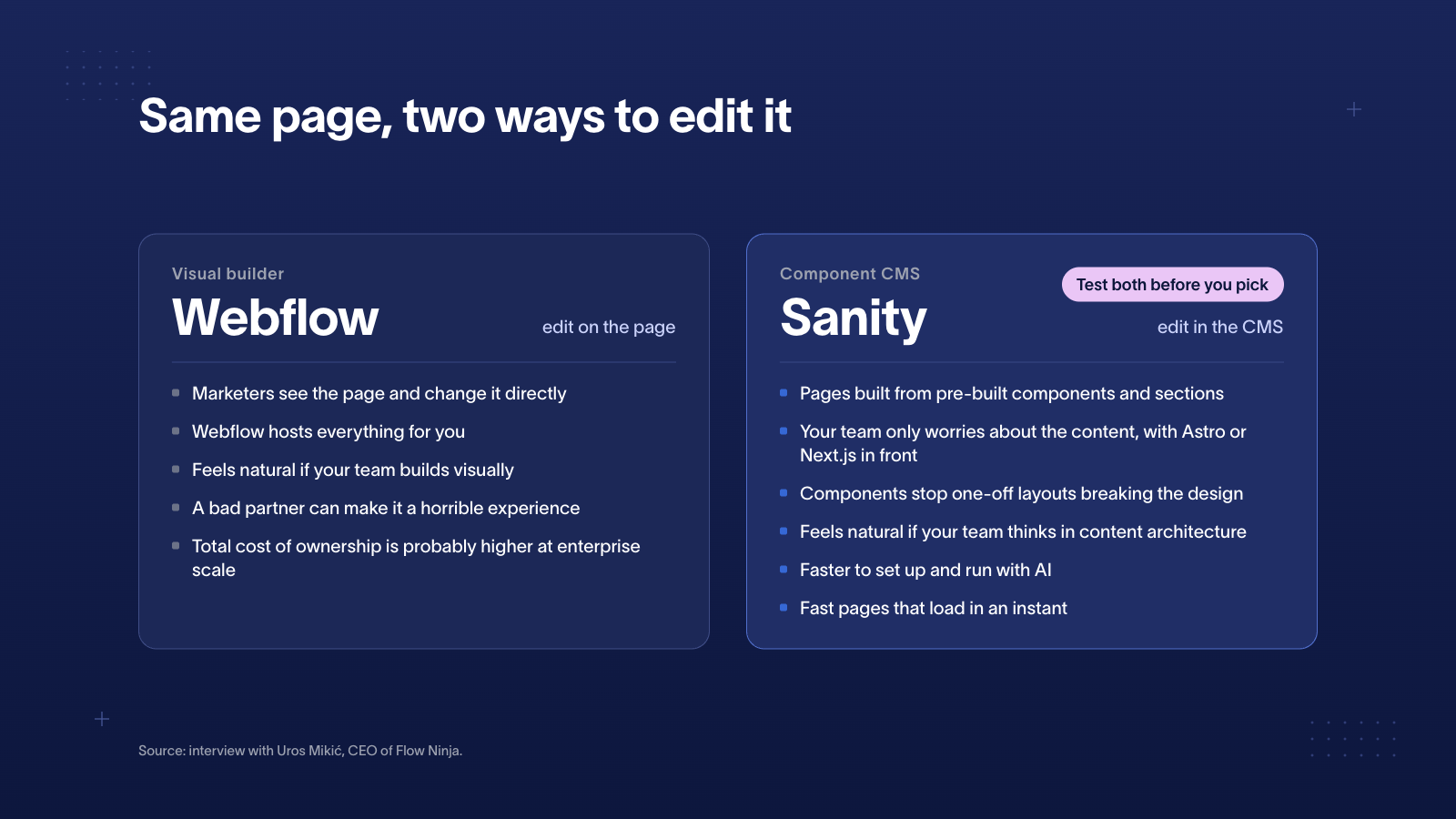
Webflow is a visual builder: marketers see the page and change it directly. Sanity is content-first: marketers build pages from pre-built components and sections inside the CMS, then preview the result.
How Sanity editing works
"We're going to be setting up all of the content clusters inside of Sanity, we're going to be setting up all of the components, and then we're going to be giving you the keys to the website," Uros explains. "You're not going to be building pages in a visual way. You're going to be building pages in the CMS itself."
Some teams find that freeing. "Some of our customers love that, and even some bigger customers love the idea of actually being able to just worry about the content," he says. The component library also stops one-off layouts from breaking the design system.
Which one fits your team
Uros calls it personal preference, and he means it. If your team is used to building everything visually, Webflow will feel natural. If your team thinks in content architecture, Sanity will.
Pro tip: Ask your two heaviest website editors to build the same landing page in both tools during a proof of concept. Their reaction after one afternoon tells you more than any demo.
Where do Next.js and Astro fit in?
Next.js and Astro are front-end frameworks, not content management systems. In a Sanity setup, Sanity holds the content and Astro or Next.js renders the pages your visitors see.
- Astro is the framework we see trending for marketing sites. It was acquired by Cloudflare in January 2026 and remains open source.
- Next.js is the more established option, built by Vercel, and serves a similar role. The choice between the two matters less than the choice of CMS and partner.
On speed, Uros gives Sanity the edge: "Because Astro is in the back end, Sanity is going to be much better for managing the website and for having a really, really fast website which loads in an instant." Building from components is also a little faster on Sanity. For a deeper look at the framework side, read our guide to what an Astro website costs.
Which platform works better with AI?
Today, Sanity is easier and faster to set up and extend with AI coding tools. Webflow has an MCP server, but its visual model takes more work to use with AI for meaningful long-term changes.
"Setting up the Sanity website with AI is much easier. It's much faster. It's going to allow you to do a lot more things with AI than Webflow will," Uros says. Webflow's classes and visual logic sit in front of the code, which slows AI down. With Sanity, you can build what he calls "a better website operating system."
That gap may narrow. Webflow announced Source, a workspace where marketing teams and AI agents work with the site's underlying code. Uros hopes the two can work hand in hand: Webflow for the visual, creative front end and Sanity in the back end. Our post on building with Sanity AI covers the content side.
Which argument in this decision is usually wrong?
The argument that the platform decides the outcome. It doesn't. The partner who builds and runs the site does.
"You can have a horrible experience on Webflow if you choose a bad agency, and you can have an amazing experience on Webflow if you choose a good agency," Uros says. "And it is the same on Sanity." He goes further: a great partner can even make an older, plugin-based platform work well, though few do.
Our take: Pick the partner first, then let them prove the platform. A partner who can show you both options on your own content is worth more than a perfect feature grid.
Red flags when choosing a platform partner
These are the signals that a partner is selling you a platform rather than solving your problem.
- One platform for every answer: they only build on one stack, so every brief ends with that stack.
- License-only cost talk: they quote the platform plan and skip seats, bandwidth and hosting.
- No owner for hosting: on a headless build, nobody can say who monitors and secures the front end.
- Keys and goodbye: they plan the launch but not the first 90 days of edits, fixes and new pages.
- No proof before commitment: they ask you to pick a platform from a slide deck instead of a working example.
What should you ask a partner before you commit?
Ask questions that force a specific answer about your site, not a general pitch.
- Which platform would you pick for our team, and what would make you change your mind?
- Who owns hosting, security and uptime after launch?
- What is our total cost of ownership over three years, including seats, bandwidth and hosting?
- How will our marketers publish a new landing page without a developer?
- How do you use AI in the build and in ongoing work?
- Can you show us both options on our own content before we sign?
If you want a partner's answers to these questions for your own site, let's talk.
Where does Flow Ninja fit?
We are a Webflow Enterprise partner and a partner on the official Sanity marketplace, so we do not need you to pick one. "We have the expert knowledge on both sides," Uros says.
That lets us run the decision the way he describes it: a call to walk through both platforms, and where it makes sense, a proof of concept showing what your site looks like on each, so you choose from something real. After launch, our team keeps shipping every week, running the site as a channel rather than a finished project. We call this WebOps. See how we work on Sanity and for enterprise teams, and read our side-by-side of Sanity vs Webflow for the detailed trade-offs.
Final note
Webflow, Sanity, Next.js and Astro can all run an enterprise website well. The difference between a site that ships every week and one that stalls is rarely the stack. It is who owns hosting, how your team edits, and who is accountable after launch.
Start with where your current site stands: get your free AI website audit. When you want to see both platforms on your own content, let's talk.
As Uros puts it: decide on the partner, not the platform.
{{foresight-component}}

Founder and CEO of Flow Ninja. Building in Webflow since 2015, he writes on platform choice, CMS migration, and website intelligence, and runs a YouTube channel on the same.



See your website the way a senior strategist does
Foresight scans your site across 10 strategy dimensions. You get a scored breakdown of every gap costing you leads.
Continue reading








Ready to escape your CMS nightmare?
100+ successful migrations. 0 ranking disasters at launch. One embedded team that's done this before.