How to run your website as a marketing channel: the operating model
Running your website as a marketing channel means giving it one owner, one ranked backlog, a weekly shipping rhythm and numbers it answers for: pipeline by page, demos booked, search and AI visibility, and time to launch. This is the operating model we set up on day one, and why the launch-and-forget website no longer works.
Key takeaways
- Every marketing dollar ends up on your website, so improving the site makes every other channel cheaper.
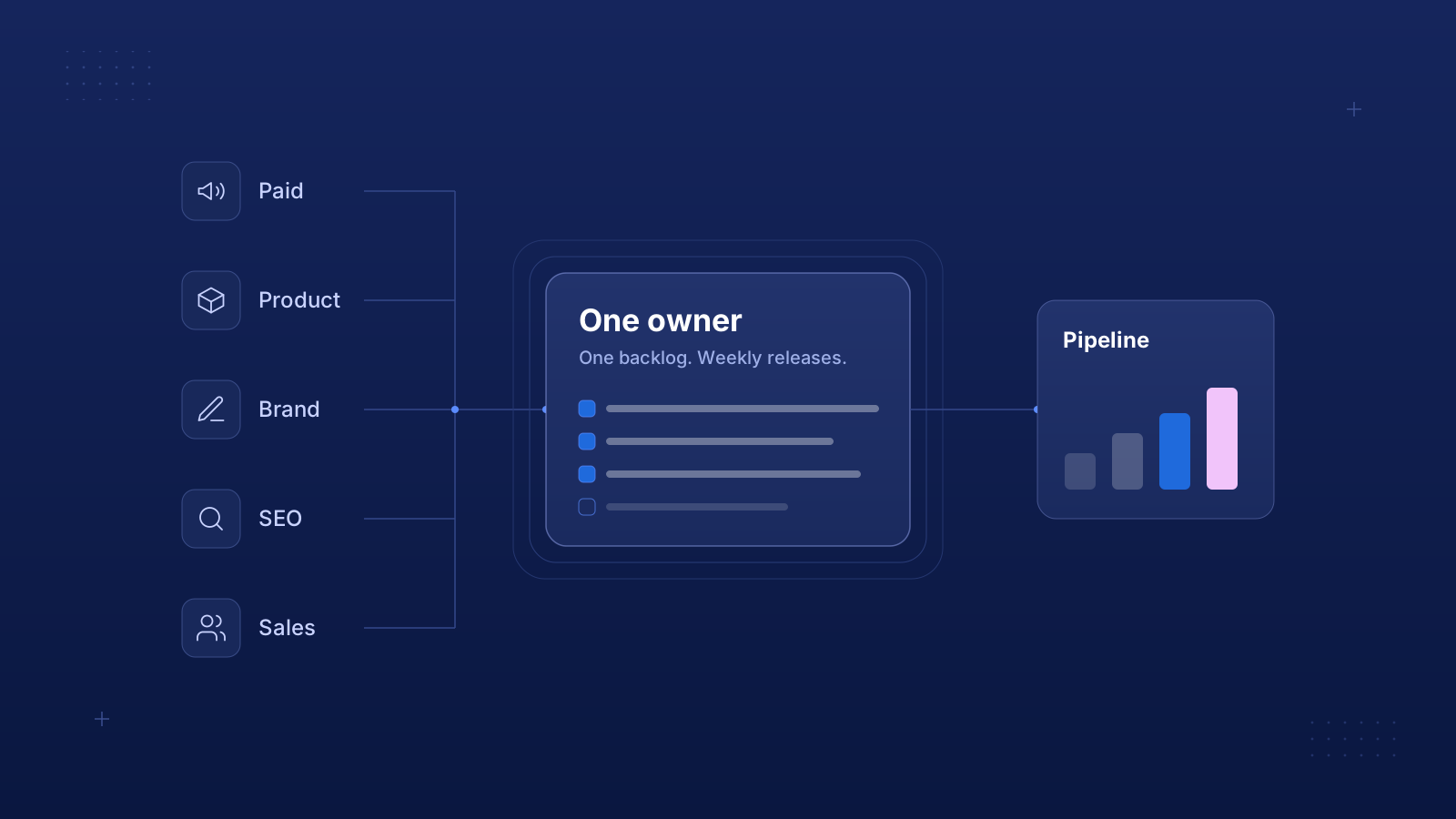
- One owner answers for website results, and every team feeds one ranked backlog.
- Measure pipeline by page, demos, search and AI visibility, and time to launch.
- AI search visitors convert many times better than organic, but only if the site is kept current.
Most companies still treat their website as a project. They gather everyone for a rebrand, people work late and over the weekends, the site goes live, everyone is exhausted and relieved, and then the website quietly gets forgotten until the next rebrand three years later. I think this is the most expensive habit in B2B marketing today, and in this guide I want to show you the operating model we use instead: who owns the website, how the work ships every week, and what gets measured.
If you want to see where your own website stands before reading on, run it through our free AI website audit below. It takes about two minutes.
What does it mean to run your website as a marketing channel?
Running your website as a channel means you treat it like paid, email or outbound: it has an owner, a plan, a weekly rhythm and numbers it answers for. It is a living thing that changes every week, not a launch that happens once. We call the discipline behind it WebOps.
Why does this matter so much? Well, because every marketing dollar ends up on your website. Whether you spend 100,000 a year or ten million, the paid clicks, the organic traffic, the ABM campaigns, the event follow ups and the people who found you in ChatGPT all land on the same pages. If those pages convert better, every other channel gets cheaper at the same time. Very few things in a marketing budget amplify everything else like that.
And it is not only marketing that needs the website. Every team meets the buyer there:
- Product marketing needs new features live as fast as they ship, because buyers research you inside AI assistants, and if the feature they want is not on your site, the assistant will happily recommend a competitor that has it.
- Sales needs pages that answer the questions prospects keep asking on calls.
- Brand needs one consistent story across every page.
- Paid and demand gen need landing pages that convert the traffic they already pay for.
Why is the "launch and forget" website model broken?
Because your marketing no longer stands still. Positioning moves every quarter, product teams ship every month, and the way buyers find you has changed more in the last two years than in the ten before it. A website that only changes during a rebrand is always behind all of that.
Table 1: Website as a project vs website as a channel
What the data on AI search says
The numbers on AI search make this very concrete:
- Ahrefs: AI search visitors were 0.5% of traffic but 12.1% of signups, roughly 23 times better than traditional organic search (Ahrefs via PPC Land, June 2025).
- Webflow: LLM traffic converted to signups at 24% against 4% for non-brand SEO, and LLMs doubled their share of signups from 4% to 8% in seven months (Graphite, January 2026).
- Seer Interactive: ChatGPT visitors converted at 15.9% against 1.76% for Google organic for one client (Seer Interactive, June 2025).
Those buyers arrive having already done their research, so they ask fewer questions on sales calls and close faster. But they only arrive if the website says the right things, in the right structure, this month and not three years ago. You cannot get that from a site that nobody owns.
What we hear on sales calls
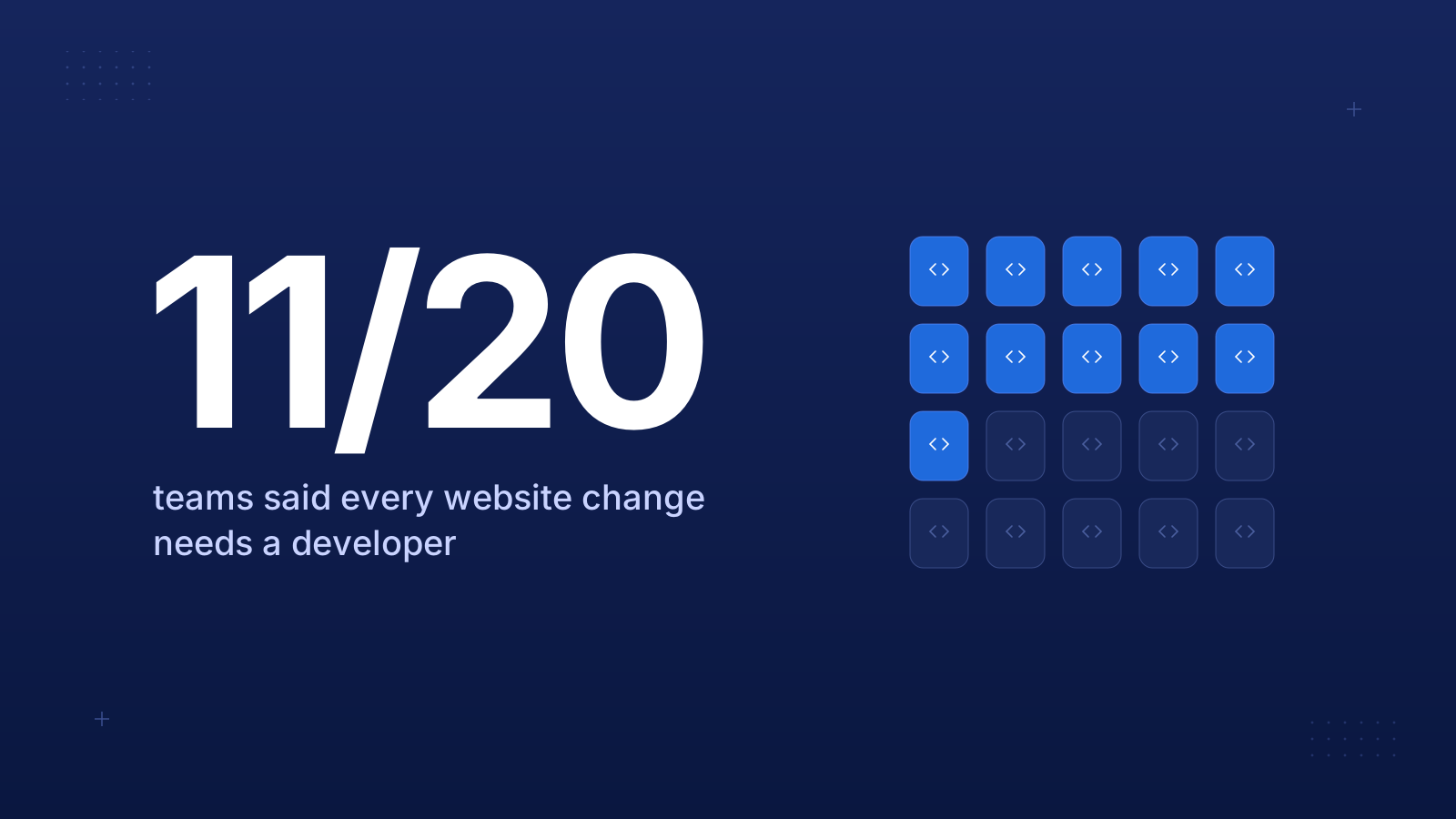
We see the same pattern in our own sales calls. In 11 of the last 20 conversations we had with marketing teams, they told us that every website change needs a developer. So the site waits, the campaign launches anyway, and the money lands on pages that were written for last year's story.
What do most agencies and in-house teams get wrong when they set up the operating model?
They run the website on opinions. Somebody senior likes a new hero, somebody else wants a new section, the agency ships what was asked for, and nobody can tell you afterwards whether any of it moved a number.
I strongly believe you cannot be a good website partner, internal or external, without analytics you trust. Whenever we start with a company, the first thing we do is make sure we know what happened on the website before we arrived, so that we can prove what happened after. On an ongoing engagement we go further: we take the company's business goals, turn them into concrete goals for the website, and review them every quarter so we always know whether we are doing a good job or not.
We do have a fully in house creative team, and the work has to look great, but we will never grow a website on somebody's "feeling". We grow it on numbers: is it converting more or less, where people come from, how they explore, what the market is doing, and what every department needs from the site to hit its own goals.
What should a CMO know about running the website as a channel?
If I had one minute with a CMO, I would tell them three things, in this order.
1. Set up the measurement
Custom conversions, proper tracking, and the full journey of every lead and every closed deal. If you cannot see which pages a deal touched, you cannot invest in the website with any confidence. If you are not sure where your tracking stands, get your free AI website audit and you will know in a few minutes.
2. Make a plan with a strategist
Audit what you have, decide what you are focusing on, and pick the few initiatives that will actually move the number. A backlog full of requests is not a plan.
3. Give the website dedicated owners
Do not expect your marketing team to run it on the side. No matter how big the budget, every marketer has a dozen things on their plate, and the website will always lose to the campaign that is due on Friday. Someone touches it a little, then moves to paid, then moves to the next launch, and the site falls behind again. You need people whose only job is to move the website forward, either in house or as an extension of your team.
Who should own website outcomes, and what does the weekly rhythm look like?
One owner answers for the results, and every team feeds that owner.
The roles we set up on day one
Every role has one thing it owns and one number it answers for.
Table 2: The roles we set up on day one
The weekly rhythm
The rhythm is simple and it repeats every week:
- Find problems: review the data and spot what is leaking.
- Make the plan: rank the backlog by business impact.
- Ship the work: development, content and creative go live.
- Show results: report what moved, then start again.
What gets measured
- Pipeline by page
- Demos booked
- Visibility in search and in AI answers
- Time to launch
The tools matter less than the rhythm, but if you are choosing them, our comparison of WebOps platforms for marketing teams is a good place to start. And if you want to see how this model would look for your team, let's talk.
What results does this model produce?
On our own website
We run our own website this way, because I like to say we eat our own dog food. We ship changes every week, from product messaging to articles to resources people actually use, and whatever we recommend to our customers we have usually felt on our own skin first. A service business is harder to grow on organic channels than a product company, so if it works for us, it works.
What it looks like for clients
- Judi Health: discovery to launch in about two and a half months, two websites merged into one platform, and traffic up 66% in the first week after launch.
- Uberall: demos up 20% year over year while we run their website.
- 21Shares: about $300,000 a year saved on the WebOps model, and dozens of product launches a year because one team owns the website and talks to everyone internally.
The website operating model at a glance
A quick reference for the whole article, in one place.
Ownership
- One owner: a WebOps manager with a strategist, answering for results.
- Every team feeds in: paid, product marketing, brand, content and SEO, sales.
Workflow
- One backlog ranked by business impact.
- Weekly loop: find problems, make the plan, ship the work, show results.
Metrics
- Revenue: pipeline by page and demos booked.
- Visibility: search rankings and citations in AI answers.
- Speed: time to launch.
Final note
For the companies that do this well, the website stops being a brochure and becomes an extension of the product: the place where the buyer's journey starts, where they learn how the product works, and where they decide to talk to you. That is what running the website as a channel really means, and it is why I think the next three years belong to the teams that stop rebuilding their website and start running it. If you want to know where your website stands today, run it through Foresight, our free AI website audit. When you are ready to talk to a person, let's talk.
{{foresight-component}}
What is a website operating model?
A website operating model defines who owns the website, how work gets prioritised and shipped, and which numbers the website answers for. In a channel model, one owner keeps a single backlog for every team and reviews pipeline, demos and visibility every week.
Who should own the company website?
One owner should answer for website outcomes, usually a WebOps manager working with a strategist. Marketing, product marketing, brand, sales and SEO all feed requests into that owner, who ranks them by business impact.
What should you measure when the website is a marketing channel?
Measure pipeline by page, demos booked, visibility in search and AI answers, and time to launch. Track the full journey of every lead and closed deal so you know which pages influence revenue.
Can an in-house marketing team run the website as a channel?
Only if someone's full-time job is the website. When the website is one task among many, it loses to campaigns and launches. Many companies pair a small internal owner with a WebOps partner that covers strategy, analytics, SEO and AEO, development and creative.
Does AI search traffic convert better than organic search?
Published studies say yes. Ahrefs saw AI search visitors convert about 23 times better than organic search, and Webflow's LLM traffic converted to signups at 24% against 4% for non-brand SEO.
What does a WebOps manager do?
A WebOps manager is the technical owner of the website. They run one backlog for every team, rank requests by business impact, manage releases and site health, and report on time to launch.
How often should a B2B website be updated?
Every week. Teams that run the website as a channel ship small improvements weekly, from product messaging to tests to new content, instead of waiting for a rebrand every two to three years.
How do you prove the website's impact on pipeline?
Set up custom conversions and track the full journey of every lead and closed deal, so you can see which pages each deal touched. Then review pipeline by page every quarter against the website goals you set.

Founder and CEO of Flow Ninja. Building in Webflow since 2015, he writes on platform choice, CMS migration, and website intelligence, and runs a YouTube channel on the same.



See your website the way a senior strategist does
Foresight scans your site across 10 strategy dimensions. You get a scored breakdown of every gap costing you leads.
Continue reading






Ready to escape your CMS nightmare
100+ successful migrations. 0 ranking disasters at launch. One embedded team that's done this before.